



 Chat with AI
Exam 21: International Trade and Comparative Advantage

Exam 1: What Is Economics261 Questions
Exam 2: The Economy: Myth and Reality185 Questions
Exam 3: The Fundamental Economic Problem: Scarcity and Choice290 Questions
Exam 4: Supply and Demand: an Initial Look337 Questions
Exam 5: Consumer Choice: Individual and Market Demand243 Questions
Exam 6: Demand and Elasticity254 Questions
Exam 7: Production, Inputs, and Cost: Building Blocks for Supply Analysis260 Questions
Exam 8: Output, Price, and Profit: the Importance of Marginal Analysis234 Questions
Exam 9: The Financial Markets and the Economy: the Tail That Wags the Dog227 Questions
Exam 10: The Firm and the Industry Under Perfect Competition253 Questions
Exam 11: The Case for Free Markets: the Price System259 Questions
Exam 12: Monopoly244 Questions
Exam 13: Between Competition and Monopoly254 Questions
Exam 14: Limiting Market Power: Antitrust and Regulation155 Questions
Exam 15: The Shortcomings of Free Markets219 Questions
Exam 16: Externalities, Externaliteis, the Environment, and Natural Resources222 Questions
Exam 17: Taxation and Resource Allocation221 Questions
Exam 18: Pricing the Factors of Production233 Questions
Exam 19: Labor and Entrepreneurship: the Human Inputs271 Questions
Exam 20: Poverty, Inequality, and Discrimination171 Questions
Exam 21: International Trade and Comparative Advantage226 Questions
Exam 22: Contemporary Issues in the Us Economy23 Questions
Select questions type


A country can gain by importing a good that it can make itself if
(Multiple Choice)
5.0/5  (80)
(80) Suppose that a tariff is imposed on imports of minivans. Show graphically what the effect is in terms of price and quantity of imports. Be sure that your graph is completely and correctly labeled. What determines how much of the tariff is paid by the buyers of the minivans?
(Essay)
4.9/5 (75)
(75) ____ is a doctrine that holds that exports are good for a country, whereas imports are harmful.
(Multiple Choice)
4.7/5 (72)
(72) If a nation has a comparative advantage in the production of a good,
(Multiple Choice)
4.9/5 (79)
(79) Is the call for protection on the basis of national defense valid?
(Multiple Choice)
4.9/5 (87)
(87) If England uses one week's time to produce 10 yards of cloth or 2 barrels of wine and Portugal uses one week's time to produce 12 yards of cloth or 6 barrels of wine, England has the comparative advantage in both goods.
(True/False)
4.9/5 (85)
(85) The basic concept behind strategic trade policy is that free trade is the best policy to pursue, but some countries don't play by those rules. Therefore,
(Multiple Choice)
4.8/5 (76)
(76) Self-sufficiency is the best way to increase one's material welfare.
(True/False)
4.7/5 (76)
(76) The following table shows the units of output a worker can produce per month in country A and country B.  Which of the following statements about absolute advantage is true?
 (Multiple Choice)
4.7/5 (67)
(67) "The United States has more oil in Alaska than there is oil in Kuwait. Therefore, the United States should stop importing oil." Evaluate this statement using economic analysis.
(Essay)
4.9/5 (63)
(63) Voluntary exchange is based on the principle that all parties must gain from trade.
(True/False)
4.9/5 (92)
(92) Suppose that with 1 unit of labor, Canada can produce 40 TVs or 20 computers. With 1 unit of labor, Taiwan can produce 30 TVs or 10 computers. Which of the following is correct?
(Multiple Choice)
4.7/5 (72)
(72) If England uses one week's time to produce 10 yards of cloth or 2 barrels of wine and Portugal uses one week's time to produce 12 yards of cloth or 6 barrels of wine, then England has a comparative advantage in the production of cloth.
(True/False)
4.9/5 (77)
(77) In William Safire's 1983 essay, "Smoot-Hawley Lives," he argues that the United States should
(Multiple Choice)
4.8/5 (72)
(72) Figure 34-6
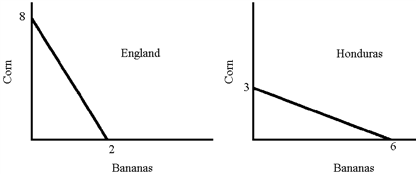 From the graph in Figure 34-6, the opportunity cost of a unit of bananas is
 (Multiple Choice)
4.8/5 (93)
(93) Unequal distribution of resources is one of the main reasons for international trade.
(True/False)
4.8/5 (84)
(84) Strategic trade policy relies on threats of protectionism to protect free trade.
(True/False)
4.8/5 (93)
(93) If a nation does not have an absolute advantage in producing anything, it
(Multiple Choice)
4.8/5 (91)
(91) 
Filters
- Essay(0)
- Multiple Choice(0)
- Short Answer(0)
- True False(0)
- Matching(0)