



 Chat with AI
Exam 21: International Trade and Comparative Advantage

Exam 1: What Is Economics261 Questions
Exam 2: The Economy: Myth and Reality185 Questions
Exam 3: The Fundamental Economic Problem: Scarcity and Choice290 Questions
Exam 4: Supply and Demand: an Initial Look337 Questions
Exam 5: Consumer Choice: Individual and Market Demand243 Questions
Exam 6: Demand and Elasticity254 Questions
Exam 7: Production, Inputs, and Cost: Building Blocks for Supply Analysis260 Questions
Exam 8: Output, Price, and Profit: the Importance of Marginal Analysis234 Questions
Exam 9: The Financial Markets and the Economy: the Tail That Wags the Dog227 Questions
Exam 10: The Firm and the Industry Under Perfect Competition253 Questions
Exam 11: The Case for Free Markets: the Price System259 Questions
Exam 12: Monopoly244 Questions
Exam 13: Between Competition and Monopoly254 Questions
Exam 14: Limiting Market Power: Antitrust and Regulation155 Questions
Exam 15: The Shortcomings of Free Markets219 Questions
Exam 16: Externalities, Externaliteis, the Environment, and Natural Resources222 Questions
Exam 17: Taxation and Resource Allocation221 Questions
Exam 18: Pricing the Factors of Production233 Questions
Exam 19: Labor and Entrepreneurship: the Human Inputs271 Questions
Exam 20: Poverty, Inequality, and Discrimination171 Questions
Exam 21: International Trade and Comparative Advantage226 Questions
Exam 22: Contemporary Issues in the Us Economy23 Questions
Select questions type


"I oppose a free trade agreement with Mexico because American workers will lose jobs to low-paid Mexican workers." Explain whether you agree or disagree with this statement.
(Essay)
4.9/5  (83)
(83) "Free trade benefits one country at another country's expense." Evaluate this statement using economic analysis.
(Essay)
4.9/5 (71)
(71) What is strategic trade policy? What are the pros and cons of such a policy by a nation in its dealings with other nations?
(Essay)
4.7/5 (82)
(82) Gain from trade is the increase in total production due to specialization allowed by trade.
(True/False)
4.9/5 (80)
(80) Quebec is capable of producing 10,000 pallets of wood shingles or 8,000 barrels of maple syrup. Vermont is capable of producing 12,000 pallets of wood shingles or 12,000 barrels of maple syrup.
a. Graph these production possibilities curves. Indicate from the slope, which has the absolute advantage, which the comparative advantage, and whether there are gains from trade.
b. Assume that Vermont and Quebec each specializes in the good in which they have a comparative advantage. Suppose that Vermont and Quebec decide to trade 5,000 pallets of shingles for 5,000 barrels of syrup. Indicate this on the graph. How does this affect the well-being of the two societies? Explain.
(Essay)
4.9/5 (70)
(70) Figure 34-9
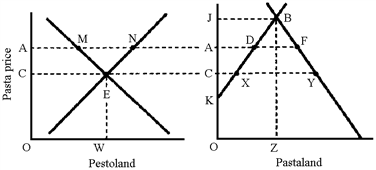 In Figure 34-9, at price OC total quantity demanded exceeds quantity supplied and price will rise to
 (Multiple Choice)
4.9/5 (82)
(82) Suppose that the United States can make 15 cars or 20 bottles of wine with one year's worth of labor. France can make 10 cars or 18 bottles of wine with one year's worth of labor. From these numbers, we can conclude that
(Multiple Choice)
4.7/5 (77)
(77) 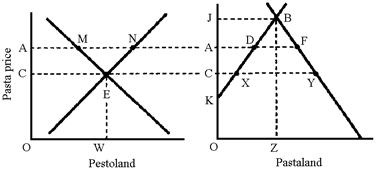 In Figure 34-9, at price OC
Specialization means that a country devotes its energy and resources to only a small proportion of the world's productive activities.
(True/False)
4.9/5 (79)
(79) If Japan imposes a quota on imports of rice, the effect will be
(Multiple Choice)
4.9/5 (87)
(87) Which of the following statements regarding the cheap foreign labor argument is correct?
(Multiple Choice)
4.8/5 (88)
(88) Figure 34-7
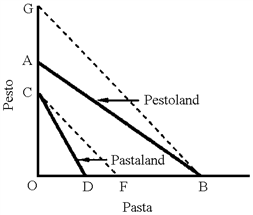 In Figure 34-7, CF has the same slope as BG. AB and CD are the production possibilities of Pestoland and Pastaland, respectively. If both countries are given the opportunity to trade at prices indicated by CF,
 (Multiple Choice)
4.8/5 (83)
(83) 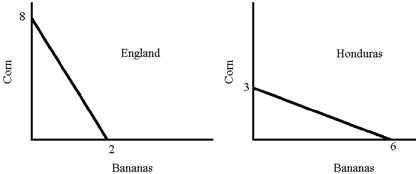 From Figure 34-6, one can infer that
Figure 34-9
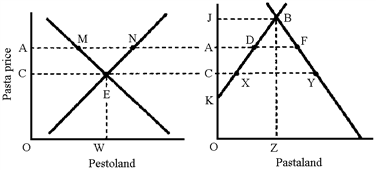 In Figure 34-9, Pestoland exports pasta to Pastaland. The equilibrium price of pasta will be
 (Multiple Choice)
4.9/5 (81)
(81) Table 34-4 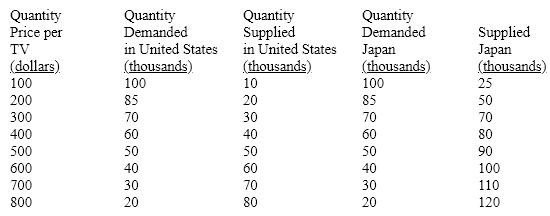 Table 34-4 presents the demand and supply schedules for television sets in Japan and the United States. If there is no trade between these countries, what are the equilibrium price and quantity in Japan?
 (Multiple Choice)
4.8/5 (72)
(72) American producers often complain about dumping. What is dumping, and should it be prohibited?
(Essay)
4.7/5 (80)
(80) A country that must inhibit imports should give preference to
(Multiple Choice)
4.8/5 (74)
(74) 
Filters
- Essay(0)
- Multiple Choice(0)
- Short Answer(0)
- True False(0)
- Matching(0)