



 Chat with AI
Exam 21: International Trade and Comparative Advantage

Exam 1: What Is Economics261 Questions
Exam 2: The Economy: Myth and Reality185 Questions
Exam 3: The Fundamental Economic Problem: Scarcity and Choice290 Questions
Exam 4: Supply and Demand: an Initial Look337 Questions
Exam 5: Consumer Choice: Individual and Market Demand243 Questions
Exam 6: Demand and Elasticity254 Questions
Exam 7: Production, Inputs, and Cost: Building Blocks for Supply Analysis260 Questions
Exam 8: Output, Price, and Profit: the Importance of Marginal Analysis234 Questions
Exam 9: The Financial Markets and the Economy: the Tail That Wags the Dog227 Questions
Exam 10: The Firm and the Industry Under Perfect Competition253 Questions
Exam 11: The Case for Free Markets: the Price System259 Questions
Exam 12: Monopoly244 Questions
Exam 13: Between Competition and Monopoly254 Questions
Exam 14: Limiting Market Power: Antitrust and Regulation155 Questions
Exam 15: The Shortcomings of Free Markets219 Questions
Exam 16: Externalities, Externaliteis, the Environment, and Natural Resources222 Questions
Exam 17: Taxation and Resource Allocation221 Questions
Exam 18: Pricing the Factors of Production233 Questions
Exam 19: Labor and Entrepreneurship: the Human Inputs271 Questions
Exam 20: Poverty, Inequality, and Discrimination171 Questions
Exam 21: International Trade and Comparative Advantage226 Questions
Exam 22: Contemporary Issues in the Us Economy23 Questions
Select questions type


If a nation imposes a tariff on imports, the portion of the tax paid by citizens depends upon
(Multiple Choice)
4.9/5  (79)
(79) The logic of why international trade increases well-being is
(Multiple Choice)
4.9/5 (77)
(77) If South Korea has an absolute advantage in the production of an item, it must also have a comparative advantage in the production of that item.
(True/False)
4.8/5 (70)
(70) Figure 34-4
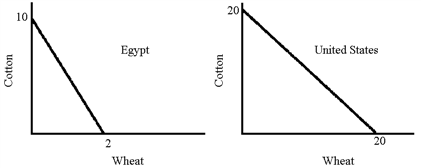 In Figure 34-4, the opportunity cost of a unit of wheat in terms of cotton is
 (Multiple Choice)
4.9/5 (76)
(76) Figure 34-7
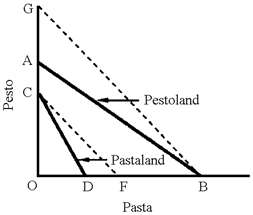 In Figure 34-7, AB represents the production possibilities of Pestoland and CD that of Pastaland. The graph indicates Pestoland has an absolute
 (Multiple Choice)
4.8/5 (78)
(78) A country has a comparative advantage over another in the production of gadgets if it can produce
(Multiple Choice)
4.8/5 (87)
(87) Quebec is capable of producing 10 pallets of wood shingles or 8 barrels of maple syrup with a unit of labor. Vermont is capable of producing 12 pallets of wood shingles or 12 barrels of maple syrup with a unit of labor. Assume that this is typical of the labor force as a whole. Which location has the absolute advantage and which has the comparative advantage, in the production of each good? Can these locations reap gains from trade?
(Essay)
4.7/5 (80)
(80) Is the call for protection on the basis of "infant industry" valid?
(Multiple Choice)
4.9/5 (90)
(90) 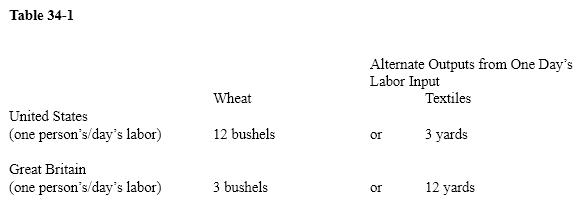 From Table 34-1, the United States
If the United States imposes a tariff on the import of Japanese cars instead of a quota, the price
(Multiple Choice)
4.8/5 (97)
(97) Opportunity cost refers to whatever is given up to obtain some item.
(True/False)
4.9/5 (82)
(82) 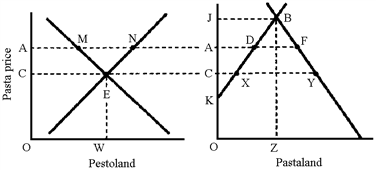 In Figure 34-9, Pestoland at price OA
Absolute advantage is the ability to produce a good using fewer inputs than another producer.
(True/False)
4.9/5 (78)
(78) Japan and China produce guns and rice. The country with the lowest opportunity cost of guns (in terms of rice)will
(Multiple Choice)
5.0/5 (75)
(75) If a country produces a commodity in the range of decreasing returns to scale, and the country begins to export more in a pure free trade system, the domestic price of the commodity will
(Multiple Choice)
4.7/5 (88)
(88) If a country begins to import more of a commodity, one can normally expect the price of the commodity to
(Multiple Choice)
4.8/5 (85)
(85) Comparative advantage is a comparison among producers based on opportunity cost.
(True/False)
4.8/5 (73)
(73) 
Filters
- Essay(0)
- Multiple Choice(0)
- Short Answer(0)
- True False(0)
- Matching(0)