



 Chat with AI
Exam 21: International Trade and Comparative Advantage

Exam 1: What Is Economics261 Questions
Exam 2: The Economy: Myth and Reality185 Questions
Exam 3: The Fundamental Economic Problem: Scarcity and Choice290 Questions
Exam 4: Supply and Demand: an Initial Look337 Questions
Exam 5: Consumer Choice: Individual and Market Demand243 Questions
Exam 6: Demand and Elasticity254 Questions
Exam 7: Production, Inputs, and Cost: Building Blocks for Supply Analysis260 Questions
Exam 8: Output, Price, and Profit: the Importance of Marginal Analysis234 Questions
Exam 9: The Financial Markets and the Economy: the Tail That Wags the Dog227 Questions
Exam 10: The Firm and the Industry Under Perfect Competition253 Questions
Exam 11: The Case for Free Markets: the Price System259 Questions
Exam 12: Monopoly244 Questions
Exam 13: Between Competition and Monopoly254 Questions
Exam 14: Limiting Market Power: Antitrust and Regulation155 Questions
Exam 15: The Shortcomings of Free Markets219 Questions
Exam 16: Externalities, Externaliteis, the Environment, and Natural Resources222 Questions
Exam 17: Taxation and Resource Allocation221 Questions
Exam 18: Pricing the Factors of Production233 Questions
Exam 19: Labor and Entrepreneurship: the Human Inputs271 Questions
Exam 20: Poverty, Inequality, and Discrimination171 Questions
Exam 21: International Trade and Comparative Advantage226 Questions
Exam 22: Contemporary Issues in the Us Economy23 Questions
Select questions type


If the production possibilities curves of two countries have the same slope,
(Multiple Choice)
4.9/5  (82)
(82) Table 34-1 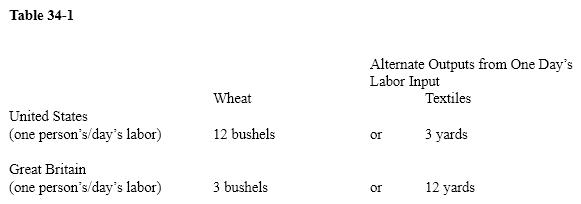 From Table 34-1, the opportunity cost of one bushel of wheat in Great Britain is
 (Multiple Choice)
4.9/5 (86)
(86) Suppose that the citizens of South Dakota decided to limit imports of citrus fruit from Florida and California on the grounds that climatic differences give those two states an unfair advantage in the production of those products. How would the analysis used to explain international trade apply?
(Essay)
4.9/5 (83)
(83) Carefully define the following terms and explain their importance to the study of economics.
a. Specialization
b. Absolute advantage
c. Comparative advantage
d. Quota
e. Trade adjustment assistance
(Essay)
4.9/5 (80)
(80) If nations begin to specialize in production for the purpose of trade,
(Multiple Choice)
4.8/5 (79)
(79) The trade philosophy of the Clinton administration is best characterized as
(Multiple Choice)
4.8/5 (73)
(73) Assume that a country imposes a tariff in order to gain a price advantage on an item. What is the typical response from the exporting country?
(Multiple Choice)
4.8/5 (70)
(70) If a nation can produce greater quantities of a good than another nation, it has a(n)
(Multiple Choice)
5.0/5 (65)
(65) Table 34-4 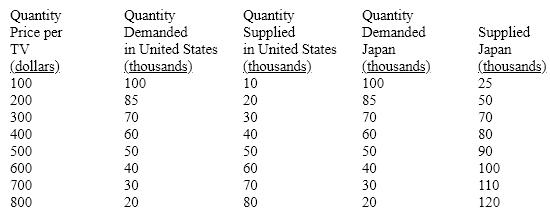 Table 34-4 presents the demand and supply schedules for television sets in Japan and the United States. If Japan and the United States trade with each other, what will be the equilibrium price in the world market for television sets?
 (Multiple Choice)
4.8/5 (71)
(71) If a country has an absolute advantage in the production of an item, it must also have a comparative advantage in the production of that item.
(True/False)
4.9/5 (72)
(72) Absolute advantage is a comparison among producers based on productivity.
(True/False)
4.8/5 (88)
(88) Table 34-4 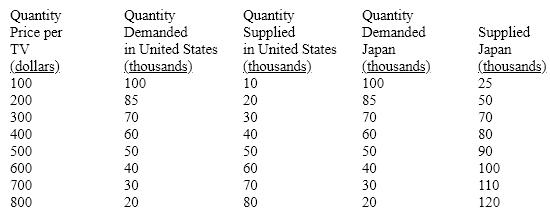 Table 34-4 presents the demand and supply schedules for television sets in Japan and the United States. If Japan and the United States trade with each other, which country will export television sets and how many?
 (Multiple Choice)
4.9/5 (83)
(83) Trade adjustment assistance provides special unemployment benefits, loans, retraining programs, and other aid to workers and firms that are harmed by foreign competition.
(True/False)
4.9/5 (80)
(80) The United States is known worldwide as being a low-tariff nation.
(True/False)
4.9/5 (88)
(88) 
Filters
- Essay(0)
- Multiple Choice(0)
- Short Answer(0)
- True False(0)
- Matching(0)