



 Chat with AI
Exam 21: International Trade and Comparative Advantage

Exam 1: What Is Economics261 Questions
Exam 2: The Economy: Myth and Reality185 Questions
Exam 3: The Fundamental Economic Problem: Scarcity and Choice290 Questions
Exam 4: Supply and Demand: an Initial Look337 Questions
Exam 5: Consumer Choice: Individual and Market Demand243 Questions
Exam 6: Demand and Elasticity254 Questions
Exam 7: Production, Inputs, and Cost: Building Blocks for Supply Analysis260 Questions
Exam 8: Output, Price, and Profit: the Importance of Marginal Analysis234 Questions
Exam 9: The Financial Markets and the Economy: the Tail That Wags the Dog227 Questions
Exam 10: The Firm and the Industry Under Perfect Competition253 Questions
Exam 11: The Case for Free Markets: the Price System259 Questions
Exam 12: Monopoly244 Questions
Exam 13: Between Competition and Monopoly254 Questions
Exam 14: Limiting Market Power: Antitrust and Regulation155 Questions
Exam 15: The Shortcomings of Free Markets219 Questions
Exam 16: Externalities, Externaliteis, the Environment, and Natural Resources222 Questions
Exam 17: Taxation and Resource Allocation221 Questions
Exam 18: Pricing the Factors of Production233 Questions
Exam 19: Labor and Entrepreneurship: the Human Inputs271 Questions
Exam 20: Poverty, Inequality, and Discrimination171 Questions
Exam 21: International Trade and Comparative Advantage226 Questions
Exam 22: Contemporary Issues in the Us Economy23 Questions
Select questions type


Dumping means selling goods in a foreign market at lower prices than those charged in the home market.
(True/False)
4.8/5  (70)
(70) David Ricardo discovered that two countries can still gain by trading even if one country is more efficient in the production of every commodity. Ricardo's discovery is called the law of
(Multiple Choice)
4.9/5 (77)
(77) The two primary reasons to adopt measures to restrict trade are that
(Multiple Choice)
4.7/5 (83)
(83) What is an export subsidy? Discuss some of the recent examples where such subsidies were controversial.
(Essay)
4.8/5 (66)
(66) Large gains from trade are most likely when countries are very different.
(True/False)
4.9/5 (58)
(58) Table 34-2 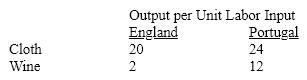 Using the data from Table 34-2, suppose England transfers 2 units of labor from wine to cloth and Portugal transfers 1 unit from cloth to wine. The combined production of wine and cloth will be increased by
 (Multiple Choice)
4.8/5 (89)
(89) 
Filters
- Essay(0)
- Multiple Choice(0)
- Short Answer(0)
- True False(0)
- Matching(0)