



 Chat with AI
Exam 12: Monopoly

Exam 1: What Is Economics261 Questions
Exam 2: The Economy: Myth and Reality185 Questions
Exam 3: The Fundamental Economic Problem: Scarcity and Choice290 Questions
Exam 4: Supply and Demand: an Initial Look337 Questions
Exam 5: Consumer Choice: Individual and Market Demand243 Questions
Exam 6: Demand and Elasticity254 Questions
Exam 7: Production, Inputs, and Cost: Building Blocks for Supply Analysis260 Questions
Exam 8: Output, Price, and Profit: the Importance of Marginal Analysis234 Questions
Exam 9: The Financial Markets and the Economy: the Tail That Wags the Dog227 Questions
Exam 10: The Firm and the Industry Under Perfect Competition253 Questions
Exam 11: The Case for Free Markets: the Price System259 Questions
Exam 12: Monopoly244 Questions
Exam 13: Between Competition and Monopoly254 Questions
Exam 14: Limiting Market Power: Antitrust and Regulation155 Questions
Exam 15: The Shortcomings of Free Markets219 Questions
Exam 16: Externalities, Externaliteis, the Environment, and Natural Resources222 Questions
Exam 17: Taxation and Resource Allocation221 Questions
Exam 18: Pricing the Factors of Production233 Questions
Exam 19: Labor and Entrepreneurship: the Human Inputs271 Questions
Exam 20: Poverty, Inequality, and Discrimination171 Questions
Exam 21: International Trade and Comparative Advantage226 Questions
Exam 22: Contemporary Issues in the Us Economy23 Questions
Select questions type


Explain the source of monopoly power for DeBeers' Diamond Mine in South Africa, Microsoft (owned by Bill Gates), the American Medical Association (which licenses doctors), Polaroid's Instant Picture Cameras, USAir (which owns virtually all the gates at the airport in Charlotte, North Carolina), and electric utilities.
(Essay)
4.9/5  (98)
(98) A natural monopoly would benefit by being broken into many smaller firms.
(True/False)
4.8/5 (73)
(73) If a firm was able to acquire control over access to bauxite, the ore used in aluminum manufacturing, it would gain monopoly control of the aluminum industry because that firm
(Multiple Choice)
4.7/5 (87)
(87) Compared to perfect competition, a monopoly in the long run
(Multiple Choice)
4.9/5 (87)
(87) At his current level of output, a monopolist has an MR of $10, an MC of $6, and an economic profit of zero. If the market demand curve is downward sloping and his or her marginal cost curve upward sloping, the monopolist
(Multiple Choice)
4.9/5 (85)
(85) A natural monopoly occurs when a single firm can produce the entire output of the market at a lower average cost than could many firms.
(True/False)
4.9/5 (75)
(75) Figure 11-6
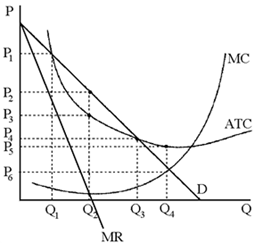 The profit-maximizing monopolist in Figure 11-6 will produce ____ units of output.
 (Multiple Choice)
5.0/5 (81)
(81) Is the monopolist supply decision more complicated than that of competitive supply?
(Multiple Choice)
4.9/5 (79)
(79) Under what conditions might a monopoly be more efficient than a perfectly competitive firm?
(Essay)
4.9/5 (74)
(74) The marginal revenue curve for a monopolist is the same as its demand curve.
(True/False)
4.7/5 (64)
(64) The marginal revenue curve for a monopolist is always below the demand curve.
(True/False)
4.8/5 (73)
(73) Too much of society's scarce resources are used to produce goods in monopoly markets.
(True/False)
4.9/5 (79)
(79) It is possible that if a monopoly is broken up, the cost of production for that product could increase.
(True/False)
4.8/5 (81)
(81) Since the Red Cross supplies 95 percent of the blood in the United States, it can be considered a monopolist. Assume that it, in fact, operates like a monopolist. The Red Cross currently charges hospitals and other users $21 for a pint of blood. In order to increase the supply of blood, the government offers the Red Cross a $10 million, lump-sum subsidy. How much more blood supply will the subsidy generate?
(Multiple Choice)
4.8/5 (74)
(74) Which of the following is not potentially a barrier to entry into the widget market?
(Multiple Choice)
4.7/5 (72)
(72) 
Filters
- Essay(0)
- Multiple Choice(0)
- Short Answer(0)
- True False(0)
- Matching(0)