



 Chat with AI
Exam 12: Monopoly

Exam 1: What Is Economics261 Questions
Exam 2: The Economy: Myth and Reality185 Questions
Exam 3: The Fundamental Economic Problem: Scarcity and Choice290 Questions
Exam 4: Supply and Demand: an Initial Look337 Questions
Exam 5: Consumer Choice: Individual and Market Demand243 Questions
Exam 6: Demand and Elasticity254 Questions
Exam 7: Production, Inputs, and Cost: Building Blocks for Supply Analysis260 Questions
Exam 8: Output, Price, and Profit: the Importance of Marginal Analysis234 Questions
Exam 9: The Financial Markets and the Economy: the Tail That Wags the Dog227 Questions
Exam 10: The Firm and the Industry Under Perfect Competition253 Questions
Exam 11: The Case for Free Markets: the Price System259 Questions
Exam 12: Monopoly244 Questions
Exam 13: Between Competition and Monopoly254 Questions
Exam 14: Limiting Market Power: Antitrust and Regulation155 Questions
Exam 15: The Shortcomings of Free Markets219 Questions
Exam 16: Externalities, Externaliteis, the Environment, and Natural Resources222 Questions
Exam 17: Taxation and Resource Allocation221 Questions
Exam 18: Pricing the Factors of Production233 Questions
Exam 19: Labor and Entrepreneurship: the Human Inputs271 Questions
Exam 20: Poverty, Inequality, and Discrimination171 Questions
Exam 21: International Trade and Comparative Advantage226 Questions
Exam 22: Contemporary Issues in the Us Economy23 Questions
Select questions type


Figure 11-1
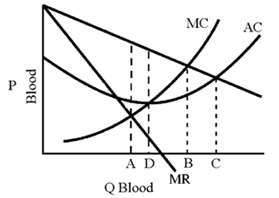 The Red Cross is virtually the only operator of blood banks in the United States. In Figure 11-1 are the demand and supply curves facing the Red Cross blood bank. If it were to operate like a profit-maximizing business, how many units of blood would it sell?
 (Multiple Choice)
4.9/5  (78)
(78) A monopoly firm always devotes some of its profits to research.
(True/False)
4.8/5 (96)
(96) In perfect competition, one result of the model was that there were no economic profits in the long run. In a monopoly, the firm typically earns a positive economic profit. Why is there this difference?
(Essay)
5.0/5 (81)
(81) A monopolist can maximize profits by determining the quantity where price is equal to marginal cost.
(True/False)
5.0/5 (76)
(76) In cases of natural monopoly, it is best to have only one firm producing all of the output in a market.
(True/False)
4.9/5 (63)
(63) Figure 11-7
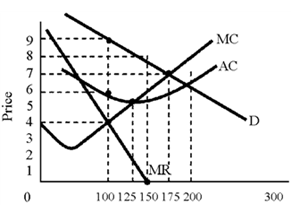 The firm in Figure 11-7 is an unregulated monopolist; it will earn long-run profits of how much?
 (Multiple Choice)
4.8/5 (89)
(89) In cases of natural monopolies, society would be better off with many firms competing with each other.
(True/False)
4.9/5 (83)
(83) Bargain airline fares in which airlines charge varying rates to passengers for the same flight and service is an example of
(Multiple Choice)
4.8/5 (83)
(83) If a monopoly firm reduced the price of its product, which of following must have been true?
(Multiple Choice)
4.9/5 (79)
(79) Figure 11-5
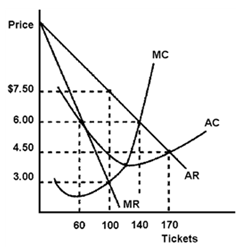 In Figure 11-5, Crown Theater, a monopolist movie theater, has chosen the profit-maximizing output. At this output level, what is total cost for the firm?
 (Multiple Choice)
4.9/5 (94)
(94) The key element in preserving a monopoly is keeping rivals out of the market.
(True/False)
4.8/5 (78)
(78) Give a complete and concise definition of each of the following terms.
a. Deliberately erected entry barriers
b. Inefficiency of monopoly
c. Price discrimination
d. Profit-maximizing equilibrium for a monopolist
(Essay)
4.8/5 (74)
(74) A profit-maximizing monopolist will stop production while MR is still greater than MC.
(True/False)
4.9/5 (70)
(70) A monopoly may breed inefficiency by reducing competition and restricting production.
(True/False)
4.7/5 (94)
(94) 
Filters
- Essay(0)
- Multiple Choice(0)
- Short Answer(0)
- True False(0)
- Matching(0)