



 Chat with AI
Exam 12: Monopoly

Exam 1: What Is Economics261 Questions
Exam 2: The Economy: Myth and Reality185 Questions
Exam 3: The Fundamental Economic Problem: Scarcity and Choice290 Questions
Exam 4: Supply and Demand: an Initial Look337 Questions
Exam 5: Consumer Choice: Individual and Market Demand243 Questions
Exam 6: Demand and Elasticity254 Questions
Exam 7: Production, Inputs, and Cost: Building Blocks for Supply Analysis260 Questions
Exam 8: Output, Price, and Profit: the Importance of Marginal Analysis234 Questions
Exam 9: The Financial Markets and the Economy: the Tail That Wags the Dog227 Questions
Exam 10: The Firm and the Industry Under Perfect Competition253 Questions
Exam 11: The Case for Free Markets: the Price System259 Questions
Exam 12: Monopoly244 Questions
Exam 13: Between Competition and Monopoly254 Questions
Exam 14: Limiting Market Power: Antitrust and Regulation155 Questions
Exam 15: The Shortcomings of Free Markets219 Questions
Exam 16: Externalities, Externaliteis, the Environment, and Natural Resources222 Questions
Exam 17: Taxation and Resource Allocation221 Questions
Exam 18: Pricing the Factors of Production233 Questions
Exam 19: Labor and Entrepreneurship: the Human Inputs271 Questions
Exam 20: Poverty, Inequality, and Discrimination171 Questions
Exam 21: International Trade and Comparative Advantage226 Questions
Exam 22: Contemporary Issues in the Us Economy23 Questions
Select questions type


A monopolist's profit per unit is shown by the difference between price and average cost per unit.
(True/False)
4.9/5  (62)
(62) A monopolist firm may be more innovative than a competitive firm.
(True/False)
4.8/5 (86)
(86) Because a monopolist must cut its price to increase its sales by one unit,
(Multiple Choice)
4.7/5 (94)
(94) Figure 11-4
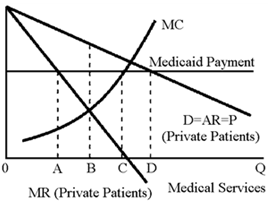 Physicians have two types of patients: private patients who pay directly or with insurance, and Medicaid patients whose care is paid for by the state. Physicians must lower prices to attract more private patients, but they can add unlimited Medicaid patients at a constant price. The situation facing Dr. Casey is depicted in Figure 11-4. Units of medical service (say, number of patients × number of visits)are measured on the horizontal axis. How many units of medical service will Dr. Casey deliver?
 (Multiple Choice)
4.7/5 (76)
(76) Define the following terms and explain their importance to the study of economics.
a. Pure monopoly
b. Barriers to entry
c. Patent
d. Natural monopoly
e. Sunk costs
(Essay)
4.7/5 (65)
(65) Table 11-2 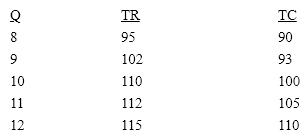 In Table 11-2, marginal revenue at the profit-maximizing output is how much?
 (Multiple Choice)
4.9/5 (88)
(88) Figure 11-7
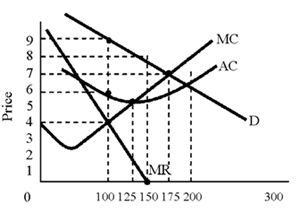 For the firm in Figure 11-7, an unregulated monopolist, output falls below the efficient level in the short run by how much?
 (Multiple Choice)
4.9/5 (73)
(73) A monopolist can sell 10 lunchboxes if he or she charges $10 per lunchbox and 11 lunchboxes if he or she charges $9. The MR from selling the 11th lunchbox is
(Multiple Choice)
4.8/5 (74)
(74) A monopolist can earn a positive economic profit, even in the long run.
(True/False)
4.8/5 (73)
(73) Figure 11-2
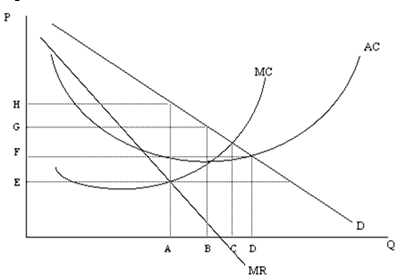 In Figure 11-2, at what quantity would the monopolist maximize profit?
 (Multiple Choice)
4.7/5 (75)
(75) If the monopolist's supply curve is drawn, it is a positively sloped curve similar to that for the perfectly competitive market.
(True/False)
4.8/5 (74)
(74) Figure 11-5
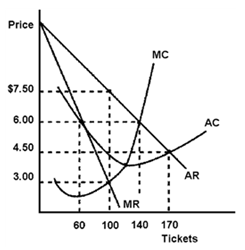 In Figure 11-5 are the cost and revenue curves of a monopolist in the theater market, Crown Theater, which is the only movie theater in the city. At its profit-maximizing quantity of tickets sold, movie goers will buy ____ tickets.
 (Multiple Choice)
4.8/5 (77)
(77) Figure 11-6
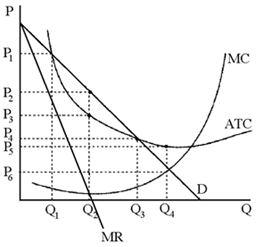 The profit-maximizing monopolist in Figure 11-6 will sell its output at
 (Multiple Choice)
4.8/5 (74)
(74) A price-discriminating firm will always maximize profit by following the condition that
(Multiple Choice)
4.9/5 (78)
(78) In the long run, profit-maximizing monopolists facing a downward-sloping demand curve
(Multiple Choice)
4.8/5 (70)
(70) 
Filters
- Essay(0)
- Multiple Choice(0)
- Short Answer(0)
- True False(0)
- Matching(0)