



 Chat with AI
Exam 12: Monopoly

Exam 1: What Is Economics261 Questions
Exam 2: The Economy: Myth and Reality185 Questions
Exam 3: The Fundamental Economic Problem: Scarcity and Choice290 Questions
Exam 4: Supply and Demand: an Initial Look337 Questions
Exam 5: Consumer Choice: Individual and Market Demand243 Questions
Exam 6: Demand and Elasticity254 Questions
Exam 7: Production, Inputs, and Cost: Building Blocks for Supply Analysis260 Questions
Exam 8: Output, Price, and Profit: the Importance of Marginal Analysis234 Questions
Exam 9: The Financial Markets and the Economy: the Tail That Wags the Dog227 Questions
Exam 10: The Firm and the Industry Under Perfect Competition253 Questions
Exam 11: The Case for Free Markets: the Price System259 Questions
Exam 12: Monopoly244 Questions
Exam 13: Between Competition and Monopoly254 Questions
Exam 14: Limiting Market Power: Antitrust and Regulation155 Questions
Exam 15: The Shortcomings of Free Markets219 Questions
Exam 16: Externalities, Externaliteis, the Environment, and Natural Resources222 Questions
Exam 17: Taxation and Resource Allocation221 Questions
Exam 18: Pricing the Factors of Production233 Questions
Exam 19: Labor and Entrepreneurship: the Human Inputs271 Questions
Exam 20: Poverty, Inequality, and Discrimination171 Questions
Exam 21: International Trade and Comparative Advantage226 Questions
Exam 22: Contemporary Issues in the Us Economy23 Questions
Select questions type


A monopolist is a price maker who will lose some business if the price is increased.
(True/False)
4.9/5  (70)
(70) Until recently, the drug maker Pfizer enjoyed a monopoly of the cholesterol-control drug Lipitor because of patent rights.
(True/False)
4.7/5 (76)
(76) A positive aspect of monopolies is that they may aid innovation in the marketplace.
(True/False)
4.8/5 (92)
(92) Figure 11-1
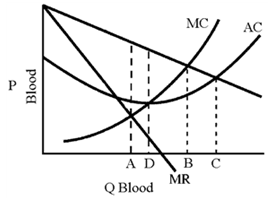 The Red Cross is virtually the only operator of blood banks in the United States. In Figure 11-1 are the demand and cost curves facing the Red Cross blood bank. If the Red Cross were to set price and quantity at the level that it would obtain in the long run in a competitive industry, how much blood would it sell?
 (Multiple Choice)
4.8/5 (85)
(85) At a given output level, a monopolist earns a profit only if the
(Multiple Choice)
4.7/5 (92)
(92) Economists object to monopolies on the grounds of efficiency. Why is this? Explain.
(Essay)
4.9/5 (74)
(74) The differences between a competitive market and a monopoly include all of these except
(Multiple Choice)
4.9/5 (83)
(83) The existence of a natural monopoly stems from the size of the firm relative to the total market demand for the product of that firm.
(True/False)
4.8/5 (81)
(81) The presence of large sunk costs often serves as a naturally imposed barrier to entry.
(True/False)
4.8/5 (78)
(78) A natural monopoly is one that deliberately erects entry barriers.
(True/False)
4.9/5 (71)
(71) What is true for monopoly that is not true for perfect competition?
(Multiple Choice)
4.8/5 (90)
(90) What is a key criterion involved in deciding a natural monopoly?
(Multiple Choice)
4.9/5 (66)
(66) 
Filters
- Essay(0)
- Multiple Choice(0)
- Short Answer(0)
- True False(0)
- Matching(0)