



 Chat with AI
Exam 12: Monopoly

Exam 1: What Is Economics261 Questions
Exam 2: The Economy: Myth and Reality185 Questions
Exam 3: The Fundamental Economic Problem: Scarcity and Choice290 Questions
Exam 4: Supply and Demand: an Initial Look337 Questions
Exam 5: Consumer Choice: Individual and Market Demand243 Questions
Exam 6: Demand and Elasticity254 Questions
Exam 7: Production, Inputs, and Cost: Building Blocks for Supply Analysis260 Questions
Exam 8: Output, Price, and Profit: the Importance of Marginal Analysis234 Questions
Exam 9: The Financial Markets and the Economy: the Tail That Wags the Dog227 Questions
Exam 10: The Firm and the Industry Under Perfect Competition253 Questions
Exam 11: The Case for Free Markets: the Price System259 Questions
Exam 12: Monopoly244 Questions
Exam 13: Between Competition and Monopoly254 Questions
Exam 14: Limiting Market Power: Antitrust and Regulation155 Questions
Exam 15: The Shortcomings of Free Markets219 Questions
Exam 16: Externalities, Externaliteis, the Environment, and Natural Resources222 Questions
Exam 17: Taxation and Resource Allocation221 Questions
Exam 18: Pricing the Factors of Production233 Questions
Exam 19: Labor and Entrepreneurship: the Human Inputs271 Questions
Exam 20: Poverty, Inequality, and Discrimination171 Questions
Exam 21: International Trade and Comparative Advantage226 Questions
Exam 22: Contemporary Issues in the Us Economy23 Questions
Select questions type


Figure 11-7
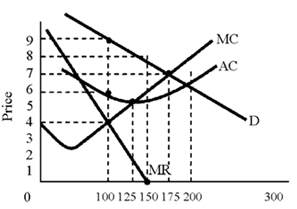 The firm in Figure 11-7 is an unregulated monopolist; it will produce which of the following?
 (Multiple Choice)
4.7/5  (78)
(78) Which of the following will occur if a natural monopoly is broken into two smaller firms?
(Multiple Choice)
4.9/5 (88)
(88) Figure 11-9
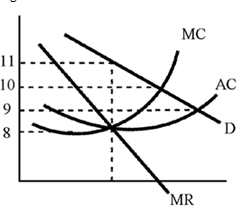 In Figure 11-9, how much more than the short-run competitive price will the profit-maximizing monopolist charge?
 (Multiple Choice)
4.9/5 (62)
(62) Economists consider price discrimination to always be undesirable.
(True/False)
4.7/5 (68)
(68) Pure monopoly is not studied because of its descriptive realism, but because it is a stepping stone toward more realistic models.
(True/False)
4.8/5 (75)
(75) It is possible to distinguish a monopoly from perfect competition by noting that only competitive firms can earn economic profits in the short run.
(True/False)
4.9/5 (68)
(68) The difference in prices for first-class and coach airline tickets exemplifies price discrimination.
(True/False)
4.9/5 (88)
(88) Since a monopolist firm will lose some customers when the price is increased, it will make every effort to keep the price as low as possible.
(True/False)
4.8/5 (70)
(70) A profit maximizing monopolist always chooses to operate at the output level where
(Multiple Choice)
4.9/5 (86)
(86) Table 11-2 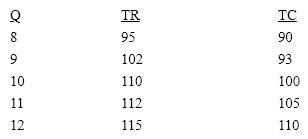 In Table 11-2, average cost at the profit-maximizing output is how much?
 (Multiple Choice)
4.8/5 (85)
(85) Provide two circumstances where monopoly may offer efficiency advantages over competition.
(Essay)
4.8/5 (83)
(83) A monopolist will increase output to the point where MR equals MC and not beyond.
(True/False)
4.8/5 (73)
(73) Which of the following is NOT a characteristic of a pure monopoly?
(Multiple Choice)
4.8/5 (77)
(77) Price discrimination allows a monopolist to make higher profits.
(True/False)
4.7/5 (65)
(65) 
Filters
- Essay(0)
- Multiple Choice(0)
- Short Answer(0)
- True False(0)
- Matching(0)