



 Chat with AI
Exam 12: Monopoly

Exam 1: What Is Economics261 Questions
Exam 2: The Economy: Myth and Reality185 Questions
Exam 3: The Fundamental Economic Problem: Scarcity and Choice290 Questions
Exam 4: Supply and Demand: an Initial Look337 Questions
Exam 5: Consumer Choice: Individual and Market Demand243 Questions
Exam 6: Demand and Elasticity254 Questions
Exam 7: Production, Inputs, and Cost: Building Blocks for Supply Analysis260 Questions
Exam 8: Output, Price, and Profit: the Importance of Marginal Analysis234 Questions
Exam 9: The Financial Markets and the Economy: the Tail That Wags the Dog227 Questions
Exam 10: The Firm and the Industry Under Perfect Competition253 Questions
Exam 11: The Case for Free Markets: the Price System259 Questions
Exam 12: Monopoly244 Questions
Exam 13: Between Competition and Monopoly254 Questions
Exam 14: Limiting Market Power: Antitrust and Regulation155 Questions
Exam 15: The Shortcomings of Free Markets219 Questions
Exam 16: Externalities, Externaliteis, the Environment, and Natural Resources222 Questions
Exam 17: Taxation and Resource Allocation221 Questions
Exam 18: Pricing the Factors of Production233 Questions
Exam 19: Labor and Entrepreneurship: the Human Inputs271 Questions
Exam 20: Poverty, Inequality, and Discrimination171 Questions
Exam 21: International Trade and Comparative Advantage226 Questions
Exam 22: Contemporary Issues in the Us Economy23 Questions
Select questions type


Why does perfect competition shun advertising? Does advertising benefit a monopoly?
(Essay)
4.8/5  (86)
(86) Figure 11-6
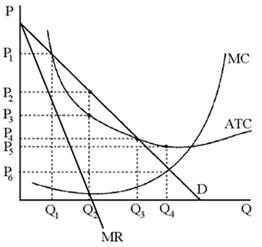 At its optimal output level, the profit-maximizing monopolist in Figure 11-6 will earn a profit equal to
 (Multiple Choice)
4.9/5 (75)
(75) What is true for both a monopolist and a perfect competitor?
(Multiple Choice)
4.8/5 (83)
(83) Owning a patent can always provide a firm with monopoly control of a market.
(True/False)
4.8/5 (78)
(78) What is the equilibrium condition for price discriminating monopoly firm? Give some examples for price discrimination.
(Essay)
4.8/5 (80)
(80) A natural monopoly market is characterized diseconomies of scale over the entire range of output.
(True/False)
4.8/5 (74)
(74) The ability to control a scarce resource or input is a characteristic of perfect competition.
(True/False)
4.9/5 (80)
(80) Table 11-1 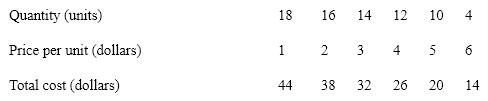 Table 11-1 shows demand and total cost schedules for Monopoliteria. At its profit-maximizing level of output, Monopoliteria's profit is
 (Multiple Choice)
4.9/5 (75)
(75) Entry barriers are present in monopoly markets but are not in perfectly competitive markets.
(True/False)
4.9/5 (62)
(62) Figure 11-4
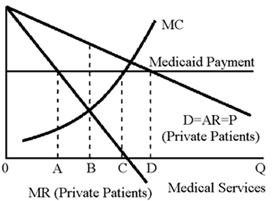 Physicians have two types of patients: private patients who pay directly or with insurance, and Medicaid patients whose care is paid for by the state. Physicians must lower prices to attract more private patients, but they can add unlimited Medicaid patients at a constant price. The situation facing Dr. Casey is depicted in Figure 11-4. Units of medical service (say, number of patients × number of visits)are measured on the horizontal axis. How many units of medical service will Dr. Casey deliver to Medicaid patients?
 (Multiple Choice)
4.9/5 (72)
(72) The average total cost curve of a natural monopoly is always
(Multiple Choice)
4.9/5 (70)
(70) The two basic reasons why a monopoly exists are barriers to entry and cost advantages.
(True/False)
4.7/5 (88)
(88) Explain how each of the following industries practices price discrimination.
a. Movie theaters
b. Airlines
c. Auto dealers
d. U.S. Postal Service
(Essay)
4.8/5 (83)
(83) 
Filters
- Essay(0)
- Multiple Choice(0)
- Short Answer(0)
- True False(0)
- Matching(0)