



 Chat with AI
Exam 5: Consumer Choice: Individual and Market Demand

Exam 1: What Is Economics261 Questions
Exam 2: The Economy: Myth and Reality185 Questions
Exam 3: The Fundamental Economic Problem: Scarcity and Choice290 Questions
Exam 4: Supply and Demand: an Initial Look337 Questions
Exam 5: Consumer Choice: Individual and Market Demand243 Questions
Exam 6: Demand and Elasticity254 Questions
Exam 7: Production, Inputs, and Cost: Building Blocks for Supply Analysis260 Questions
Exam 8: Output, Price, and Profit: the Importance of Marginal Analysis234 Questions
Exam 9: The Financial Markets and the Economy: the Tail That Wags the Dog227 Questions
Exam 10: The Firm and the Industry Under Perfect Competition253 Questions
Exam 11: The Case for Free Markets: the Price System259 Questions
Exam 12: Monopoly244 Questions
Exam 13: Between Competition and Monopoly254 Questions
Exam 14: Limiting Market Power: Antitrust and Regulation155 Questions
Exam 15: The Shortcomings of Free Markets219 Questions
Exam 16: Externalities, Externaliteis, the Environment, and Natural Resources222 Questions
Exam 17: Taxation and Resource Allocation221 Questions
Exam 18: Pricing the Factors of Production233 Questions
Exam 19: Labor and Entrepreneurship: the Human Inputs271 Questions
Exam 20: Poverty, Inequality, and Discrimination171 Questions
Exam 21: International Trade and Comparative Advantage226 Questions
Exam 22: Contemporary Issues in the Us Economy23 Questions
Select questions type


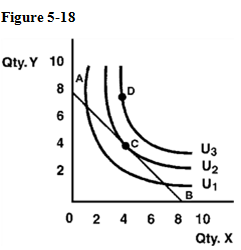 In Figure 5-18, point D for the consumer

What is the relationship between marginal utility and an individual demand curve?
(Essay)
4.7/5  (81)
(81) Consumer choice theory generally concludes that is based on the hypothesis that each consumer wants to
(Multiple Choice)
4.9/5 (76)
(76) If a person receives a consumer's surplus from the purchase of a good, it must be that
(Multiple Choice)
4.8/5 (84)
(84) The slope of an indifference curve represents the maximum amount of one commodity that a consumer is willing to give up in exchange for one more unit of another commodity.
(True/False)
4.8/5 (80)
(80) The diamond-water puzzle, described by Adam Smith, suggests that the consumer's surplus of water is high and the consumer's surplus for diamonds is low.
(True/False)
4.8/5 (95)
(95) The budget line represents a consumer's preferences for a commodity.
(True/False)
4.9/5 (77)
(77) Figure 5-13
 -In Figure 5-13, the consumer can afford any combination of X and Y represented by a point
 (Multiple Choice)
4.8/5 (77)
(77) Consumers should purchase quantities of a good to the point where MU > P.
(True/False)
4.9/5 (73)
(73) The market demand curve is the vertical summation of all individual demand curves.
(True/False)
4.9/5 (76)
(76) Consumer's surplus exists only for the last unit of a good that a buyer has purchased.
(True/False)
4.8/5 (88)
(88) If point A on an indifference curve lies higher (measured vertically)than point B on the same curve, Point A automatically represents higher total utility than point B.
(True/False)
5.0/5 (75)
(75) Alice has $10 to spend on wine and cheese. If wine is $2.50 a glass and cheese $2, draw the corresponding budget line. Then draw three indifference curves, one showing the amount of wine and cheese Alice would choose, one showing less preferred combinations of wine and cheese, and the last showing preferred but unaffordable combinations.
(Essay)
4.8/5 (90)
(90) Total utility increases if one more unit of a product is purchased and marginal utility is negative.
(True/False)
4.8/5 (86)
(86) An increase in income produces a parallel, outward shift in the budget line.
(True/False)
4.9/5 (72)
(72) Given a typical demand curve and a decline in price, the consumer who wishes to maximize total utility must increase the quantity purchased of a good to arrive at an optimal MU = P point.
(True/False)
4.8/5 (68)
(68) The marginal rate of substitution represents the maximum amount of one commodity a consumer is willing to give up in exchange for one more unit of another commodity.
(True/False)
4.7/5 (84)
(84) 
Filters
- Essay(0)
- Multiple Choice(0)
- Short Answer(0)
- True False(0)
- Matching(0)