



 Chat with AI
Exam 5: Consumer Choice: Individual and Market Demand

Exam 1: What Is Economics261 Questions
Exam 2: The Economy: Myth and Reality185 Questions
Exam 3: The Fundamental Economic Problem: Scarcity and Choice290 Questions
Exam 4: Supply and Demand: an Initial Look337 Questions
Exam 5: Consumer Choice: Individual and Market Demand243 Questions
Exam 6: Demand and Elasticity254 Questions
Exam 7: Production, Inputs, and Cost: Building Blocks for Supply Analysis260 Questions
Exam 8: Output, Price, and Profit: the Importance of Marginal Analysis234 Questions
Exam 9: The Financial Markets and the Economy: the Tail That Wags the Dog227 Questions
Exam 10: The Firm and the Industry Under Perfect Competition253 Questions
Exam 11: The Case for Free Markets: the Price System259 Questions
Exam 12: Monopoly244 Questions
Exam 13: Between Competition and Monopoly254 Questions
Exam 14: Limiting Market Power: Antitrust and Regulation155 Questions
Exam 15: The Shortcomings of Free Markets219 Questions
Exam 16: Externalities, Externaliteis, the Environment, and Natural Resources222 Questions
Exam 17: Taxation and Resource Allocation221 Questions
Exam 18: Pricing the Factors of Production233 Questions
Exam 19: Labor and Entrepreneurship: the Human Inputs271 Questions
Exam 20: Poverty, Inequality, and Discrimination171 Questions
Exam 21: International Trade and Comparative Advantage226 Questions
Exam 22: Contemporary Issues in the Us Economy23 Questions
Select questions type


By changing the amount of income a consumer has to spend, a change in the price of one good may affect the quantity demanded of another good.
(True/False)
4.9/5  (91)
(91) Elaine values the utility of her first cup of coffee at $1; a second cup, $.75; and a third cup, $.50. If Elaine drinks three cups of coffee for breakfast, her marginal utility is equal to
(Multiple Choice)
4.9/5 (64)
(64) The law of diminishing marginal utility states that total utility will increase at a decreasing rate as additional units of a commodity are acquired.
(True/False)
4.7/5 (72)
(72) All of the points on a budget line result in combination of goods that expend all of her income.
(True/False)
4.8/5 (81)
(81) If we graph marginal utility, the curve has a negative slope. This is because of the
(Multiple Choice)
4.8/5 (81)
(81) The consumer maximizes his total utility (measured in money terms)when, at his chosen quantity of every good he buys, marginal utility
(Multiple Choice)
4.8/5 (74)
(74) Jason considers a crystal bowl, a silver dish, and a pewter figurine, each priced $45 at the local gift shop. He chooses the silver dish because according to economic theory,
(Multiple Choice)
4.9/5 (89)
(89) As a rule, the more of a commodity a consumer acquires, the smaller will be her total utility from that good.
(True/False)
4.8/5 (76)
(76) A bottle of wine costs $8 and a quiche costs $5. At Robert's present levels of consumption, he spends all his income and receives marginal utility of $10 from the last bottle of wine and marginal utility of $4 from the last quiche. To maximize his total utility, Robert should
(Multiple Choice)
4.7/5 (67)
(67) All points on an indifference curve represent combinations of two goods that are equally desirable to the consumer.
(True/False)
4.9/5 (70)
(70) In general, as a consumer acquires more and more of a good, the marginal utility remains constant.
(True/False)
4.9/5 (87)
(87) Figure 5-9
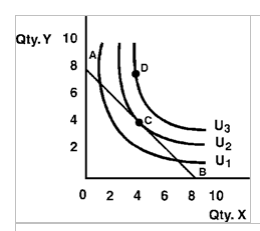 In Figure 5-9, the consumer's marginal rate of substitution at his optimum choice of X and Y is
 (Multiple Choice)
4.8/5 (82)
(82) Suppose the price of butter falls because milk price supports are removed. Will people's tastes shift away from margarine and toward butter?
(Essay)
5.0/5 (77)
(77) Figure 5-12
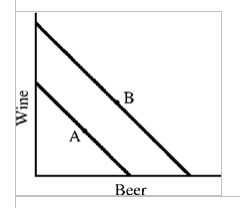 In Figure 5-12, if a consumer equilibrium moves from B to A, this shows that
 (Multiple Choice)
4.9/5 (84)
(84) At the end points on a budget line, the consumer is not spending all of his budget, since one of the goods is not being purchased.
(True/False)
4.8/5 (80)
(80) 
Filters
- Essay(0)
- Multiple Choice(0)
- Short Answer(0)
- True False(0)
- Matching(0)