



 Chat with AI
Exam 5: Consumer Choice: Individual and Market Demand

Exam 1: What Is Economics261 Questions
Exam 2: The Economy: Myth and Reality185 Questions
Exam 3: The Fundamental Economic Problem: Scarcity and Choice290 Questions
Exam 4: Supply and Demand: an Initial Look337 Questions
Exam 5: Consumer Choice: Individual and Market Demand243 Questions
Exam 6: Demand and Elasticity254 Questions
Exam 7: Production, Inputs, and Cost: Building Blocks for Supply Analysis260 Questions
Exam 8: Output, Price, and Profit: the Importance of Marginal Analysis234 Questions
Exam 9: The Financial Markets and the Economy: the Tail That Wags the Dog227 Questions
Exam 10: The Firm and the Industry Under Perfect Competition253 Questions
Exam 11: The Case for Free Markets: the Price System259 Questions
Exam 12: Monopoly244 Questions
Exam 13: Between Competition and Monopoly254 Questions
Exam 14: Limiting Market Power: Antitrust and Regulation155 Questions
Exam 15: The Shortcomings of Free Markets219 Questions
Exam 16: Externalities, Externaliteis, the Environment, and Natural Resources222 Questions
Exam 17: Taxation and Resource Allocation221 Questions
Exam 18: Pricing the Factors of Production233 Questions
Exam 19: Labor and Entrepreneurship: the Human Inputs271 Questions
Exam 20: Poverty, Inequality, and Discrimination171 Questions
Exam 21: International Trade and Comparative Advantage226 Questions
Exam 22: Contemporary Issues in the Us Economy23 Questions
Select questions type


Draw individual demands for caviar for Al, Barbara, Chuck, and Denise where Al's demand is relatively inelastic, Barbara's is elastic, Chuck's is upward sloping, and Denise refuses to eat caviar at any price. Then draw the corresponding market demand.
(Essay)
4.9/5  (85)
(85) Any point on the lowest indifference curve is preferable to a point on a higher indifference curve.
(True/False)
5.0/5 (79)
(79) Use consumer indifference curves and budget lines to show the optimal consumption curves for a normal good and for an inferior good. (Use two graphs.)Be sure your graphs are completely and correctly labeled.
(Essay)
4.7/5 (72)
(72) An inferior good is one that consumers buy in smaller quantities when the price of that good rises.
(True/False)
4.7/5 (77)
(77) Total utility increases if one more unit of a product is purchased and marginal utility is positive.
(True/False)
4.9/5 (77)
(77) The slope of the budget line is the amount of one commodity that a consumer must give up in order to obtain an additional unit of the other commodity.
(True/False)
4.9/5 (72)
(72) An individual demand curve for a good is ____ her marginal utility curve for the good.
(Multiple Choice)
4.8/5 (84)
(84) If the marginal net utility of beer is a positive number, the consumer should buy more beer in order to maximize utility.
(True/False)
4.8/5 (65)
(65) If you go to a bar tonight and have three beers before going home to study economics, will you likely receive some consumer's surplus? Explain why or why not.
(Essay)
4.9/5 (88)
(88) A consumer who chooses the optimal bundle will go to a point on the highest attainable indifference curve.
(True/False)
4.8/5 (60)
(60) Figure 5-6
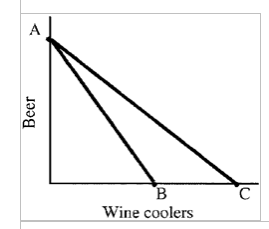 In Figure 5-6, a shift in the budget line from AC to AB indicates
 (Multiple Choice)
4.8/5 (74)
(74) Figure 5-3
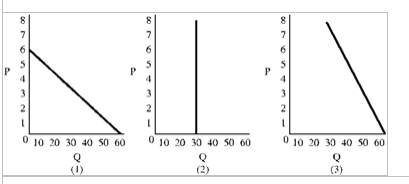 Suppose that the market price rises from $3 to $5. What is the change in market demand?
 (Multiple Choice)
4.9/5 (78)
(78) Because the consumer's budget is limited, purchase decisions among available goods must of necessity be interdependent.
(True/False)
4.8/5 (77)
(77) The host at a party offers Justin a sixth beer. Justin says, "No thanks, man. The marginal utility of that fifth beer was, like, 20 cents, but the marginal utility of the sixth would be minus 10 cents." From his comments, we deduce that Justin
(Multiple Choice)
4.9/5 (89)
(89) 
Filters
- Essay(0)
- Multiple Choice(0)
- Short Answer(0)
- True False(0)
- Matching(0)