



 Chat with AI
Exam 5: Consumer Choice: Individual and Market Demand

Exam 1: What Is Economics261 Questions
Exam 2: The Economy: Myth and Reality185 Questions
Exam 3: The Fundamental Economic Problem: Scarcity and Choice290 Questions
Exam 4: Supply and Demand: an Initial Look337 Questions
Exam 5: Consumer Choice: Individual and Market Demand243 Questions
Exam 6: Demand and Elasticity254 Questions
Exam 7: Production, Inputs, and Cost: Building Blocks for Supply Analysis260 Questions
Exam 8: Output, Price, and Profit: the Importance of Marginal Analysis234 Questions
Exam 9: The Financial Markets and the Economy: the Tail That Wags the Dog227 Questions
Exam 10: The Firm and the Industry Under Perfect Competition253 Questions
Exam 11: The Case for Free Markets: the Price System259 Questions
Exam 12: Monopoly244 Questions
Exam 13: Between Competition and Monopoly254 Questions
Exam 14: Limiting Market Power: Antitrust and Regulation155 Questions
Exam 15: The Shortcomings of Free Markets219 Questions
Exam 16: Externalities, Externaliteis, the Environment, and Natural Resources222 Questions
Exam 17: Taxation and Resource Allocation221 Questions
Exam 18: Pricing the Factors of Production233 Questions
Exam 19: Labor and Entrepreneurship: the Human Inputs271 Questions
Exam 20: Poverty, Inequality, and Discrimination171 Questions
Exam 21: International Trade and Comparative Advantage226 Questions
Exam 22: Contemporary Issues in the Us Economy23 Questions
Select questions type


Figure 5-4 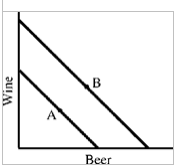 In Figure 5-4, the rightward shift in budget lines from the one containing point A to the one containing point B
 (Multiple Choice)
4.9/5  (83)
(83) Which of the following is characteristic of indifference curves?
(Multiple Choice)
4.9/5 (84)
(84) The number of compact discs purchased by a consumer depends on the price of the discs as well as the prices of all other goods purchased.
(True/False)
4.9/5 (80)
(80) How do you calculate consumer's surplus? What happens to consumer's surplus when the price of a commodity rises?
(Essay)
4.8/5 (79)
(79) If a good has "snob appeal," consumers may purchase less when the price falls.
(True/False)
4.8/5 (83)
(83) The theory of consumer choice is based on the hypothesis that each consumer wants to
(Multiple Choice)
5.0/5 (71)
(71) When the price of one good decreases, such as hot dogs, it may also increase the demand for other, related goods, like mustard.
(True/False)
4.9/5 (90)
(90) The budget line facing a household includes information on
(Multiple Choice)
4.9/5 (89)
(89) Figure 5-3
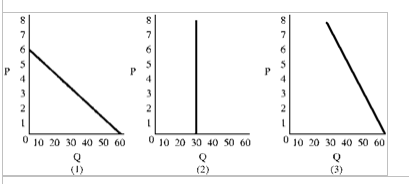 In Figure 5-3, a decline in price from 3 to 1 will increase market quantity demanded by
 (Multiple Choice)
4.9/5 (71)
(71) Figure 5-8
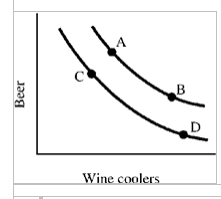 In Figure 5-8, the consumer is indifferent between the combinations of beer and wine coolers indicated by points
 (Multiple Choice)
4.9/5 (64)
(64) What is the marginal rate of substitution, and what role does it play in determining the consumer's optimum choice?
(Essay)
4.8/5 (85)
(85) Marginal utility is measured by the maximum amount of money a consumer is willing to pay for one more unit of a commodity.
(True/False)
4.8/5 (81)
(81) The slope of a consumer's indifference curve between two commodities represents
(Multiple Choice)
4.9/5 (76)
(76) 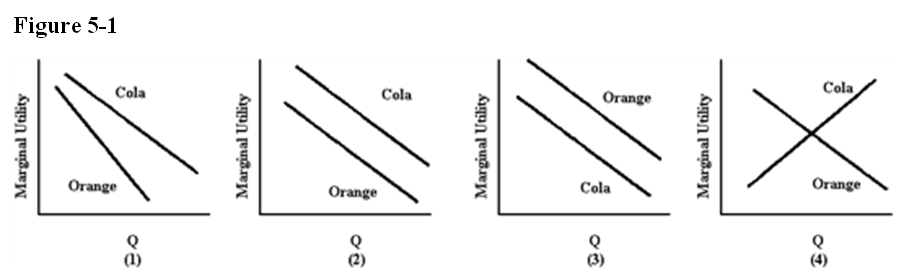 -In Figure 5-1 from the text, if the price of pizzas is $8:
a.how many pizzas will the consumer purchase?
B.what is the payment for the optimal number of pizzas?
C. how much consumer's surplus will the consumer receive?
-In Figure 5-1 from the text, if the price of pizzas is $8:
a.how many pizzas will the consumer purchase?
B.what is the payment for the optimal number of pizzas?
C. how much consumer's surplus will the consumer receive? (Essay)
4.8/5 (75)
(75) The law of diminishing marginal utility states that total utility will decrease at an increasing rate as additional units of a commodity are consumed.
(True/False)
4.9/5 (69)
(69) 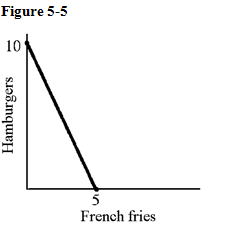 -Figure 5-5 shows a consumer budget line for french fries and hamburgers. The price of an order of fries is $2. This implies that the price of a burger is
 (Multiple Choice)
4.7/5 (76)
(76) 
Filters
- Essay(0)
- Multiple Choice(0)
- Short Answer(0)
- True False(0)
- Matching(0)