



 Chat with AI
Exam 5: Consumer Choice: Individual and Market Demand

Exam 1: What Is Economics261 Questions
Exam 2: The Economy: Myth and Reality185 Questions
Exam 3: The Fundamental Economic Problem: Scarcity and Choice290 Questions
Exam 4: Supply and Demand: an Initial Look337 Questions
Exam 5: Consumer Choice: Individual and Market Demand243 Questions
Exam 6: Demand and Elasticity254 Questions
Exam 7: Production, Inputs, and Cost: Building Blocks for Supply Analysis260 Questions
Exam 8: Output, Price, and Profit: the Importance of Marginal Analysis234 Questions
Exam 9: The Financial Markets and the Economy: the Tail That Wags the Dog227 Questions
Exam 10: The Firm and the Industry Under Perfect Competition253 Questions
Exam 11: The Case for Free Markets: the Price System259 Questions
Exam 12: Monopoly244 Questions
Exam 13: Between Competition and Monopoly254 Questions
Exam 14: Limiting Market Power: Antitrust and Regulation155 Questions
Exam 15: The Shortcomings of Free Markets219 Questions
Exam 16: Externalities, Externaliteis, the Environment, and Natural Resources222 Questions
Exam 17: Taxation and Resource Allocation221 Questions
Exam 18: Pricing the Factors of Production233 Questions
Exam 19: Labor and Entrepreneurship: the Human Inputs271 Questions
Exam 20: Poverty, Inequality, and Discrimination171 Questions
Exam 21: International Trade and Comparative Advantage226 Questions
Exam 22: Contemporary Issues in the Us Economy23 Questions
Select questions type


A consumer possesses five pounds of bananas and values their total utility at $2.14. If one additional pound is acquired and marginal utility is 11 cents, total utility will
(Multiple Choice)
4.8/5  (63)
(63) Vicki consumes meat loaf and pizza. To keep her utility constant, you must give her more of one good if you take some of the other away. This information implies that
(Multiple Choice)
4.7/5 (73)
(73) If the marginal net utility of beer is negative, the consumer should buy more beer in order to increase the total utility.
(True/False)
4.8/5 (81)
(81) An inferior good is one that consumers buy in smaller quantities when incomes rise.
(True/False)
4.9/5 (77)
(77) Figure 5-11
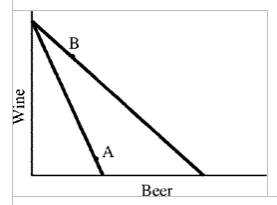 In Figure 5-11, a consumer is initially at point A. There is a price change and she moves to B. It follows that
 (Multiple Choice)
4.9/5 (78)
(78) A well-known women's college whose tuition lagged below similar schools found recruiting difficult and enrollment falling. A substantial tuition increase was implemented, and dormitories were soon full again. This can be explained by
(Multiple Choice)
4.8/5 (80)
(80) 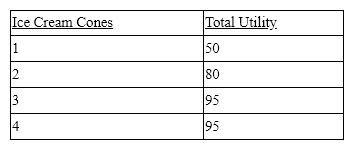 Using Table 5-3, graph the marginal utility curve.
Which of the following scenarios could be an example of increasing marginal utility?
(Multiple Choice)
4.9/5 (70)
(70) Market demand curves may slope downward even if some individual demand curves do not because
(Multiple Choice)
4.9/5 (67)
(67) Draw the point of consumer equilibrium from an indifference map and budget line. Explain why this is the point of optimization. Be sure your diagram is fully and correctly labeled.
(Essay)
4.8/5 (80)
(80) If a consumer is purchasing a good and her net marginal utility is positive,
(Multiple Choice)
4.9/5 (91)
(91) 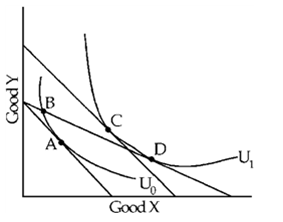 In Figure 5-17, the consumer would prefer
The resolution of Adam Smith's diamond-water puzzle is based on the distinction between marginal and total utility.
(True/False)
4.9/5 (87)
(87) Suppose that Joan, the only consumer of pork, has a downward-sloping demand curve for pork and faces an upward-sloping supply curve. If her demand curve shifts out because she develops a craving for pork, then at the new equilibrium (everything else equal),
(Multiple Choice)
4.9/5 (94)
(94) Total utility decreases when diminishing marginal utility is present.
(True/False)
4.8/5 (81)
(81) 
Filters
- Essay(0)
- Multiple Choice(0)
- Short Answer(0)
- True False(0)
- Matching(0)