



 Chat with AI
Exam 5: Consumer Choice: Individual and Market Demand

Exam 1: What Is Economics261 Questions
Exam 2: The Economy: Myth and Reality185 Questions
Exam 3: The Fundamental Economic Problem: Scarcity and Choice290 Questions
Exam 4: Supply and Demand: an Initial Look337 Questions
Exam 5: Consumer Choice: Individual and Market Demand243 Questions
Exam 6: Demand and Elasticity254 Questions
Exam 7: Production, Inputs, and Cost: Building Blocks for Supply Analysis260 Questions
Exam 8: Output, Price, and Profit: the Importance of Marginal Analysis234 Questions
Exam 9: The Financial Markets and the Economy: the Tail That Wags the Dog227 Questions
Exam 10: The Firm and the Industry Under Perfect Competition253 Questions
Exam 11: The Case for Free Markets: the Price System259 Questions
Exam 12: Monopoly244 Questions
Exam 13: Between Competition and Monopoly254 Questions
Exam 14: Limiting Market Power: Antitrust and Regulation155 Questions
Exam 15: The Shortcomings of Free Markets219 Questions
Exam 16: Externalities, Externaliteis, the Environment, and Natural Resources222 Questions
Exam 17: Taxation and Resource Allocation221 Questions
Exam 18: Pricing the Factors of Production233 Questions
Exam 19: Labor and Entrepreneurship: the Human Inputs271 Questions
Exam 20: Poverty, Inequality, and Discrimination171 Questions
Exam 21: International Trade and Comparative Advantage226 Questions
Exam 22: Contemporary Issues in the Us Economy23 Questions
Select questions type


Consumer's surplus is the difference between the worth of a commodity to the consumer and the price the consumer pays for the commodity.
(True/False)
4.7/5  (84)
(84) Which of the following observations is not true of a budget line?
(Multiple Choice)
4.9/5 (76)
(76) A consumer cannot gain consumer's surplus if she purchases more than one unit of a good.
(True/False)
4.9/5 (79)
(79) Consumer's surplus is what one consumer is willing to pay for a commodity over what another consumer is willing to pay for the same commodity.
(True/False)
4.9/5 (71)
(71) Which of the following factors is always present in consumer decision making?
(Multiple Choice)
4.9/5 (80)
(80) The slope of the budget line is determined only by the prices of the commodities purchased.
(True/False)
4.9/5 (79)
(79) Figure 5-16
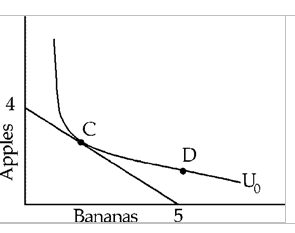 - In Figure 5-16, a decrease in the price of apples will
 (Multiple Choice)
4.9/5 (78)
(78) Elaine values the utility of her first cup of coffee at $1; a second cup, $.75; and a third cup, $.50. If Elaine drinks three cups of coffee for breakfast, her total utility is equal to
(Multiple Choice)
4.8/5 (81)
(81) A change in the price of one good results in a rotation of the budget line, so that it is steeper or flatter.
(True/False)
4.9/5 (76)
(76) A decrease in the price of one good results in a parallel shift in the budget line.
(True/False)
4.9/5 (78)
(78) When drawn correctly and preferences are consistent, indifference curves do not intersect.
(True/False)
4.7/5 (90)
(90) 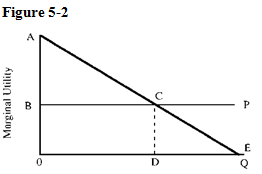 In Figure 5-2, consumer's surplus is measured by the area
The demand curve can be derived from indifference curves by varying the price of the commodity in question.
(True/False)
4.9/5 (82)
(82) The real cost of a decision is the opportunity cost measured in the commodities forgone.
(True/False)
4.9/5 (83)
(83) If I use 1,000 gallons of water a month at a price of $.01 a gallon, is my consumer's surplus likely to be large or small? Explain.
(Essay)
4.8/5 (82)
(82) Indifference curves show all combinations of commodities that are equally desirable to the consumer.
(True/False)
4.8/5 (76)
(76) Figure 5-17
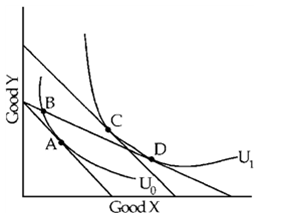 In Figure 5-17, which of the marked points would an economist use to help him construct a single demand curve for X?
 (Multiple Choice)
5.0/5 (82)
(82) 
Filters
- Essay(0)
- Multiple Choice(0)
- Short Answer(0)
- True False(0)
- Matching(0)