



 Chat with AI
Exam 48: Regulating the Internal Environment: Osmoregulation, Excretion, and Thermoregulation

Exam 1: Introduction to Biological Concepts and Research86 Questions
Exam 2: Life, Chemistry, and Water87 Questions
Exam 3: Biological Molecules: the Carbon Compounds of Life86 Questions
Exam 4: Cells87 Questions
Exam 5: Membranes and Transport88 Questions
Exam 6: Energy, Enzymes, and Biological Reactions87 Questions
Exam 7: Cellular Respiration: Harvesting Chemical Energy88 Questions
Exam 8: Photosynthesis83 Questions
Exam 9: Cell Communication87 Questions
Exam 10: Cell Division and Mitosis88 Questions
Exam 11: Meiosis: the Cellular Basis of Sexual Reproduction80 Questions
Exam 12: Mendel, Genes, and Inheritance79 Questions
Exam 13: Genes, Chromosomes, and Human Genetics92 Questions
Exam 14: Dna Structure, Replication, and Organization79 Questions
Exam 15: Gene Expression: From Dna to Protein83 Questions
Exam 16: Regulation of Gene Expression84 Questions
Exam 17: Bacterial and Viral Genetics85 Questions
Exam 18: Dna Technology: Making and Using Genetically Altered Organisms, and Other Applications90 Questions
Exam 19: Genomes and Proteomes81 Questions
Exam 20: The Development of Evolutionary Thought92 Questions
Exam 21: Microevolution: Genetic Changes Within Populations88 Questions
Exam 22: Speciation89 Questions
Exam 23: Paleobiology and Macroevolution87 Questions
Exam 24: Systematic Biology: Phylogeny and Classification95 Questions
Exam 25: The Origin of Life86 Questions
Exam 26: Prokaryotes and Viruses86 Questions
Exam 27: Protists90 Questions
Exam 28: Seedless Plants88 Questions
Exam 29: Seed Plants90 Questions
Exam 30: Fungi88 Questions
Exam 31: Animal Phylogeny, Acoelomates, and Protostomes95 Questions
Exam 32: Deuterostomes: Vertebrates and Their Closest Relatives93 Questions
Exam 33: The Plant Body90 Questions
Exam 34: Transport in Plants94 Questions
Exam 35: Plant Nutrition85 Questions
Exam 36: Reproduction and Development in Flowering Plants89 Questions
Exam 37: Plant Signals and Responses to the Environment90 Questions
Exam 38: Introduction to Animal Organization and Physiology87 Questions
Exam 39: Information Flow and the Neuron88 Questions
Exam 40: Nervous Systems88 Questions
Exam 41: Sensory Systems87 Questions
Exam 42: The Endocrine System94 Questions
Exam 43: Muscles, Bones, and Body Movements87 Questions
Exam 44: The Circulatory System87 Questions
Exam 45: Defenses Against Disease83 Questions
Exam 46: Gas Exchange: the Respiratory System87 Questions
Exam 47: Digestive Systems and Animal Nutrition92 Questions
Exam 48: Regulating the Internal Environment: Osmoregulation, Excretion, and Thermoregulation88 Questions
Exam 49: Animal Reproduction76 Questions
Exam 50: Animal Development88 Questions
Exam 51: Ecology and the Biosphere88 Questions
Exam 52: Population Ecology92 Questions
Exam 53: Population Interactions and Community Ecology89 Questions
Exam 54: Ecosystems90 Questions
Exam 55: Biodiversity and Conservation Biology89 Questions
Exam 56: Animal Behavior87 Questions
Select questions type


Freshwater fishes deal with the osmotic stress of living in hypoosmotic conditions in part by ____.
(Multiple Choice)
4.8/5  (82)
(82) Winged arthropods rely solely on behavioral mechanisms for thermoregulation.
(True/False)
4.8/5 (97)
(97) Cells in the juxtaglomerular apparatus secrete ____ in response to a significant drop in blood pressure or blood volume.
(Multiple Choice)
4.7/5 (80)
(80) Many terrestrial ectotherms regulate their temperature by ____.
(Multiple Choice)
4.9/5 (82)
(82) Polycystic kidney disease results in kidney failure due to ____.
(Multiple Choice)
4.9/5 (70)
(70) The main form of nitrogenous wastes released by mammals to their environment is ____.
(Multiple Choice)
4.9/5 (76)
(76) The osmoreceptors that detect and react to dehydration are located in the ____.
(Multiple Choice)
4.8/5 (69)
(69) In all but the simplest animals, osmoregulation and excretion is carried out using tubules that are ____.
(Multiple Choice)
5.0/5 (72)
(72) Many birds, such as seagulls (which rarely drink fresh water), deal with the osmotic stress of taking in large quantities of salt in their food mainly by ____.
(Multiple Choice)
4.7/5 (65)
(65) The smallest branches of ____ end(s) with a large flame cell.
(Multiple Choice)
4.8/5 (62)
(62) If you were stranded in the Sahara Desert with very little water, you would likely die as a result of ____.
(Multiple Choice)
4.8/5 (79)
(79) The movement of some molecules and ions out of excretory system tubules and back into body fluids is called ____.
(Multiple Choice)
4.8/5 (73)
(73) 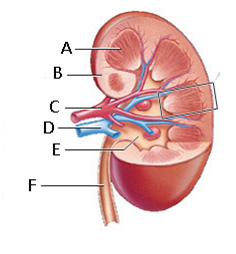
Figure 48.1
Answer the questions using the accompanying figure. Use the following terms to label the diagram of a kidney. Not all choices will be used.
Correct Answer: Verified
Premises:
Responses:
(Matching)
5.0/5 (90)
(90) The relatively simple excretory system used by flatworms consists of tubules called ____.
(Multiple Choice)
4.8/5 (93)
(93) The process of ____ is the transfer of heat from a body to a fluid that passes over its surface.
(Multiple Choice)
4.7/5 (92)
(92) The hormone ADH causes the reabsorption of water in the kidney by increasing the number of aquaporin water channels in the plasma membrane of the collecting ducts.
(True/False)
4.9/5 (76)
(76) Would drinking a gallon of tap water, a gallon of sea water, or a gallon of beer produce the most urine? Which would produce the least urine? Why?
(Essay)
4.8/5 (73)
(73) 
Filters
- Essay(0)
- Multiple Choice(0)
- Short Answer(0)
- True False(0)
- Matching(0)