



 Chat with AI
Exam 15: Gene Expression: From Dna to Protein

Exam 1: Introduction to Biological Concepts and Research86 Questions
Exam 2: Life, Chemistry, and Water87 Questions
Exam 3: Biological Molecules: the Carbon Compounds of Life86 Questions
Exam 4: Cells87 Questions
Exam 5: Membranes and Transport88 Questions
Exam 6: Energy, Enzymes, and Biological Reactions87 Questions
Exam 7: Cellular Respiration: Harvesting Chemical Energy88 Questions
Exam 8: Photosynthesis83 Questions
Exam 9: Cell Communication87 Questions
Exam 10: Cell Division and Mitosis88 Questions
Exam 11: Meiosis: the Cellular Basis of Sexual Reproduction80 Questions
Exam 12: Mendel, Genes, and Inheritance79 Questions
Exam 13: Genes, Chromosomes, and Human Genetics92 Questions
Exam 14: Dna Structure, Replication, and Organization79 Questions
Exam 15: Gene Expression: From Dna to Protein83 Questions
Exam 16: Regulation of Gene Expression84 Questions
Exam 17: Bacterial and Viral Genetics85 Questions
Exam 18: Dna Technology: Making and Using Genetically Altered Organisms, and Other Applications90 Questions
Exam 19: Genomes and Proteomes81 Questions
Exam 20: The Development of Evolutionary Thought92 Questions
Exam 21: Microevolution: Genetic Changes Within Populations88 Questions
Exam 22: Speciation89 Questions
Exam 23: Paleobiology and Macroevolution87 Questions
Exam 24: Systematic Biology: Phylogeny and Classification95 Questions
Exam 25: The Origin of Life86 Questions
Exam 26: Prokaryotes and Viruses86 Questions
Exam 27: Protists90 Questions
Exam 28: Seedless Plants88 Questions
Exam 29: Seed Plants90 Questions
Exam 30: Fungi88 Questions
Exam 31: Animal Phylogeny, Acoelomates, and Protostomes95 Questions
Exam 32: Deuterostomes: Vertebrates and Their Closest Relatives93 Questions
Exam 33: The Plant Body90 Questions
Exam 34: Transport in Plants94 Questions
Exam 35: Plant Nutrition85 Questions
Exam 36: Reproduction and Development in Flowering Plants89 Questions
Exam 37: Plant Signals and Responses to the Environment90 Questions
Exam 38: Introduction to Animal Organization and Physiology87 Questions
Exam 39: Information Flow and the Neuron88 Questions
Exam 40: Nervous Systems88 Questions
Exam 41: Sensory Systems87 Questions
Exam 42: The Endocrine System94 Questions
Exam 43: Muscles, Bones, and Body Movements87 Questions
Exam 44: The Circulatory System87 Questions
Exam 45: Defenses Against Disease83 Questions
Exam 46: Gas Exchange: the Respiratory System87 Questions
Exam 47: Digestive Systems and Animal Nutrition92 Questions
Exam 48: Regulating the Internal Environment: Osmoregulation, Excretion, and Thermoregulation88 Questions
Exam 49: Animal Reproduction76 Questions
Exam 50: Animal Development88 Questions
Exam 51: Ecology and the Biosphere88 Questions
Exam 52: Population Ecology92 Questions
Exam 53: Population Interactions and Community Ecology89 Questions
Exam 54: Ecosystems90 Questions
Exam 55: Biodiversity and Conservation Biology89 Questions
Exam 56: Animal Behavior87 Questions
Select questions type


Except for the stop codons, the codons in the genetic code specify which of the ____ amino acids will be added to a growing polypeptide chain.
(Multiple Choice)
4.8/5  (89)
(89) At the start of translation, the initiator tRNA pairs with the start codon at the ____ of the ribosome.
(Multiple Choice)
4.9/5 (63)
(63) The ribosome binding site in an mRNA transcript is located ____ and is where ____.
(Multiple Choice)
4.7/5 (74)
(74) The regions retained in finished mRNA transcripts after pre-mRNA processing are called ____.
(Multiple Choice)
4.8/5 (76)
(76) List two main differences between the processes of transcription and DNA replication.
(Essay)
5.0/5 (78)
(78) Protein-encoding genes in eukaryotes are transcribed by ____.
(Multiple Choice)
4.9/5 (93)
(93) Proteins called transcription factors are involved in ____ of transcription.
(Multiple Choice)
4.8/5 (69)
(69) Substitution of one base pair for another in a coding region of a gene can result in a ____ mutation where the changed codon specifies a different amino acid.
(Multiple Choice)
4.9/5 (67)
(67) In an mRNA transcript, the 3' UTR refers to the region of the mRNA that is ____.
(Multiple Choice)
4.9/5 (84)
(84) The central dogma describes the flow of information of gene expression as ____.
(Multiple Choice)
4.8/5 (79)
(79) Substitution of one base pair for another in a coding region of a gene can result in a ____ mutation where a codon specifying an amino acid is changed to a stop codon.
(Multiple Choice)
5.0/5 (80)
(80) Helper proteins that assist in protein folding are called ____.
(Multiple Choice)
4.7/5 (80)
(80) Translation ends when a stop codon in the ____ site allows a ____ to bind there.
(Multiple Choice)
4.8/5 (71)
(71) Describe how exon shuffling could lead to the formation of novel proteins.
(Essay)
4.9/5 (76)
(76) 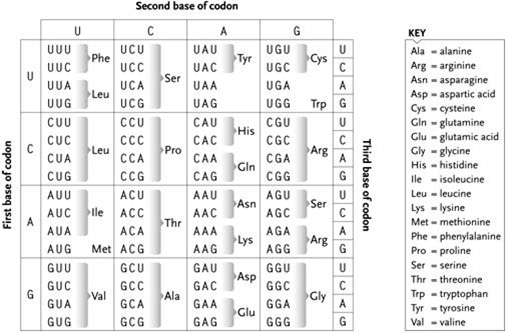 Use the table above for questions
-
Assume that an mRNA transcript is synthesized complementary to this DNA sequence:
3'-CTTACATGGCATCC-5'
See the provided genetic code table. If the start codon is considered the first codon, which amino acid is specified by the second codon?
Use the table above for questions
-
Assume that an mRNA transcript is synthesized complementary to this DNA sequence:
3'-CTTACATGGCATCC-5'
See the provided genetic code table. If the start codon is considered the first codon, which amino acid is specified by the second codon? (Multiple Choice)
4.8/5 (80)
(80) 
Filters
- Essay(0)
- Multiple Choice(0)
- Short Answer(0)
- True False(0)
- Matching(0)