



 Chat with AI
Exam 3: Biological Molecules: the Carbon Compounds of Life

Exam 1: Introduction to Biological Concepts and Research86 Questions
Exam 2: Life, Chemistry, and Water87 Questions
Exam 3: Biological Molecules: the Carbon Compounds of Life86 Questions
Exam 4: Cells87 Questions
Exam 5: Membranes and Transport88 Questions
Exam 6: Energy, Enzymes, and Biological Reactions87 Questions
Exam 7: Cellular Respiration: Harvesting Chemical Energy88 Questions
Exam 8: Photosynthesis83 Questions
Exam 9: Cell Communication87 Questions
Exam 10: Cell Division and Mitosis88 Questions
Exam 11: Meiosis: the Cellular Basis of Sexual Reproduction80 Questions
Exam 12: Mendel, Genes, and Inheritance79 Questions
Exam 13: Genes, Chromosomes, and Human Genetics92 Questions
Exam 14: Dna Structure, Replication, and Organization79 Questions
Exam 15: Gene Expression: From Dna to Protein83 Questions
Exam 16: Regulation of Gene Expression84 Questions
Exam 17: Bacterial and Viral Genetics85 Questions
Exam 18: Dna Technology: Making and Using Genetically Altered Organisms, and Other Applications90 Questions
Exam 19: Genomes and Proteomes81 Questions
Exam 20: The Development of Evolutionary Thought92 Questions
Exam 21: Microevolution: Genetic Changes Within Populations88 Questions
Exam 22: Speciation89 Questions
Exam 23: Paleobiology and Macroevolution87 Questions
Exam 24: Systematic Biology: Phylogeny and Classification95 Questions
Exam 25: The Origin of Life86 Questions
Exam 26: Prokaryotes and Viruses86 Questions
Exam 27: Protists90 Questions
Exam 28: Seedless Plants88 Questions
Exam 29: Seed Plants90 Questions
Exam 30: Fungi88 Questions
Exam 31: Animal Phylogeny, Acoelomates, and Protostomes95 Questions
Exam 32: Deuterostomes: Vertebrates and Their Closest Relatives93 Questions
Exam 33: The Plant Body90 Questions
Exam 34: Transport in Plants94 Questions
Exam 35: Plant Nutrition85 Questions
Exam 36: Reproduction and Development in Flowering Plants89 Questions
Exam 37: Plant Signals and Responses to the Environment90 Questions
Exam 38: Introduction to Animal Organization and Physiology87 Questions
Exam 39: Information Flow and the Neuron88 Questions
Exam 40: Nervous Systems88 Questions
Exam 41: Sensory Systems87 Questions
Exam 42: The Endocrine System94 Questions
Exam 43: Muscles, Bones, and Body Movements87 Questions
Exam 44: The Circulatory System87 Questions
Exam 45: Defenses Against Disease83 Questions
Exam 46: Gas Exchange: the Respiratory System87 Questions
Exam 47: Digestive Systems and Animal Nutrition92 Questions
Exam 48: Regulating the Internal Environment: Osmoregulation, Excretion, and Thermoregulation88 Questions
Exam 49: Animal Reproduction76 Questions
Exam 50: Animal Development88 Questions
Exam 51: Ecology and the Biosphere88 Questions
Exam 52: Population Ecology92 Questions
Exam 53: Population Interactions and Community Ecology89 Questions
Exam 54: Ecosystems90 Questions
Exam 55: Biodiversity and Conservation Biology89 Questions
Exam 56: Animal Behavior87 Questions
Select questions type


We would expect to find fatty acids with ____ carbons in living organisms.
(Multiple Choice)
4.8/5  (76)
(76) One important way in which RNA differs from DNA is that RNA is missing a key hydroxyl group on its sugar.
(True/False)
4.9/5 (75)
(75) Which molecules are the most important for a cell to protect from damage if the cell is to stay alive and reproduce?
(Multiple Choice)
4.7/5 (100)
(100) The complementary sequence to the DNA template 5'-ATACGCT-3' is 3'-TATGCGA-5'.
(True/False)
4.8/5 (85)
(85) HDL cholesterol is considered "good" cholesterol. What role does HDL play in preventing coronary heart disease?
(Multiple Choice)
4.9/5 (80)
(80) 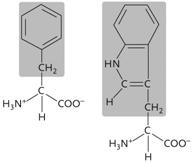 Figure 3.13
The two amino acids in the accompanying figure both have side chains ( R groups) that are ____.
Figure 3.13
The two amino acids in the accompanying figure both have side chains ( R groups) that are ____. (Multiple Choice)
4.8/5 (65)
(65) When molecules are referred to as D- or L- (for example D-forms of sugars and L-forms of amino acids), the D- and L- designations refer to the specific ____.
(Multiple Choice)
4.9/5 (82)
(82) Reactions that use the equivalent of a water molecule to break a molecule into smaller subunits are called ____ reactions.
(Multiple Choice)
4.9/5 (76)
(76) The molecule in the accompanying figure is ____, and has ____.
(Multiple Choice)
4.7/5 (79)
(79) Which functional group forms the highly reactive part of aldehydes and ketones?
(Multiple Choice)
4.9/5 (88)
(88) In addition to serving as building blocks of DNA, what other function do nucleotides perform in a cell?
(Multiple Choice)
5.0/5 (75)
(75) Triglycerides are used to coat skin, hair, and feathers of animals to keep them protected, lubricated, and pliable.
(True/False)
4.9/5 (82)
(82) In many animals, this polysaccharide is found in large quantities in liver and muscle cells. It is highly branched, with many a(1-4) and a(1-6) linkages.
(Multiple Choice)
4.9/5 (99)
(99) Hereditary information in all eukaryotes, prokaryotes, and viruses is stored in ____.
(Multiple Choice)
4.8/5 (84)
(84) 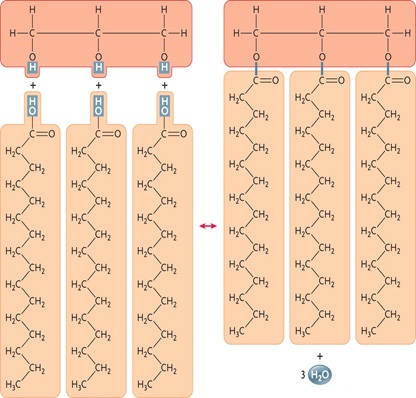 Figure 3.6
The molecule in the accompanying figure is a(n) ____.
Figure 3.6
The molecule in the accompanying figure is a(n) ____. (Multiple Choice)
4.8/5 (84)
(84) Which amino acid can be involved in special covalent "disulfide bridges" that, when present, help to stabilize the tertiary and quaternary structure of proteins?
(Multiple Choice)
4.7/5 (62)
(62) Isomers are two or more molecules with ____ chemical formula and ____ molecular structures.
(Multiple Choice)
4.8/5 (89)
(89) In his experiments, Anfinsen treated a protein with a chemical that broke disulfide bonds and then removed the chemical to see how this would affect the function of the molecule. What did he conclude from these experiments?
(Multiple Choice)
4.9/5 (87)
(87) Waxy coatings, such as those found on skin, hair, and feathers of some animals and the cuticle of some plants, are commonly used by living organisms for protection against water loss and for lubrication. Such waxes are considered to be a type of ____.
(Multiple Choice)
4.8/5 (89)
(89) 
Filters
- Essay(0)
- Multiple Choice(0)
- Short Answer(0)
- True False(0)
- Matching(0)