



 Chat with AI
Exam 28: Liberalism, Civil Rights, and War in Vietnam

Exam 1: Native Peoples of America72 Questions
Exam 2: The Rise of the Atlantic World131 Questions
Exam 3: The Emergence of Colonial Societies119 Questions
Exam 4: The Bonds of Empire106 Questions
Exam 5: Roads to Revolution112 Questions
Exam 6: Securing Independence, Defining Nationhood129 Questions
Exam 7: Launching the New Republic105 Questions
Exam 8: America at War and Peace113 Questions
Exam 9: The Transformation of American Society99 Questions
Exam 10: Democratic Politics, Religious Revival, and Reform106 Questions
Exam 11: Technology, Culture, and Everyday Life103 Questions
Exam 12: The Old South and Slavery105 Questions
Exam 13: Immigration, Expansion, and Sectional Conflict99 Questions
Exam 14: From Compromise to Secession108 Questions
Exam 15: Crucible of Freedom: Civil War129 Questions
Exam 16: Reconstruction and Resistance99 Questions
Exam 17: The Transformation of the Trans-Mississippi West110 Questions
Exam 18: The Rise of Industrial America92 Questions
Exam 19: Immigration, Urbanization, and Everyday Life91 Questions
Exam 20: Politics and Expansion in an Industrializing Age124 Questions
Exam 21: The Progressive Era122 Questions
Exam 22: Global Involvements and World War I105 Questions
Exam 23: Coping With Change101 Questions
Exam 24: The Great Depression and the New Deal107 Questions
Exam 25: Americans and a World in Crisis105 Questions
Exam 26: The Cold War Abroad and at Home121 Questions
Exam 27: America at Midcentury104 Questions
Exam 28: Liberalism, Civil Rights, and War in Vietnam126 Questions
Exam 29: A Time of Upheaval118 Questions
Exam 30: A Conservative Revival and the End of the Cold War156 Questions
Exam 31: A Changing Nation: Homefront Crises and New Global Realities101 Questions
Select questions type


Instructions: Identify the following. Be as specific as possible, and include names, dates, and relevant facts as appropriate. Be sure to explain the significance of the person or term.
Indian Self-Determination Act
(Essay)
5.0/5  (72)
(72) Instructions: Identify the following. Be as specific as possible, and include names, dates, and relevant facts as appropriate. Be sure to explain the significance of the person or term.
Operation Rolling Thunder
(Essay)
4.7/5 (86)
(86) Which of the following was not part of President Richard Nixon's strategy in Southeast Asia?
(Multiple Choice)
4.9/5 (76)
(76) Discuss Lyndon Johnson's vision for a Great Society. To what extent was Johnson able to deliver on his promises? To what extent did he fail? Why?
(Essay)
4.8/5 (81)
(81) Instructions: Identify the following. Be as specific as possible, and include names, dates, and relevant facts as appropriate. Be sure to explain the significance of the person or term.
Tet Offensive
(Short Answer)
4.8/5 (75)
(75) Instructions: Identify the following. Be as specific as possible, and include names, dates, and relevant facts as appropriate. Be sure to explain the significance of the person or term.
Kennedy and Vietnam
(Essay)
4.8/5 (83)
(83) Instructions: Choose the letter on the accompanying map of East Asia that correctly identifies each of the following:
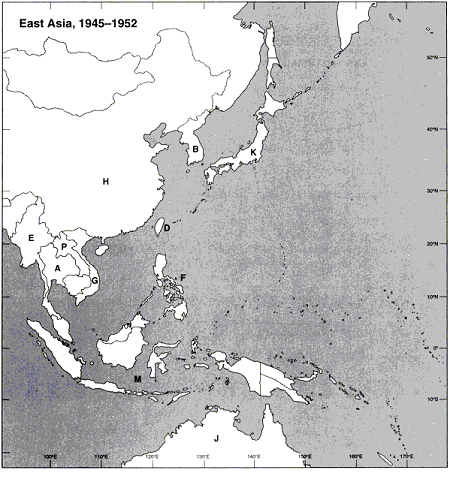 Thailand
 (Short Answer)
5.0/5 (83)
(83) How and why did opposition to the Vietnam War grow? Who supported the war, and who opposed it? What role did student protests play in ending the war?
(Essay)
5.0/5 (69)
(69) Which of the following was an explanation offered for the destructive race riots that swept American cities between 1964 and 1968?
(Multiple Choice)
4.8/5 (90)
(90) Instructions: Identify the following. Be as specific as possible, and include names, dates, and relevant facts as appropriate. Be sure to explain the significance of the person or term.
Malcolm X, Elijah Muhammad
(Short Answer)
4.8/5 (75)
(75) How did Eugene "Bull" Conner help Martin Luther King's civil rights efforts in 1963?
(Multiple Choice)
4.7/5 (81)
(81) MAP QUESTIONS
Instructions: Choose the letter on the accompanying map of Indochina that correctly identifies each of the following:
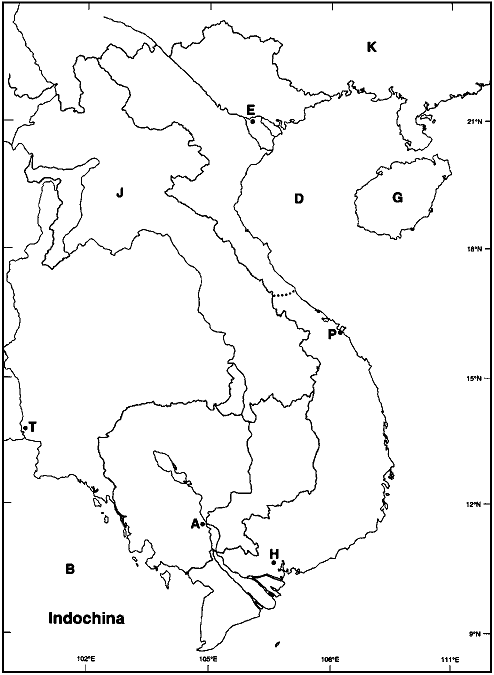 Saigon
 (Short Answer)
4.8/5 (89)
(89) Who was largely responsible for kindling the ethnic pride and solidarity of Mexican-Americans in the 1960s?
(Multiple Choice)
4.9/5 (85)
(85) What impact did the photographic record of the war in Vietnam have? What makes these images so powerful and such successful examples of visual culture? What do they exposeand what goes unstated? How might they have affected public opinion regarding the war?
(Essay)
4.8/5 (73)
(73) Which of the following captures the approach of the Kennedy administration to the issue of civil rights?
(Multiple Choice)
4.8/5 (77)
(77) MAP QUESTIONS
Instructions: Choose the letter on the accompanying map of Indochina that correctly identifies each of the following:
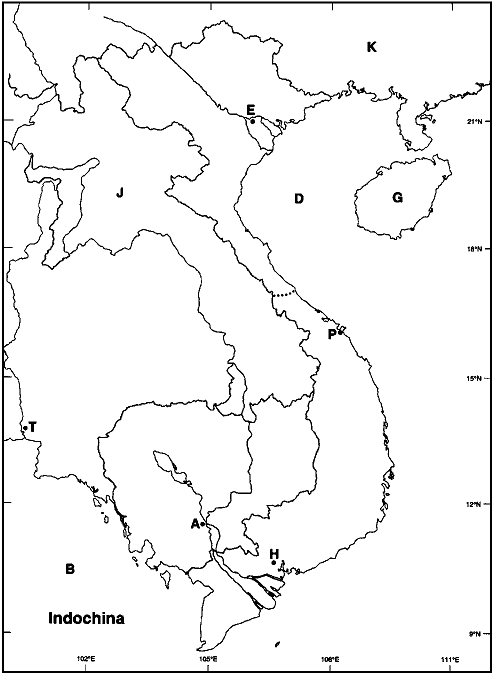 Hanoi
Hanoi (Short Answer)
4.8/5 (68)
(68) 
Filters
- Essay(0)
- Multiple Choice(0)
- Short Answer(0)
- True False(0)
- Matching(0)