



 Chat with AI
Exam 12: The Old South and Slavery

Exam 1: Native Peoples of America72 Questions
Exam 2: The Rise of the Atlantic World131 Questions
Exam 3: The Emergence of Colonial Societies119 Questions
Exam 4: The Bonds of Empire106 Questions
Exam 5: Roads to Revolution112 Questions
Exam 6: Securing Independence, Defining Nationhood129 Questions
Exam 7: Launching the New Republic105 Questions
Exam 8: America at War and Peace113 Questions
Exam 9: The Transformation of American Society99 Questions
Exam 10: Democratic Politics, Religious Revival, and Reform106 Questions
Exam 11: Technology, Culture, and Everyday Life103 Questions
Exam 12: The Old South and Slavery105 Questions
Exam 13: Immigration, Expansion, and Sectional Conflict99 Questions
Exam 14: From Compromise to Secession108 Questions
Exam 15: Crucible of Freedom: Civil War129 Questions
Exam 16: Reconstruction and Resistance99 Questions
Exam 17: The Transformation of the Trans-Mississippi West110 Questions
Exam 18: The Rise of Industrial America92 Questions
Exam 19: Immigration, Urbanization, and Everyday Life91 Questions
Exam 20: Politics and Expansion in an Industrializing Age124 Questions
Exam 21: The Progressive Era122 Questions
Exam 22: Global Involvements and World War I105 Questions
Exam 23: Coping With Change101 Questions
Exam 24: The Great Depression and the New Deal107 Questions
Exam 25: Americans and a World in Crisis105 Questions
Exam 26: The Cold War Abroad and at Home121 Questions
Exam 27: America at Midcentury104 Questions
Exam 28: Liberalism, Civil Rights, and War in Vietnam126 Questions
Exam 29: A Time of Upheaval118 Questions
Exam 30: A Conservative Revival and the End of the Cold War156 Questions
Exam 31: A Changing Nation: Homefront Crises and New Global Realities101 Questions
Select questions type


Instructions: On the accompanying map of the South, draw in lines to indicate the following:
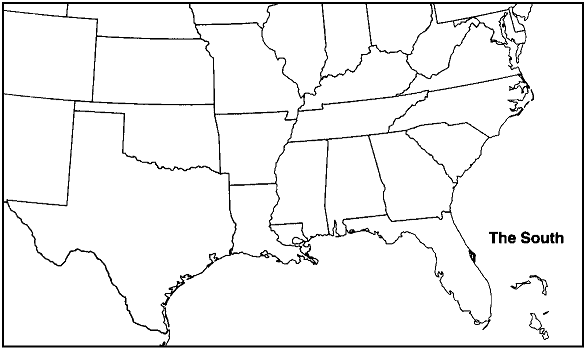 Mississippi River
 (Short Answer)
4.9/5  (74)
(74) How did the rise of cotton cultivation affect the society and economy of the Old South?
(Essay)
4.8/5 (99)
(99) Instructions: Identify the following. Be as specific as possible, and include names, dates, and relevant facts as appropriate. Be sure to explain the significance of the person or term.
People of the pine barrens
(Essay)
4.7/5 (81)
(81) Instructions: Identify the following. Be as specific as possible, and include names, dates, and relevant facts as appropriate. Be sure to explain the significance of the person or term.
Internal Slave Trade
(Essay)
4.8/5 (77)
(77) Which of these reflects the opportunities that cities provided for free blacks in the Old South?
(Multiple Choice)
4.8/5 (67)
(67) Instructions: Identify the following. Be as specific as possible, and include names, dates, and relevant facts as appropriate. Be sure to explain the significance of the person or term.
Hinton R. Helper, The Impending Crisis of the South
(Essay)
4.8/5 (76)
(76) MAP QUESTIONS
Instructions: Choose the letter on the accompanying map of the South that correctly identifies each of the following:
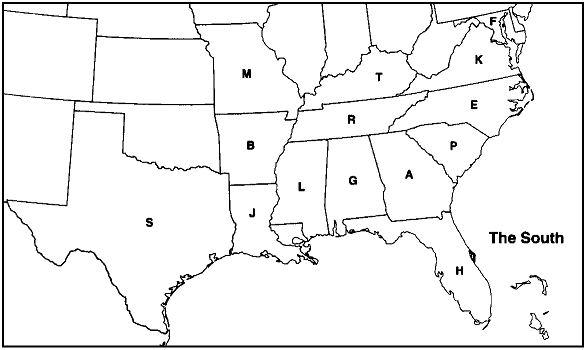 Louisiana
 (Short Answer)
4.7/5 (81)
(81) Instructions: Identify the following. Be as specific as possible, and include names, dates, and relevant facts as appropriate. Be sure to explain the significance of the person or term.
F ree blacks
(Essay)
4.9/5 (85)
(85) The complex code of honor that shaped relationships among elite men in the Old South is defined as
(Multiple Choice)
4.8/5 (79)
(79) Compare and contrast the Upper South with the Lower South. In what ways were they similar and different? Why did they possess a basic political unity that was destined to put them in political opposition to the North?
(Essay)
4.7/5 (69)
(69) Which of the following statements is not an accurate description of slavery?
(Multiple Choice)
4.8/5 (81)
(81) Which of the following is a crop that was not associated with the Upper South?
(Multiple Choice)
4.9/5 (85)
(85) Instructions: Identify the following. Be as specific as possible, and include names, dates, and relevant facts as appropriate. Be sure to explain the significance of the person or term.
Pidgin
(Essay)
4.8/5 (74)
(74) Instructions: Identify the following. Be as specific as possible, and include names, dates, and relevant facts as appropriate. Be sure to explain the significance of the person or term.
Harriet Tubman, Underground Railroad
(Essay)
4.9/5 (74)
(74) What fact of life was the greatest source of sorrow for plantation wives?
(Multiple Choice)
4.8/5 (69)
(69) Compare and contrast the four major southern white social groups in terms of economic goals, attitudes toward slavery, and political aspirations.
(Essay)
4.8/5 (83)
(83) Instructions: Identify the following. Be as specific as possible, and include names, dates, and relevant facts as appropriate. Be sure to explain the significance of the person or term.
Frederick Douglass
(Essay)
4.9/5 (95)
(95) 
Filters
- Essay(0)
- Multiple Choice(0)
- Short Answer(0)
- True False(0)
- Matching(0)