



 Chat with AI
Exam 11: Technology, Culture, and Everyday Life

Exam 1: Native Peoples of America72 Questions
Exam 2: The Rise of the Atlantic World131 Questions
Exam 3: The Emergence of Colonial Societies119 Questions
Exam 4: The Bonds of Empire106 Questions
Exam 5: Roads to Revolution112 Questions
Exam 6: Securing Independence, Defining Nationhood129 Questions
Exam 7: Launching the New Republic105 Questions
Exam 8: America at War and Peace113 Questions
Exam 9: The Transformation of American Society99 Questions
Exam 10: Democratic Politics, Religious Revival, and Reform106 Questions
Exam 11: Technology, Culture, and Everyday Life103 Questions
Exam 12: The Old South and Slavery105 Questions
Exam 13: Immigration, Expansion, and Sectional Conflict99 Questions
Exam 14: From Compromise to Secession108 Questions
Exam 15: Crucible of Freedom: Civil War129 Questions
Exam 16: Reconstruction and Resistance99 Questions
Exam 17: The Transformation of the Trans-Mississippi West110 Questions
Exam 18: The Rise of Industrial America92 Questions
Exam 19: Immigration, Urbanization, and Everyday Life91 Questions
Exam 20: Politics and Expansion in an Industrializing Age124 Questions
Exam 21: The Progressive Era122 Questions
Exam 22: Global Involvements and World War I105 Questions
Exam 23: Coping With Change101 Questions
Exam 24: The Great Depression and the New Deal107 Questions
Exam 25: Americans and a World in Crisis105 Questions
Exam 26: The Cold War Abroad and at Home121 Questions
Exam 27: America at Midcentury104 Questions
Exam 28: Liberalism, Civil Rights, and War in Vietnam126 Questions
Exam 29: A Time of Upheaval118 Questions
Exam 30: A Conservative Revival and the End of the Cold War156 Questions
Exam 31: A Changing Nation: Homefront Crises and New Global Realities101 Questions
Select questions type


Which of the following statements accurately describes railroads in the United States in 1860?
(Multiple Choice)
4.8/5  (81)
(81) Instructions: Identify the following. Be as specific as possible, and include names, dates, and relevant facts as appropriate. Be sure to explain the significance of the person or term.
Edgar Allan Poe
(Essay)
4.9/5 (95)
(95) Instructions: Identify the following. Be as specific as possible, and include names, dates, and relevant facts as appropriate. Be sure to explain the significance of the person or term.
Hudson River school
(Short Answer)
4.9/5 (78)
(78) Instructions: Identify the following. Be as specific as possible, and include names, dates, and relevant facts as appropriate. Be sure to explain the significance of the person or term.
Epidemics
(Essay)
4.8/5 (67)
(67) Instructions: Identify the following. Be as specific as possible, and include names, dates, and relevant facts as appropriate. Be sure to explain the significance of the person or term.
Samuel Colt
(Short Answer)
4.9/5 (77)
(77) MAP QUESTIONS
Instructions: Choose the letter on the accompanying map of the eastern United States that correctly identifies each of the following:
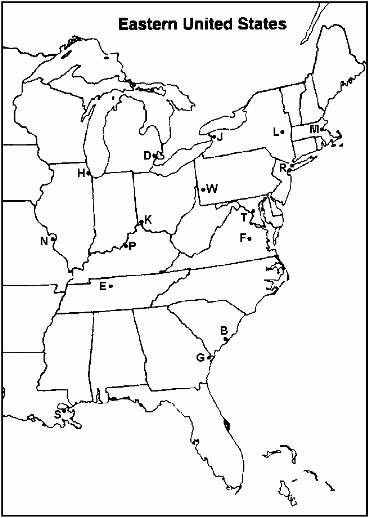 New York, New York
 (Short Answer)
4.8/5 (76)
(76) What technological improvements increased industrial productivity between 1840 and 1860?
(Essay)
5.0/5 (70)
(70) How did home furniture change during the antebellum period?
(Multiple Choice)
4.7/5 (91)
(91) MAP QUESTIONS
Instructions: Choose the letter on the accompanying map of the eastern United States that correctly identifies each of the following:
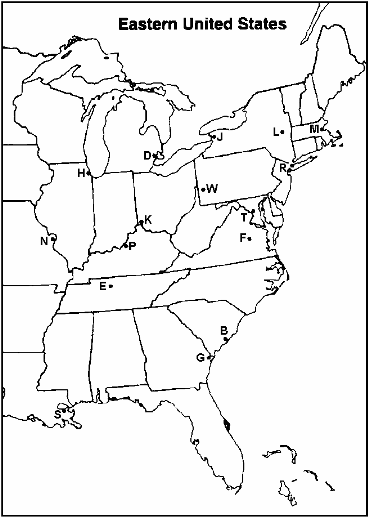 Richmond, Virginia
 (Short Answer)
4.9/5 (94)
(94) How was the building of the railroads in the United States financed?
(Multiple Choice)
4.9/5 (90)
(90) How did railroads grow in the decades before the Civil War? What impact did they have on the economic development of the antebellum United States? In what sense were railroads the nation's first "big business"?
(Essay)
4.9/5 (79)
(79) How did Americans' relationship to and understanding of the land contribute to agricultural innovation in the decades before the Civil War? How did other factors contribute to innovation?
(Essay)
4.8/5 (75)
(75) Instructions: Identify the following. Be as specific as possible, and include names, dates, and relevant facts as appropriate. Be sure to explain the significance of the person or term.
Astor Place Riot
(Short Answer)
4.7/5 (70)
(70) Which of the following statements best captures the attitude of many antebellum Americans about technology?
(Multiple Choice)
4.9/5 (75)
(75) Instructions: Identify the following. Be as specific as possible, and include names, dates, and relevant facts as appropriate. Be sure to explain the significance of the person or term.
Isaac M. Singer
(Short Answer)
4.8/5 (88)
(88) Which of the following was not a popular health or scientific movement in antebellum America?
(Multiple Choice)
4.8/5 (79)
(79) What medical development greatly advanced the image of surgeons and the success of health care in the decades before the Civil War?
(Multiple Choice)
4.8/5 (95)
(95) 
Filters
- Essay(0)
- Multiple Choice(0)
- Short Answer(0)
- True False(0)
- Matching(0)