



 Chat with AI
Exam 10: Democratic Politics, Religious Revival, and Reform

Exam 1: Native Peoples of America72 Questions
Exam 2: The Rise of the Atlantic World131 Questions
Exam 3: The Emergence of Colonial Societies119 Questions
Exam 4: The Bonds of Empire106 Questions
Exam 5: Roads to Revolution112 Questions
Exam 6: Securing Independence, Defining Nationhood129 Questions
Exam 7: Launching the New Republic105 Questions
Exam 8: America at War and Peace113 Questions
Exam 9: The Transformation of American Society99 Questions
Exam 10: Democratic Politics, Religious Revival, and Reform106 Questions
Exam 11: Technology, Culture, and Everyday Life103 Questions
Exam 12: The Old South and Slavery105 Questions
Exam 13: Immigration, Expansion, and Sectional Conflict99 Questions
Exam 14: From Compromise to Secession108 Questions
Exam 15: Crucible of Freedom: Civil War129 Questions
Exam 16: Reconstruction and Resistance99 Questions
Exam 17: The Transformation of the Trans-Mississippi West110 Questions
Exam 18: The Rise of Industrial America92 Questions
Exam 19: Immigration, Urbanization, and Everyday Life91 Questions
Exam 20: Politics and Expansion in an Industrializing Age124 Questions
Exam 21: The Progressive Era122 Questions
Exam 22: Global Involvements and World War I105 Questions
Exam 23: Coping With Change101 Questions
Exam 24: The Great Depression and the New Deal107 Questions
Exam 25: Americans and a World in Crisis105 Questions
Exam 26: The Cold War Abroad and at Home121 Questions
Exam 27: America at Midcentury104 Questions
Exam 28: Liberalism, Civil Rights, and War in Vietnam126 Questions
Exam 29: A Time of Upheaval118 Questions
Exam 30: A Conservative Revival and the End of the Cold War156 Questions
Exam 31: A Changing Nation: Homefront Crises and New Global Realities101 Questions
Select questions type


After 1837, which political party became the anti-bank, hard-money party?
(Multiple Choice)
4.9/5  (67)
(67) Instructions: Identify the following. Be as specific as possible, and include names, dates, and relevant facts as appropriate. Be sure to explain the significance of the person or term.
Second Great Awakening
(Short Answer)
4.8/5 (87)
(87) Instructions: Identify the following. Be as specific as possible, and include names, dates, and relevant facts as appropriate. Be sure to explain the significance of the person or term.
Gag rule
(Short Answer)
4.7/5 (85)
(85) Discuss how religious movements began to remake American society during the Age of Jackson.
(Essay)
4.8/5 (86)
(86) MAP QUESTIONS
Instructions: Choose the letter on the accompanying map of the United States that correctly identifies each of the following:
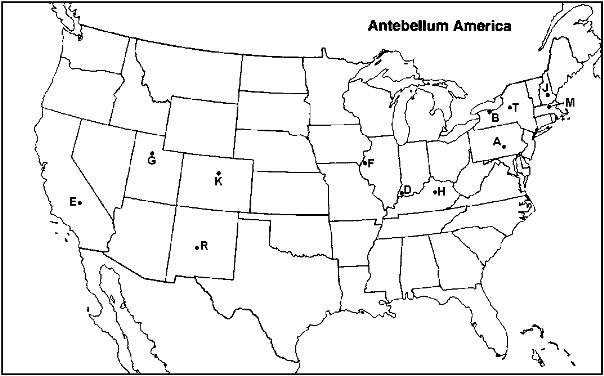 Nauvoo, Illinois
 (Short Answer)
4.8/5 (84)
(84) In his "war" on the Bank of the United States, President Jackson
(Multiple Choice)
4.8/5 (80)
(80) Instructions: Identify the following. Be as specific as possible, and include names, dates, and relevant facts as appropriate. Be sure to explain the significance of the person or term.
Democratic Party
(Short Answer)
4.9/5 (87)
(87) Instructions: Identify the following. Be as specific as possible, and include names, dates, and relevant facts as appropriate. Be sure to explain the significance of the person or term.
Election of 1824
(Essay)
4.8/5 (85)
(85) Instructions: Identify the following. Be as specific as possible, and include names, dates, and relevant facts as appropriate. Be sure to explain the significance of the person or term.
John Humphrey Noyes and Oneida
(Essay)
4.7/5 (72)
(72) What was the main cause of the great increase in the popular vote between the 1836 and 1840 presidential elections?
(Multiple Choice)
4.9/5 (89)
(89) Which sect believed that Jesus was not divine but merely an exemplary human being?
(Multiple Choice)
4.9/5 (86)
(86) How did the democratization of American politics contribute to the rise of Andrew Jackson?
(Essay)
4.9/5 (88)
(88) Instructions: Identify the following. Be as specific as possible, and include names, dates, and relevant facts as appropriate. Be sure to explain the significance of the person or term.
Independent Treasury Act
(Short Answer)
4.9/5 (79)
(79) Women hold their first national women's rights convention in 1848 at
(Multiple Choice)
4.9/5 (77)
(77) What were the reasons for the controversy over the Bank of the United States? Explain both the pro-bank and anti-bank positions. What does the controversy reveal about the American economy, attitudes about business and banking, and the relationship between the economy and the political system?
(Essay)
4.7/5 (78)
(78) 
Filters
- Essay(0)
- Multiple Choice(0)
- Short Answer(0)
- True False(0)
- Matching(0)