



 Chat with AI
Exam 35: The International Monetary System: Order or Disorder

Exam 1: What Is Economics254 Questions
Exam 2: The Economony: Myth and Reality184 Questions
Exam 3: The Fundamental Economic Problem: Scarcity and Choice278 Questions
Exam 4: Supply and Demand: an Initial Look297 Questions
Exam 5: Consumer Choice: Individual and Market Demand213 Questions
Exam 6: Demand and Elasticity247 Questions
Exam 7: Production, Inputs, and Cost: Building Blocks for Supply Analysis246 Questions
Exam 8: Output, Price, and Profit: the Importance of Marginal Analysis232 Questions
Exam 9: The Financial Markets and the Economy: the Tail That Wags the Dog225 Questions
Exam 10: The Firm and the Industry Under Perfect Competition219 Questions
Exam 11: The Case for Free Markets: the Price System251 Questions
Exam 12: Monopoly236 Questions
Exam 13: Between Competition and Monopoly248 Questions
Exam 14: Limiting Market Power: Antitrust and Regulation152 Questions
Exam 15: The Shortcomings of Free Markets210 Questions
Exam 16: The Economics of the Environment, and Natural Resources218 Questions
Exam 17: Taxation and Resource Allocation218 Questions
Exam 18: Pricing the Factors of Production230 Questions
Exam 19: Labor and Entrepreneurship: the Human Inputs267 Questions
Exam 20: Poverty, Inequality, and Discrimination167 Questions
Exam 21: An Introduction to Macroeconomics212 Questions
Exam 22: The Goals of Macroeconomic Policy212 Questions
Exam 23: Economic Growth: Theory and Policy226 Questions
Exam 24: Aggregate Demand and the Powerful Consumer216 Questions
Exam 25: Demand-Side Equilibrium: Unemployment or Inflation215 Questions
Exam 26: Bringing in the Supply Side: Unemployment and Inflation228 Questions
Exam 27: Managing Aggregate Demand: Fiscal Policy207 Questions
Exam 28: Money and the Banking System222 Questions
Exam 29: Monetary Policy: Conventional and Unconventional208 Questions
Exam 30: The Financial Crisis and the Great Recession64 Questions
Exam 31: The Debate Over Monetary and Fiscal Policy216 Questions
Exam 32: Budget Deficits in the Short and Long Run214 Questions
Exam 33: The Trade-Off Between Inflation and Unemployment218 Questions
Exam 34: International Trade and Comparative Advantage215 Questions
Exam 35: The International Monetary System: Order or Disorder216 Questions
Exam 36: Exchange Rates and the Macroeconomy215 Questions
Exam 37: Contemporary Issues in the Useconomy23 Questions
Select questions type


Who among the following is most likely to favor an appreciation of the U.S.dollar?
(Multiple Choice)
4.9/5  (79)
(79) Which of the following would cause a decrease in the demand for U.S.dollars?
(Multiple Choice)
4.8/5 (101)
(101) In the spring of 2002, Argentina was forced to devalue its peso and disband its currency board that was responsible for the fixed exchange rate between the peso and the U.S.dollar.Explain the origin of this crisis and the painful remedies that Argentina has had to endure.
(Essay)
4.9/5 (64)
(64) If gold and the dollar are substitutes, a cut in the Japanese discount rate can be expected to
(Multiple Choice)
4.8/5 (76)
(76) On May 12, 2011, it cost U.S.$.04 to buy 1 Russian ruble.How many Russian rubles would U.S.$1 buy?
(Multiple Choice)
4.9/5 (91)
(91) Because central banks intervene in currency markets, the term ____ has been used to describe the system.
(Multiple Choice)
4.8/5 (83)
(83) Figure 19-2
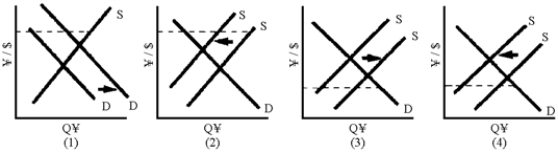 -Of the graphs in Figure 19-2, where the broken line represents the fixed exchange rate, which one shows a reduction in the price level in Japan that would reduce a balance of payments deficit?
 (Multiple Choice)
5.0/5 (78)
(78) Figure 19-1
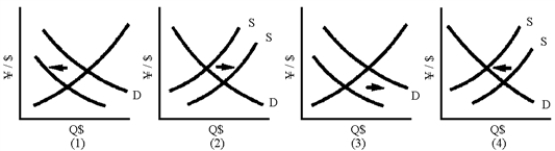 -Of the graphs in Figure 19-1, which one shows the effects of an economic boom in the United States and a depreciation of the dollar?
 (Multiple Choice)
4.9/5 (68)
(68) The principal result of the rising value of the U.S.dollar in the mid-1990s was a(n)
(Multiple Choice)
4.8/5 (80)
(80) What is the euro and why has it been created? How has its value changed relative to the U.S.dollar since its inception?
(Essay)
4.8/5 (90)
(90) The current account balance includes international purchases and sales of goods and services, cross-border interest and dividend payments, and cross-border gifts to and from both private individuals and governments.It is approximately the same as net exports.
(True/False)
4.9/5 (72)
(72) Floating exchange rates are rates determined in free markets by the law of supply and demand.
(True/False)
4.8/5 (80)
(80) On June 3, 2005, it cost 1.22 U.S.dollars to buy 1 euro.How many euros did it take to buy 1 U.S.dollar?
(Multiple Choice)
4.9/5 (85)
(85) If a Mexican pension fund decides to purchase U.S.government bonds, what is the effect in the foreign-exchange market?
(Multiple Choice)
4.8/5 (85)
(85) Figure 19-1
-Of the graphs in Figure 19-1, which one shows that an expansion of the Japanese economy leads to a depreciation of the yen?
-Of the graphs in Figure 19-1, which one shows that an expansion of the Japanese economy leads to a depreciation of the yen? (Multiple Choice)
4.9/5 (74)
(74) If nations erect tariffs and quotas to restrict trade, what is likely to happen to predicted values of currencies drawn from the purchasing power parity theory?
(Multiple Choice)
4.8/5 (67)
(67) As the U.S.dollar's foreign-exchange value falls, we should expect to see
(Multiple Choice)
4.8/5 (93)
(93) The current role of the International Monetary Fund is one of
(Multiple Choice)
4.8/5 (83)
(83) 
Filters
- Essay(0)
- Multiple Choice(0)
- Short Answer(0)
- True False(0)
- Matching(0)