



 Chat with AI
Exam 35: The International Monetary System: Order or Disorder

Exam 1: What Is Economics254 Questions
Exam 2: The Economony: Myth and Reality184 Questions
Exam 3: The Fundamental Economic Problem: Scarcity and Choice278 Questions
Exam 4: Supply and Demand: an Initial Look297 Questions
Exam 5: Consumer Choice: Individual and Market Demand213 Questions
Exam 6: Demand and Elasticity247 Questions
Exam 7: Production, Inputs, and Cost: Building Blocks for Supply Analysis246 Questions
Exam 8: Output, Price, and Profit: the Importance of Marginal Analysis232 Questions
Exam 9: The Financial Markets and the Economy: the Tail That Wags the Dog225 Questions
Exam 10: The Firm and the Industry Under Perfect Competition219 Questions
Exam 11: The Case for Free Markets: the Price System251 Questions
Exam 12: Monopoly236 Questions
Exam 13: Between Competition and Monopoly248 Questions
Exam 14: Limiting Market Power: Antitrust and Regulation152 Questions
Exam 15: The Shortcomings of Free Markets210 Questions
Exam 16: The Economics of the Environment, and Natural Resources218 Questions
Exam 17: Taxation and Resource Allocation218 Questions
Exam 18: Pricing the Factors of Production230 Questions
Exam 19: Labor and Entrepreneurship: the Human Inputs267 Questions
Exam 20: Poverty, Inequality, and Discrimination167 Questions
Exam 21: An Introduction to Macroeconomics212 Questions
Exam 22: The Goals of Macroeconomic Policy212 Questions
Exam 23: Economic Growth: Theory and Policy226 Questions
Exam 24: Aggregate Demand and the Powerful Consumer216 Questions
Exam 25: Demand-Side Equilibrium: Unemployment or Inflation215 Questions
Exam 26: Bringing in the Supply Side: Unemployment and Inflation228 Questions
Exam 27: Managing Aggregate Demand: Fiscal Policy207 Questions
Exam 28: Money and the Banking System222 Questions
Exam 29: Monetary Policy: Conventional and Unconventional208 Questions
Exam 30: The Financial Crisis and the Great Recession64 Questions
Exam 31: The Debate Over Monetary and Fiscal Policy216 Questions
Exam 32: Budget Deficits in the Short and Long Run214 Questions
Exam 33: The Trade-Off Between Inflation and Unemployment218 Questions
Exam 34: International Trade and Comparative Advantage215 Questions
Exam 35: The International Monetary System: Order or Disorder216 Questions
Exam 36: Exchange Rates and the Macroeconomy215 Questions
Exam 37: Contemporary Issues in the Useconomy23 Questions
Select questions type


In the long run, the chief determinant of exchange rate changes is a change in
(Multiple Choice)
4.9/5  (87)
(87) One major reason why the purchasing power parity theory does not always predict exchange rates accurately is that the theory focuses on trade in
(Multiple Choice)
4.8/5 (72)
(72) A federal deficit that raises interest rates will, everything else being equal,
(Multiple Choice)
4.8/5 (75)
(75) If a currency decreases in value in response to market forces, this process is known as
(Multiple Choice)
5.0/5 (82)
(82) The gold standard prevented a nation from controlling its domestic economy through monetary policy.
(True/False)
4.8/5 (85)
(85) If the United States experiences an economic boom, compared to other countries, how will this affect the value of the U.S.dollar?
(Multiple Choice)
4.8/5 (81)
(81) The currency value of Agraria is set by government decree.Which of the following happens when the government alters the exchange rate so that its currency can buy more units of foreign currency?
(Multiple Choice)
4.9/5 (88)
(88) A deficit nation in a fixed exchange rate system can improve its balance of payments by increasing
(Multiple Choice)
4.8/5 (93)
(93) Figure 19-3
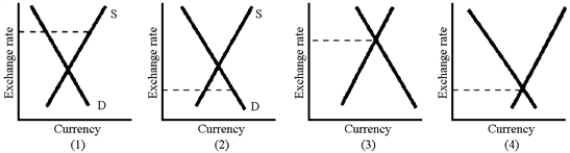 -Of the graphs in Figure 19-3, where the dotted line shows the actual exchange rate, which one shows a country with an undervalued currency and a balance of trade surplus?
 (Multiple Choice)
4.8/5 (68)
(68) Everything else being equal, one can expect the euro to appreciate relative to the dollar if
(Multiple Choice)
4.9/5 (85)
(85) The prospect of a recession in the United States would probably cause the dollar to
(Multiple Choice)
4.9/5 (79)
(79) Why is the international financial system today often called a "nonsystem"?
(Essay)
4.8/5 (76)
(76) If Wisconsin cheddar cheese sells for $3.00 per pound in the United States and for 27.90 pesos in Mexico, what is the exchange rate between the dollar and the peso (assuming PPP holds)?
(Multiple Choice)
5.0/5 (79)
(79) If Japanese tourists visit Yellowstone Park, what is the effect in the foreign-exchange market?
(Multiple Choice)
4.8/5 (83)
(83) A country, such as Argentina in 2002, that is buying its own currency to maintain a given exchange rate
(Multiple Choice)
4.7/5 (72)
(72) The decline in the value of the dollar from 1985 to 1988 was beneficial to
(Multiple Choice)
4.7/5 (78)
(78) 
Filters
- Essay(0)
- Multiple Choice(0)
- Short Answer(0)
- True False(0)
- Matching(0)