



 Chat with AI
Exam 10: Gene Control

Exam 1: Invitation to Biology80 Questions
Exam 2: Lifes Chemical Basis53 Questions
Exam 3: Molecules of Life62 Questions
Exam 4: Cell Structure and Function80 Questions
Exam 5: Ground Rules of Metabolism58 Questions
Exam 6: Where It Startsphotosynthesis57 Questions
Exam 7: How Cells Release Chemical Energy60 Questions
Exam 8: Dna Structure and Function60 Questions
Exam 9: From Dna to Protein64 Questions
Exam 10: Gene Control64 Questions
Exam 11: How Cells Reproduce77 Questions
Exam 12: Meiosis and Sexual Reproduction58 Questions
Exam 13: Observing Patterns in Inherited Traits97 Questions
Exam 14: Chromosomes and Human Inheritance74 Questions
Exam 15: Studying and Manipulating Genomes57 Questions
Exam 16: Evidence of Evolution53 Questions
Exam 17: Processes of Evolution72 Questions
Exam 18: Organizing Information About Species46 Questions
Exam 19: Lifes Origin and Early Evolution60 Questions
Exam 20: Viruses and Prokaryotes56 Questions
Exam 21: Protiststhe Simplest Eukaryotes61 Questions
Exam 22: The Land Plants66 Questions
Exam 23: Fungi52 Questions
Exam 24: Animal Evolutionthe Invertebrates74 Questions
Exam 25: Animal Evolutionthe Chordates71 Questions
Exam 26: Animal Evolutionhuman Evolution51 Questions
Exam 27: Plant Tissues79 Questions
Exam 28: Plant Nutrition and Transport68 Questions
Exam 29: Life Cycles of Flowering Plants88 Questions
Exam 30: Communication Strategies in Plants72 Questions
Exam 31: Animal Tissues and Organ Systems77 Questions
Exam 32: Neural Control96 Questions
Exam 33: Sensory Perception71 Questions
Exam 34: Endocrine Control91 Questions
Exam 35: Structural Support and Movement72 Questions
Exam 36: Circulation58 Questions
Exam 37: Immunity73 Questions
Exam 38: Respiration78 Questions
Exam 39: Digestion and Nutrition98 Questions
Exam 40: Maintaining the Internal Environment73 Questions
Exam 41: Animal Reproductive Systems105 Questions
Exam 42: Animal Development69 Questions
Exam 43: Animal Behavior74 Questions
Exam 44: Population Ecology59 Questions
Exam 45: Community Ecology71 Questions
Exam 46: Ecosystems63 Questions
Exam 47: The Biosphere72 Questions
Exam 48: Human Impacts on the Biosphere62 Questions
Select questions type


Classification.Choose the proper item below for the following statements.
a.operon
b.operator
c.promoter
d.lactose
e.regulator gene
-When the repressor is inactivated, RNA polymerase can bind to this item and allow transcription to occur.
(Essay)
4.7/5  (73)
(73) When cells stop responding to normal controls over growth and division they
(Multiple Choice)
4.9/5 (99)
(99) Classification.Choose the proper item below for the following statements.
a.operon
b.operator
c.promoter
d.lactose
e.regulator gene
-This item contains regulator, promoter, and operator regions.
(Essay)
4.9/5 (84)
(84) MATCHING
Choose the one most appropriate answer for each.
a.a condensed X chromosome
b.protein that combines with DNA all along its length
c.attaches or detaches from operator to regulate transcription
d.portion of the operon that binds RNA polymerase
e.gene capable of inducing cancerous transformations
f.genes controlling the development of the body plan
g.the mutated form is associated with breast cancer
h.binding sites on DNA where certain regulatory proteins increase transcription rates
-oncogene
(Essay)
4.8/5 (78)
(78) In the ABC model of flower development in Arabidopsis thaliana, sepals form when gene(s) ____ is(are) switched on.
(Multiple Choice)
4.8/5 (70)
(70) 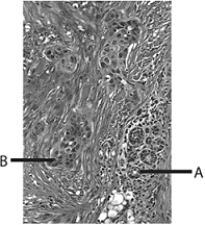 -Which letter in the above figure represents breast cancer?
 (Multiple Choice)
4.9/5 (92)
(92) MATCHING
Choose the one most appropriate answer for each.
a.a condensed X chromosome
b.protein that combines with DNA all along its length
c.attaches or detaches from operator to regulate transcription
d.portion of the operon that binds RNA polymerase
e.gene capable of inducing cancerous transformations
f.genes controlling the development of the body plan
g.the mutated form is associated with breast cancer
h.binding sites on DNA where certain regulatory proteins increase transcription rates
-transcriptional control
(Essay)
5.0/5 (81)
(81) Adding acetyl groups makes genes accessible to transcription by
(Multiple Choice)
4.8/5 (76)
(76) MATCHING
Choose the one most appropriate answer for each.
a.a condensed X chromosome
b.protein that combines with DNA all along its length
c.attaches or detaches from operator to regulate transcription
d.portion of the operon that binds RNA polymerase
e.gene capable of inducing cancerous transformations
f.genes controlling the development of the body plan
g.the mutated form is associated with breast cancer
h.binding sites on DNA where certain regulatory proteins increase transcription rates
-repressor protein
(Essay)
4.9/5 (91)
(91) Which of the following accounts for the negative control of operons?
(Multiple Choice)
4.8/5 (96)
(96) Genes located in cells in different regions of the body during embryonic development may
(Multiple Choice)
4.8/5 (86)
(86) MATCHING
Choose the one most appropriate answer for each.
a.a condensed X chromosome
b.protein that combines with DNA all along its length
c.attaches or detaches from operator to regulate transcription
d.portion of the operon that binds RNA polymerase
e.gene capable of inducing cancerous transformations
f.genes controlling the development of the body plan
g.the mutated form is associated with breast cancer
h.binding sites on DNA where certain regulatory proteins increase transcription rates
-homeotic genes
(Essay)
4.9/5 (87)
(87) Mutation of the A group gene in Arabidopsis thaliana affects development in its flower's
(Multiple Choice)
4.7/5 (92)
(92) Classification.Choose the proper item below for the following statements.
a.operon
b.operator
c.promoter
d.lactose
e.regulator gene
-What is the most efficient way to regulate gene expression from the perspective of cellular resources?
(Essay)
4.8/5 (84)
(84) 
Filters
- Essay(0)
- Multiple Choice(0)
- Short Answer(0)
- True False(0)
- Matching(0)