



 Chat with AI
Exam 14: Chromosomes and Human Inheritance

Exam 1: Invitation to Biology80 Questions
Exam 2: Lifes Chemical Basis53 Questions
Exam 3: Molecules of Life62 Questions
Exam 4: Cell Structure and Function80 Questions
Exam 5: Ground Rules of Metabolism58 Questions
Exam 6: Where It Startsphotosynthesis57 Questions
Exam 7: How Cells Release Chemical Energy60 Questions
Exam 8: Dna Structure and Function60 Questions
Exam 9: From Dna to Protein64 Questions
Exam 10: Gene Control64 Questions
Exam 11: How Cells Reproduce77 Questions
Exam 12: Meiosis and Sexual Reproduction58 Questions
Exam 13: Observing Patterns in Inherited Traits97 Questions
Exam 14: Chromosomes and Human Inheritance74 Questions
Exam 15: Studying and Manipulating Genomes57 Questions
Exam 16: Evidence of Evolution53 Questions
Exam 17: Processes of Evolution72 Questions
Exam 18: Organizing Information About Species46 Questions
Exam 19: Lifes Origin and Early Evolution60 Questions
Exam 20: Viruses and Prokaryotes56 Questions
Exam 21: Protiststhe Simplest Eukaryotes61 Questions
Exam 22: The Land Plants66 Questions
Exam 23: Fungi52 Questions
Exam 24: Animal Evolutionthe Invertebrates74 Questions
Exam 25: Animal Evolutionthe Chordates71 Questions
Exam 26: Animal Evolutionhuman Evolution51 Questions
Exam 27: Plant Tissues79 Questions
Exam 28: Plant Nutrition and Transport68 Questions
Exam 29: Life Cycles of Flowering Plants88 Questions
Exam 30: Communication Strategies in Plants72 Questions
Exam 31: Animal Tissues and Organ Systems77 Questions
Exam 32: Neural Control96 Questions
Exam 33: Sensory Perception71 Questions
Exam 34: Endocrine Control91 Questions
Exam 35: Structural Support and Movement72 Questions
Exam 36: Circulation58 Questions
Exam 37: Immunity73 Questions
Exam 38: Respiration78 Questions
Exam 39: Digestion and Nutrition98 Questions
Exam 40: Maintaining the Internal Environment73 Questions
Exam 41: Animal Reproductive Systems105 Questions
Exam 42: Animal Development69 Questions
Exam 43: Animal Behavior74 Questions
Exam 44: Population Ecology59 Questions
Exam 45: Community Ecology71 Questions
Exam 46: Ecosystems63 Questions
Exam 47: The Biosphere72 Questions
Exam 48: Human Impacts on the Biosphere62 Questions
Select questions type


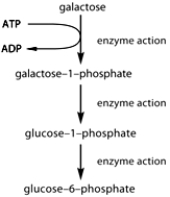 -The probability of producing a normal child by two parents who are carriers for an autosomal recessive disorder is
 (Multiple Choice)
4.9/5  (79)
(79)  -Which of the following is the genetic condition observed in the middle person from the above figure?
 (Multiple Choice)
4.9/5 (78)
(78) How did the cessation of crossing-over contribute to the disparity between the X and Y chromosomes?
(Essay)
4.8/5 (79)
(79) MATCHING
Matching.Choose the most appropriate answer for each.
a.3n; generally sterile
b.a chromosome segment is permanently transferred to a nonhomologous chromosome
c.(2n - 1); a zygote deprived of a chromosome
d.a repeat of a particular DNA sequence in the same chromosome or in nonhomologous ones
e.(2n + 1); three chromosomes of the same kind are present in a set of chromosomes
f.a piece of the chromosome is inadvertently left out during the repair process
g.inhibits microtubule assembly; used in karyotyping
h.a chromosome segment that has been cut out and rejoined at the same place, but backward
-inversion
(Essay)
4.9/5 (90)
(90) Classification.Select the best process listed below for each of the following statements.Note that you need to know that the sequence of amino acids directly reflects the sequence of genes that coded for their placement.
a.an inversion
b.a deletion
c.a gene duplication
d.a translocation
e.an addition
-Homologous sets of genes ABCDEF and aBCdEF are located on nonhomologous chromosomes.Crossing over between them is suppressed because their locations are the result of this.
(Essay)
4.8/5 (78)
(78) Classification.Select the best disorder listed below to match the following statements.
a.Galactosemia
b.Turner syndrome
c.Klinefelter's syndrome
d.hemophilia A
e.Down syndrome
-If an X-linked recessive gene is expressed in 4 percent of the men, what proportion of women would express the recessive trait?
(Essay)
4.9/5 (69)
(69) Classification.Select the best process listed below for each of the following statements.Note that you need to know that the sequence of amino acids directly reflects the sequence of genes that coded for their placement.
a.an inversion
b.a deletion
c.a gene duplication
d.a translocation
e.an addition
-The nucleotide sequences of homologous regions of DNA of two species are AATGCCCCGTTA and AATGCCCCGCTTA.If this is not the result of a nucleotide base-pair addition, then it is most likely the result of this.
(Essay)
4.8/5 (88)
(88) The sex chromosome composition of a person with Klinefelter syndrome is
(Multiple Choice)
4.8/5 (81)
(81) Classification.Select the best process listed below for each of the following statements.Note that you need to know that the sequence of amino acids directly reflects the sequence of genes that coded for their placement.
a.an inversion
b.a deletion
c.a gene duplication
d.a translocation
e.an addition
-A small region of a protein from three species is sequenced and found to be as follows:
species X is alanine, valine, threonine, alanine
species Y is alanine, glycine, threonine, alanine
species Z is alanine, valine, glycine, threonine, alanine
The difference in the amino acid sequence of species Z is most likely due to this.
(Essay)
4.9/5 (86)
(86) Classification.Select the best disorder listed below to match the following statements.
a.Galactosemia
b.Turner syndrome
c.Klinefelter's syndrome
d.hemophilia A
e.Down syndrome
-This disorder is due to a sex chromosome abnormality probably caused by nondisjunction of sex chromosomes at meiosis.
(Essay)
4.9/5 (85)
(85) Which of the following is a transfer of genes between non-homologous chromosomes?
(Multiple Choice)
4.9/5 (74)
(74) Classification.Answer the following questions in reference to the five items listed below.
a.12
b.23
c.24
d.46
e.47
-Following a gene duplication event involving only five loci, how many chromosomes will a human female have?
(Essay)
4.8/5 (91)
(91) A woman heterozygous for color blindness (an X-linked recessive allele) marries a man with normal color vision.What is the probability that their first child will be color blind?
(Multiple Choice)
4.9/5 (85)
(85) It is now possible to analyze the genetics of the new generation by
(Multiple Choice)
4.9/5 (95)
(95) Classification.Select the best disorder listed below to match the following statements.
a.Galactosemia
b.Turner syndrome
c.Klinefelter's syndrome
d.hemophilia A
e.Down syndrome
-For this disorder, both a phenotypic cure and a genotypic cure are potentially possible.
(Essay)
4.7/5 (61)
(61) Symptoms of phenylketonuria (PKU) may be minimized or suppressed by a diet low in
(Multiple Choice)
4.8/5 (89)
(89) 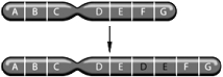 -The above figure represents which of the following chromosomal changes:
 (Multiple Choice)
4.8/5 (71)
(71) Classification.Select the best disorder listed below to match the following statements.
a.Galactosemia
b.Turner syndrome
c.Klinefelter's syndrome
d.hemophilia A
e.Down syndrome
-An X-linked recessive gene (c) produces red-green color blindness.A normal woman whose father was color blind marries a color-blind man.
(a)
What are the possible genotypes for the mother of the color-blind man?
(b)
What are the possible genotypes for the father of the color-blind man?
(c)
What are the chances that the first son will be color blind?
(d)
What are the chances that the first daughter will be color blind?
(Essay)
4.8/5 (82)
(82) Which of the following is most logical from a health perspective?
(Multiple Choice)
5.0/5 (75)
(75) 
Filters
- Essay(0)
- Multiple Choice(0)
- Short Answer(0)
- True False(0)
- Matching(0)