



 Chat with AI
Exam 19: Lifes Origin and Early Evolution

Exam 1: Invitation to Biology80 Questions
Exam 2: Lifes Chemical Basis53 Questions
Exam 3: Molecules of Life62 Questions
Exam 4: Cell Structure and Function80 Questions
Exam 5: Ground Rules of Metabolism58 Questions
Exam 6: Where It Startsphotosynthesis57 Questions
Exam 7: How Cells Release Chemical Energy60 Questions
Exam 8: Dna Structure and Function60 Questions
Exam 9: From Dna to Protein64 Questions
Exam 10: Gene Control64 Questions
Exam 11: How Cells Reproduce77 Questions
Exam 12: Meiosis and Sexual Reproduction58 Questions
Exam 13: Observing Patterns in Inherited Traits97 Questions
Exam 14: Chromosomes and Human Inheritance74 Questions
Exam 15: Studying and Manipulating Genomes57 Questions
Exam 16: Evidence of Evolution53 Questions
Exam 17: Processes of Evolution72 Questions
Exam 18: Organizing Information About Species46 Questions
Exam 19: Lifes Origin and Early Evolution60 Questions
Exam 20: Viruses and Prokaryotes56 Questions
Exam 21: Protiststhe Simplest Eukaryotes61 Questions
Exam 22: The Land Plants66 Questions
Exam 23: Fungi52 Questions
Exam 24: Animal Evolutionthe Invertebrates74 Questions
Exam 25: Animal Evolutionthe Chordates71 Questions
Exam 26: Animal Evolutionhuman Evolution51 Questions
Exam 27: Plant Tissues79 Questions
Exam 28: Plant Nutrition and Transport68 Questions
Exam 29: Life Cycles of Flowering Plants88 Questions
Exam 30: Communication Strategies in Plants72 Questions
Exam 31: Animal Tissues and Organ Systems77 Questions
Exam 32: Neural Control96 Questions
Exam 33: Sensory Perception71 Questions
Exam 34: Endocrine Control91 Questions
Exam 35: Structural Support and Movement72 Questions
Exam 36: Circulation58 Questions
Exam 37: Immunity73 Questions
Exam 38: Respiration78 Questions
Exam 39: Digestion and Nutrition98 Questions
Exam 40: Maintaining the Internal Environment73 Questions
Exam 41: Animal Reproductive Systems105 Questions
Exam 42: Animal Development69 Questions
Exam 43: Animal Behavior74 Questions
Exam 44: Population Ecology59 Questions
Exam 45: Community Ecology71 Questions
Exam 46: Ecosystems63 Questions
Exam 47: The Biosphere72 Questions
Exam 48: Human Impacts on the Biosphere62 Questions
Select questions type


DNA replaced RNA as the main information molecule probably because
(Multiple Choice)
4.9/5  (90)
(90) Provide evidence to both support and refute the current existence of life on Mars?
(Essay)
5.0/5 (95)
(95) The by-product of the metabolism of cyanobacteria that had the most effect on the further evolution of life is
(Multiple Choice)
4.9/5 (78)
(78) The endomembrane system did not start developing until the atmosphere was
(Multiple Choice)
4.9/5 (70)
(70) Membrane-like structures form when proteins or lipids are mixed with water.They serve as a model for __________, which may have preceded cells.
(Essay)
4.7/5 (66)
(66) Classification.Choose the proper item below for the following statements.
a.Thomas Brock
b.Stanley Miller
c.Kwang Jeon
d.Lynn Margulis
e.Oliver Hardy
-He/she very early provided experimental evidence for endosymbiosis.
(Essay)
4.9/5 (90)
(90) MATCHING
Matching.Choose the most appropriate letter.
a.contain DNA, but may be too small to be alive
b.simple transitional forms between early organic compounds and the first living cells
c.red alga resident of hot springs
d.first organisms with the noncyclic pathway of photosynthesis
e.source of the heat-resistant enzyme used in PCR
f.offered support for endosymbiosis
g.dome-shaped fossil remains of photoautotrophic bacteria (some nonfossil structures also form).
h.protist with photosynthetic organelles that resemble cyanobacteria
i.earliest known organism that can be assigned to a modern group
-Cyanidium caldarium
(Essay)
4.9/5 (84)
(84) MATCHING
Matching.Choose the most appropriate letter.
a.contain DNA, but may be too small to be alive
b.simple transitional forms between early organic compounds and the first living cells
c.red alga resident of hot springs
d.first organisms with the noncyclic pathway of photosynthesis
e.source of the heat-resistant enzyme used in PCR
f.offered support for endosymbiosis
g.dome-shaped fossil remains of photoautotrophic bacteria (some nonfossil structures also form).
h.protist with photosynthetic organelles that resemble cyanobacteria
i.earliest known organism that can be assigned to a modern group
-nanobes
(Essay)
4.8/5 (74)
(74) 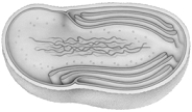 -The figure above represents
MATCHING
Matching.Choose the most appropriate letter.
a.contain DNA, but may be too small to be alive
b.simple transitional forms between early organic compounds and the first living cells
c.red alga resident of hot springs
d.first organisms with the noncyclic pathway of photosynthesis
e.source of the heat-resistant enzyme used in PCR
f.offered support for endosymbiosis
g.dome-shaped fossil remains of photoautotrophic bacteria (some nonfossil structures also form).
h.protist with photosynthetic organelles that resemble cyanobacteria
i.earliest known organism that can be assigned to a modern group
-Bangiomorpha pubescens
(Essay)
5.0/5 (100)
(100) Which of the following is the probable basis for the evolution of mitochondria and chloroplasts?
(Multiple Choice)
4.9/5 (88)
(88) Miller's reaction chamber contained gases intended to simulate the atmosphere of the ancient Earth.Which of the following gases was NOT included?
(Multiple Choice)
4.8/5 (72)
(72) Proteins that speed metabolic reactions might have first formed when reactants could have begun interacting inside tiny holes in rocks near deep-sea __________.
(Essay)
4.8/5 (83)
(83) During the first major divergence of life the atmosphere was
(Multiple Choice)
4.8/5 (76)
(76) 
Filters
- Essay(0)
- Multiple Choice(0)
- Short Answer(0)
- True False(0)
- Matching(0)