



 Chat with AI
Exam 22: The Land Plants

Exam 1: Invitation to Biology80 Questions
Exam 2: Lifes Chemical Basis53 Questions
Exam 3: Molecules of Life62 Questions
Exam 4: Cell Structure and Function80 Questions
Exam 5: Ground Rules of Metabolism58 Questions
Exam 6: Where It Startsphotosynthesis57 Questions
Exam 7: How Cells Release Chemical Energy60 Questions
Exam 8: Dna Structure and Function60 Questions
Exam 9: From Dna to Protein64 Questions
Exam 10: Gene Control64 Questions
Exam 11: How Cells Reproduce77 Questions
Exam 12: Meiosis and Sexual Reproduction58 Questions
Exam 13: Observing Patterns in Inherited Traits97 Questions
Exam 14: Chromosomes and Human Inheritance74 Questions
Exam 15: Studying and Manipulating Genomes57 Questions
Exam 16: Evidence of Evolution53 Questions
Exam 17: Processes of Evolution72 Questions
Exam 18: Organizing Information About Species46 Questions
Exam 19: Lifes Origin and Early Evolution60 Questions
Exam 20: Viruses and Prokaryotes56 Questions
Exam 21: Protiststhe Simplest Eukaryotes61 Questions
Exam 22: The Land Plants66 Questions
Exam 23: Fungi52 Questions
Exam 24: Animal Evolutionthe Invertebrates74 Questions
Exam 25: Animal Evolutionthe Chordates71 Questions
Exam 26: Animal Evolutionhuman Evolution51 Questions
Exam 27: Plant Tissues79 Questions
Exam 28: Plant Nutrition and Transport68 Questions
Exam 29: Life Cycles of Flowering Plants88 Questions
Exam 30: Communication Strategies in Plants72 Questions
Exam 31: Animal Tissues and Organ Systems77 Questions
Exam 32: Neural Control96 Questions
Exam 33: Sensory Perception71 Questions
Exam 34: Endocrine Control91 Questions
Exam 35: Structural Support and Movement72 Questions
Exam 36: Circulation58 Questions
Exam 37: Immunity73 Questions
Exam 38: Respiration78 Questions
Exam 39: Digestion and Nutrition98 Questions
Exam 40: Maintaining the Internal Environment73 Questions
Exam 41: Animal Reproductive Systems105 Questions
Exam 42: Animal Development69 Questions
Exam 43: Animal Behavior74 Questions
Exam 44: Population Ecology59 Questions
Exam 45: Community Ecology71 Questions
Exam 46: Ecosystems63 Questions
Exam 47: The Biosphere72 Questions
Exam 48: Human Impacts on the Biosphere62 Questions
Select questions type


Which of the following parts of angiosperms is not a food source?
(Multiple Choice)
4.8/5  (78)
(78) Classification.Answer the following questions in reference to the five divisions of vascular plants listed below.
a.lycophytes
b.bryophytes
c.monocots
d.conifers
e.eudicots
-Members of this group are heterosporous with well-developed seed and pollen-bearing cones.
(Essay)
4.8/5 (60)
(60) 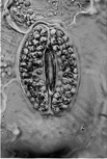 -Which of the following statements is true?
Which of the following has been called the world's most nutritious plant
(Multiple Choice)
4.8/5 (78)
(78) MATCHING
Matching.Choose the most appropriate response.
a.have rhizoids, cuticle, and protected embryo sporophyte
b.one cotyledon
c.non-seed-bearing, heart-shaped gametophytes; spore-bearing leaves with sori
d.Lycopodium; cone-bearing sporophyte; free-living gametophyte
e.only one species left
f.cypress and redwood; heterosporous; mostly evergreen
g.confined to tropics or warm, temperate zones; resemble squat cone-bearing palm trees
h.two cotyledons
i.Equisetum; homosporous; rhizomes present; aerial stems jointed; scouring rushes
j.
have coevolved with pollinating vectors
-mosses, liverworts
(Essay)
5.0/5 (84)
(84) Which would create a more acute dietary shortage for human beings - the loss of monocot crops or the loss of dicot crops?
(Essay)
4.7/5 (78)
(78) Features that contributed to success on land include a __________ that protects spores.
(Essay)
4.9/5 (88)
(88) 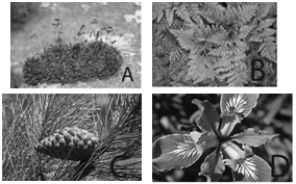 The following questions refer to the figure above.
-Which of the photographs in the above figure represents the bryophyte?
The following questions refer to the figure above.
-Which of the photographs in the above figure represents the bryophyte? (Multiple Choice)
4.9/5 (90)
(90) Features that contributed to success on land include a __________ and __________ that minimize water loss.
(Essay)
4.8/5 (69)
(69) Describe the challenges that plants faced when they entered the land, and how did they overcome them?
(Essay)
4.9/5 (88)
(88) MATCHING
Matching.Choose the most appropriate response.
a.have rhizoids, cuticle, and protected embryo sporophyte
b.one cotyledon
c.non-seed-bearing, heart-shaped gametophytes; spore-bearing leaves with sori
d.Lycopodium; cone-bearing sporophyte; free-living gametophyte
e.only one species left
f.cypress and redwood; heterosporous; mostly evergreen
g.confined to tropics or warm, temperate zones; resemble squat cone-bearing palm trees
h.two cotyledons
i.Equisetum; homosporous; rhizomes present; aerial stems jointed; scouring rushes
j.
have coevolved with pollinating vectors
-monocots
(Essay)
4.8/5 (84)
(84) The majority of vascular plants possess or are characterized by
(Multiple Choice)
4.8/5 (90)
(90) Classification.Answer the following questions in reference to the five divisions of vascular plants listed below.
a.lycophytes
b.bryophytes
c.monocots
d.conifers
e.eudicots
-The giant club mosses of the Carboniferous period were members of this group.
(Essay)
4.8/5 (89)
(89) MATCHING
Matching.Choose the most appropriate response.
a.have rhizoids, cuticle, and protected embryo sporophyte
b.one cotyledon
c.non-seed-bearing, heart-shaped gametophytes; spore-bearing leaves with sori
d.Lycopodium; cone-bearing sporophyte; free-living gametophyte
e.only one species left
f.cypress and redwood; heterosporous; mostly evergreen
g.confined to tropics or warm, temperate zones; resemble squat cone-bearing palm trees
h.two cotyledons
i.Equisetum; homosporous; rhizomes present; aerial stems jointed; scouring rushes
j.
have coevolved with pollinating vectors
-eudicots
(Essay)
4.8/5 (70)
(70) Classification.Answer the following questions in reference to the five divisions of vascular plants listed below.
a.lycophytes
b.bryophytes
c.monocots
d.conifers
e.eudicots
-Orchids are members of this division.
(Essay)
4.8/5 (86)
(86) The key innovation that helped sporophyte dominant plants survive in dry environments is
(Multiple Choice)
4.7/5 (64)
(64) 
Filters
- Essay(0)
- Multiple Choice(0)
- Short Answer(0)
- True False(0)
- Matching(0)