



 Chat with AI
Exam 27: Plant Tissues

Exam 1: Invitation to Biology80 Questions
Exam 2: Lifes Chemical Basis53 Questions
Exam 3: Molecules of Life62 Questions
Exam 4: Cell Structure and Function80 Questions
Exam 5: Ground Rules of Metabolism58 Questions
Exam 6: Where It Startsphotosynthesis57 Questions
Exam 7: How Cells Release Chemical Energy60 Questions
Exam 8: Dna Structure and Function60 Questions
Exam 9: From Dna to Protein64 Questions
Exam 10: Gene Control64 Questions
Exam 11: How Cells Reproduce77 Questions
Exam 12: Meiosis and Sexual Reproduction58 Questions
Exam 13: Observing Patterns in Inherited Traits97 Questions
Exam 14: Chromosomes and Human Inheritance74 Questions
Exam 15: Studying and Manipulating Genomes57 Questions
Exam 16: Evidence of Evolution53 Questions
Exam 17: Processes of Evolution72 Questions
Exam 18: Organizing Information About Species46 Questions
Exam 19: Lifes Origin and Early Evolution60 Questions
Exam 20: Viruses and Prokaryotes56 Questions
Exam 21: Protiststhe Simplest Eukaryotes61 Questions
Exam 22: The Land Plants66 Questions
Exam 23: Fungi52 Questions
Exam 24: Animal Evolutionthe Invertebrates74 Questions
Exam 25: Animal Evolutionthe Chordates71 Questions
Exam 26: Animal Evolutionhuman Evolution51 Questions
Exam 27: Plant Tissues79 Questions
Exam 28: Plant Nutrition and Transport68 Questions
Exam 29: Life Cycles of Flowering Plants88 Questions
Exam 30: Communication Strategies in Plants72 Questions
Exam 31: Animal Tissues and Organ Systems77 Questions
Exam 32: Neural Control96 Questions
Exam 33: Sensory Perception71 Questions
Exam 34: Endocrine Control91 Questions
Exam 35: Structural Support and Movement72 Questions
Exam 36: Circulation58 Questions
Exam 37: Immunity73 Questions
Exam 38: Respiration78 Questions
Exam 39: Digestion and Nutrition98 Questions
Exam 40: Maintaining the Internal Environment73 Questions
Exam 41: Animal Reproductive Systems105 Questions
Exam 42: Animal Development69 Questions
Exam 43: Animal Behavior74 Questions
Exam 44: Population Ecology59 Questions
Exam 45: Community Ecology71 Questions
Exam 46: Ecosystems63 Questions
Exam 47: The Biosphere72 Questions
Exam 48: Human Impacts on the Biosphere62 Questions
Select questions type


Matching.Match all applicable letters with the appropriate term(s).Letters may be used more than once, and a term may have more than one letter.
a.tissue that is part of the ground system
b.tissue that is part of the vascular system
c.tissue that is part of the dermal system
d.develops into the vascular cambium
e.leaf's photosynthetic tissues (palisade and spongy) are in this category
f.transports photosynthetic products away from leaves and stem
g.meristematic tissue
h.develops into secondary xylem and phloem
i.transports water and dissolved nutrients up to the stem and leaves
j.replaces the epidermis in plants that undergo secondary growth
k.a single layer of cells that helps control the movement of water and dissolved salts into the xylem pipeline
l.influence the movement of carbon dioxide into the leaf and movement of water out of the leaf
m.generally, dead cells that provide support and strength to all three tissue systems
n.ground tissue centrally located within a ring of vascular bundles
-endodermis
(Essay)
4.8/5  (78)
(78) 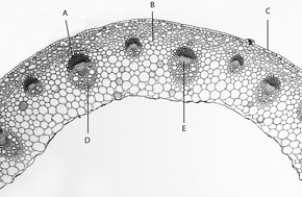 Use the figure above to answer the following questions.
-Leaves arise
Use the figure above to answer the following questions.
-Leaves arise (Multiple Choice)
4.9/5 (62)
(62) Matching.Match all applicable letters with the appropriate term(s).Letters may be used more than once, and a term may have more than one letter.
a.tissue that is part of the ground system
b.tissue that is part of the vascular system
c.tissue that is part of the dermal system
d.develops into the vascular cambium
e.leaf's photosynthetic tissues (palisade and spongy) are in this category
f.transports photosynthetic products away from leaves and stem
g.meristematic tissue
h.develops into secondary xylem and phloem
i.transports water and dissolved nutrients up to the stem and leaves
j.replaces the epidermis in plants that undergo secondary growth
k.a single layer of cells that helps control the movement of water and dissolved salts into the xylem pipeline
l.influence the movement of carbon dioxide into the leaf and movement of water out of the leaf
m.generally, dead cells that provide support and strength to all three tissue systems
n.ground tissue centrally located within a ring of vascular bundles
-phloem
(Essay)
4.9/5 (60)
(60) Do trees really sequester carbon permanently or just while they are alive?
(Essay)
4.9/5 (74)
(74) Classification.Answer the following questions in reference to the five plant tissues listed below.
a.parenchyma
b.collenchyma
c.sclerenchyma
d.xylem
e.phloem
-Ground tissue of plants, sometimes containing lignin that strengthens the adult plant.
(Essay)
4.9/5 (84)
(84) Matching.Match all applicable letters with the appropriate term(s).Letters may be used more than once, and a term may have more than one letter.
a.tissue that is part of the ground system
b.tissue that is part of the vascular system
c.tissue that is part of the dermal system
d.develops into the vascular cambium
e.leaf's photosynthetic tissues (palisade and spongy) are in this category
f.transports photosynthetic products away from leaves and stem
g.meristematic tissue
h.develops into secondary xylem and phloem
i.transports water and dissolved nutrients up to the stem and leaves
j.replaces the epidermis in plants that undergo secondary growth
k.a single layer of cells that helps control the movement of water and dissolved salts into the xylem pipeline
l.influence the movement of carbon dioxide into the leaf and movement of water out of the leaf
m.generally, dead cells that provide support and strength to all three tissue systems
n.ground tissue centrally located within a ring of vascular bundles
-periderm
(Essay)
4.7/5 (83)
(83) Matching.Match all applicable letters with the appropriate term(s).Letters may be used more than once, and a term may have more than one letter.
a.tissue that is part of the ground system
b.tissue that is part of the vascular system
c.tissue that is part of the dermal system
d.develops into the vascular cambium
e.leaf's photosynthetic tissues (palisade and spongy) are in this category
f.transports photosynthetic products away from leaves and stem
g.meristematic tissue
h.develops into secondary xylem and phloem
i.transports water and dissolved nutrients up to the stem and leaves
j.replaces the epidermis in plants that undergo secondary growth
k.a single layer of cells that helps control the movement of water and dissolved salts into the xylem pipeline
l.influence the movement of carbon dioxide into the leaf and movement of water out of the leaf
m.generally, dead cells that provide support and strength to all three tissue systems
n.ground tissue centrally located within a ring of vascular bundles
-xylem
(Essay)
4.8/5 (81)
(81) __________ covers and protects the outer surfaces of primary plant parts.
(Essay)
4.8/5 (77)
(77) Why does vascular cambium produce annual rings in xylem but not in phloem?
(Essay)
4.9/5 (78)
(78) Use the figure above to answer the following questions.
-Which of the following cells are alive at maturity?
Use the figure above to answer the following questions.
-Which of the following cells are alive at maturity? (Multiple Choice)
4.7/5 (83)
(83) 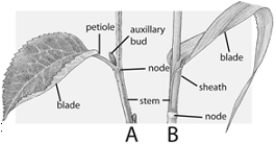 -Most monocots have numerous ____ roots arising from the stem.
 (Multiple Choice)
4.7/5 (77)
(77) 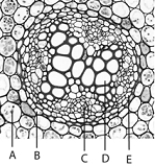 Use the figure above to answer the following questions.
-Which of the following environments would be most likely to produce trees without annual rings?
Use the figure above to answer the following questions.
-Which of the following environments would be most likely to produce trees without annual rings? (Multiple Choice)
4.9/5 (73)
(73) MATCHING
Matching.Choose the one most appropriate answer for each.
a.gives rise to periderm
b.nucleate phloem cells that help load and unload the phloem
c.dead cells with perforation plates; more efficient at water conduction than other xylem cells
d.living nonnucleated cells that conduct food from photosynthetic source area to storage sink area
e.a cylinder of parenchyma cells outside the vascular tissue but inside the endodermis
f.clusters of strands containing xylem, phloem, and vascular cambium
g.dead cells without perforation plates; the principal xylem cells of nonflowering vascular plants
h.cells with thick secondary walls impregnated with lignin that are especially abundant in some fruits and seeds
i.the principal photosynthetic region of a leaf
j.
regions that can undergo mitosis
k.gas exchange and storage plus photosynthesis
-cork cambium
(Essay)
4.8/5 (70)
(70) MATCHING
Matching.Choose the one most appropriate answer for each.
a.gives rise to periderm
b.nucleate phloem cells that help load and unload the phloem
c.dead cells with perforation plates; more efficient at water conduction than other xylem cells
d.living nonnucleated cells that conduct food from photosynthetic source area to storage sink area
e.a cylinder of parenchyma cells outside the vascular tissue but inside the endodermis
f.clusters of strands containing xylem, phloem, and vascular cambium
g.dead cells without perforation plates; the principal xylem cells of nonflowering vascular plants
h.cells with thick secondary walls impregnated with lignin that are especially abundant in some fruits and seeds
i.the principal photosynthetic region of a leaf
j.
regions that can undergo mitosis
k.gas exchange and storage plus photosynthesis
-spongy mesophyll
(Essay)
4.9/5 (86)
(86) Matching.Match all applicable letters with the appropriate term(s).Letters may be used more than once, and a term may have more than one letter.
a.tissue that is part of the ground system
b.tissue that is part of the vascular system
c.tissue that is part of the dermal system
d.develops into the vascular cambium
e.leaf's photosynthetic tissues (palisade and spongy) are in this category
f.transports photosynthetic products away from leaves and stem
g.meristematic tissue
h.develops into secondary xylem and phloem
i.transports water and dissolved nutrients up to the stem and leaves
j.replaces the epidermis in plants that undergo secondary growth
k.a single layer of cells that helps control the movement of water and dissolved salts into the xylem pipeline
l.influence the movement of carbon dioxide into the leaf and movement of water out of the leaf
m.generally, dead cells that provide support and strength to all three tissue systems
n.ground tissue centrally located within a ring of vascular bundles
-collenchyma
(Essay)
4.9/5 (82)
(82) Matching.Match all applicable letters with the appropriate term(s).Letters may be used more than once, and a term may have more than one letter.
a.tissue that is part of the ground system
b.tissue that is part of the vascular system
c.tissue that is part of the dermal system
d.develops into the vascular cambium
e.leaf's photosynthetic tissues (palisade and spongy) are in this category
f.transports photosynthetic products away from leaves and stem
g.meristematic tissue
h.develops into secondary xylem and phloem
i.transports water and dissolved nutrients up to the stem and leaves
j.replaces the epidermis in plants that undergo secondary growth
k.a single layer of cells that helps control the movement of water and dissolved salts into the xylem pipeline
l.influence the movement of carbon dioxide into the leaf and movement of water out of the leaf
m.generally, dead cells that provide support and strength to all three tissue systems
n.ground tissue centrally located within a ring of vascular bundles
-sclerenchyma
(Essay)
4.8/5 (95)
(95) 
Filters
- Essay(0)
- Multiple Choice(0)
- Short Answer(0)
- True False(0)
- Matching(0)