



 Chat with AI
Exam 28: Plant Nutrition and Transport

Exam 1: Invitation to Biology80 Questions
Exam 2: Lifes Chemical Basis53 Questions
Exam 3: Molecules of Life62 Questions
Exam 4: Cell Structure and Function80 Questions
Exam 5: Ground Rules of Metabolism58 Questions
Exam 6: Where It Startsphotosynthesis57 Questions
Exam 7: How Cells Release Chemical Energy60 Questions
Exam 8: Dna Structure and Function60 Questions
Exam 9: From Dna to Protein64 Questions
Exam 10: Gene Control64 Questions
Exam 11: How Cells Reproduce77 Questions
Exam 12: Meiosis and Sexual Reproduction58 Questions
Exam 13: Observing Patterns in Inherited Traits97 Questions
Exam 14: Chromosomes and Human Inheritance74 Questions
Exam 15: Studying and Manipulating Genomes57 Questions
Exam 16: Evidence of Evolution53 Questions
Exam 17: Processes of Evolution72 Questions
Exam 18: Organizing Information About Species46 Questions
Exam 19: Lifes Origin and Early Evolution60 Questions
Exam 20: Viruses and Prokaryotes56 Questions
Exam 21: Protiststhe Simplest Eukaryotes61 Questions
Exam 22: The Land Plants66 Questions
Exam 23: Fungi52 Questions
Exam 24: Animal Evolutionthe Invertebrates74 Questions
Exam 25: Animal Evolutionthe Chordates71 Questions
Exam 26: Animal Evolutionhuman Evolution51 Questions
Exam 27: Plant Tissues79 Questions
Exam 28: Plant Nutrition and Transport68 Questions
Exam 29: Life Cycles of Flowering Plants88 Questions
Exam 30: Communication Strategies in Plants72 Questions
Exam 31: Animal Tissues and Organ Systems77 Questions
Exam 32: Neural Control96 Questions
Exam 33: Sensory Perception71 Questions
Exam 34: Endocrine Control91 Questions
Exam 35: Structural Support and Movement72 Questions
Exam 36: Circulation58 Questions
Exam 37: Immunity73 Questions
Exam 38: Respiration78 Questions
Exam 39: Digestion and Nutrition98 Questions
Exam 40: Maintaining the Internal Environment73 Questions
Exam 41: Animal Reproductive Systems105 Questions
Exam 42: Animal Development69 Questions
Exam 43: Animal Behavior74 Questions
Exam 44: Population Ecology59 Questions
Exam 45: Community Ecology71 Questions
Exam 46: Ecosystems63 Questions
Exam 47: The Biosphere72 Questions
Exam 48: Human Impacts on the Biosphere62 Questions
Select questions type


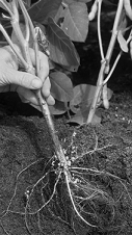 -Sieve tubes are different from vessel members because they
 (Multiple Choice)
4.8/5  (71)
(71) MATCHING
Matching.Choose the most appropriate answer response for each question.
a.responsible for opening and closing of stomata
b.mouthpart of an aphid
c.pipelines of the xylem
d.a mutually beneficial association between a fungus and a young root
e.structures on roots that house nitrogen-fixing bacteria
f.pipelines of the phloem
g.evaporation from stems and leaves
h.actively transport sucrose into sieve tubes
i.eudicot plants that tend to establish symbiotic relationships with nitrogen-fixing bacteria
j.
transport of organic molecules from source region to sink
k.a waxy band that forces water to diffuse through cells
-transpiration
(Essay)
4.9/5 (93)
(93) 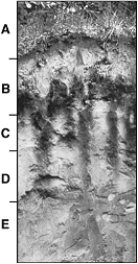 The following questions refer to the figure above illustrating soil horizons.NOTE: The labels are not the actual names of the soil horizons.
-Chlorosis, stunted growth with yellowing and death of young leaves, is caused by a deficiency of
The following questions refer to the figure above illustrating soil horizons.NOTE: The labels are not the actual names of the soil horizons.
-Chlorosis, stunted growth with yellowing and death of young leaves, is caused by a deficiency of (Multiple Choice)
4.9/5 (86)
(86) Classification.Respond to the following statements with reference to the five plant macronutrients listed below.
a.nitrogen
b.potassium
c.calcium
d.magnesium
e.phosphorus
-This nutrient is essential to formation of chlorophyll and acts as a cofactor for many enzymes.
(Essay)
4.7/5 (79)
(79) MATCHING
Matching.Choose the most appropriate answer response for each question.
a.responsible for opening and closing of stomata
b.mouthpart of an aphid
c.pipelines of the xylem
d.a mutually beneficial association between a fungus and a young root
e.structures on roots that house nitrogen-fixing bacteria
f.pipelines of the phloem
g.evaporation from stems and leaves
h.actively transport sucrose into sieve tubes
i.eudicot plants that tend to establish symbiotic relationships with nitrogen-fixing bacteria
j.
transport of organic molecules from source region to sink
k.a waxy band that forces water to diffuse through cells
-sieve tube members
(Essay)
4.8/5 (96)
(96) The following questions refer to the figure above illustrating soil horizons.NOTE: The labels are not the actual names of the soil horizons.
-Leaching is caused by
The following questions refer to the figure above illustrating soil horizons.NOTE: The labels are not the actual names of the soil horizons.
-Leaching is caused by (Multiple Choice)
4.8/5 (84)
(84) 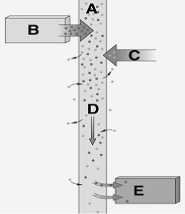 The following questions refer to the figure above illustrating transport in phloem.
-Bulk flow of organic compounds is indicated by
The following questions refer to the figure above illustrating transport in phloem.
-Bulk flow of organic compounds is indicated by (Multiple Choice)
4.9/5 (81)
(81)
-Which of the following are never sink regions for the pressure-flow translocation of organic compounds?
-Which of the following are never sink regions for the pressure-flow translocation of organic compounds? (Multiple Choice)
4.7/5 (91)
(91)
-Which of the following factors influence the opening and closing of the stomata?
-Which of the following factors influence the opening and closing of the stomata? (Multiple Choice)
4.9/5 (80)
(80)
-Which theory of water transport states that hydrogen bonding allows water molecules to maintain a continuous fluid column as water is pulled from roots to leaves?
-Which theory of water transport states that hydrogen bonding allows water molecules to maintain a continuous fluid column as water is pulled from roots to leaves? (Multiple Choice)
4.7/5 (77)
(77) __________ are soils that have roughly equal proportions of sand, silt, and clay.
(Essay)
4.8/5 (69)
(69) The following questions refer to the figure above illustrating soil horizons.NOTE: The labels are not the actual names of the soil horizons.
-Which soil horizon is composed of organic litter?
The following questions refer to the figure above illustrating soil horizons.NOTE: The labels are not the actual names of the soil horizons.
-Which soil horizon is composed of organic litter? (Multiple Choice)
4.9/5 (68)
(68)
-Movement of soluble organic material through sieve tube members occurs through
-Movement of soluble organic material through sieve tube members occurs through (Multiple Choice)
4.9/5 (63)
(63) The Army and the Environmental Protection Agency are decreasing the contamination at the Army's Aberdeen Proving Grounds by
(Multiple Choice)
4.8/5 (85)
(85) MATCHING
Matching.Choose the most appropriate answer response for each question.
a.responsible for opening and closing of stomata
b.mouthpart of an aphid
c.pipelines of the xylem
d.a mutually beneficial association between a fungus and a young root
e.structures on roots that house nitrogen-fixing bacteria
f.pipelines of the phloem
g.evaporation from stems and leaves
h.actively transport sucrose into sieve tubes
i.eudicot plants that tend to establish symbiotic relationships with nitrogen-fixing bacteria
j.
transport of organic molecules from source region to sink
k.a waxy band that forces water to diffuse through cells
-stylet
(Essay)
4.8/5 (79)
(79)
-All of the following statements are true concerning phloem tissue EXCEPT that
-All of the following statements are true concerning phloem tissue EXCEPT that (Multiple Choice)
5.0/5 (81)
(81) MATCHING
Matching.Choose the most appropriate answer response for each question.
a.responsible for opening and closing of stomata
b.mouthpart of an aphid
c.pipelines of the xylem
d.a mutually beneficial association between a fungus and a young root
e.structures on roots that house nitrogen-fixing bacteria
f.pipelines of the phloem
g.evaporation from stems and leaves
h.actively transport sucrose into sieve tubes
i.eudicot plants that tend to establish symbiotic relationships with nitrogen-fixing bacteria
j.
transport of organic molecules from source region to sink
k.a waxy band that forces water to diffuse through cells
-nodules
(Essay)
4.9/5 (84)
(84) Would a calcium deficiency be more likely to cause excess water loss or a carbon dioxide shortage for a plant (hint: think of the stoma)?
(Essay)
4.9/5 (81)
(81) 
Filters
- Essay(0)
- Multiple Choice(0)
- Short Answer(0)
- True False(0)
- Matching(0)