



 Chat with AI
Exam 36: Circulation

Exam 1: Invitation to Biology80 Questions
Exam 2: Lifes Chemical Basis53 Questions
Exam 3: Molecules of Life62 Questions
Exam 4: Cell Structure and Function80 Questions
Exam 5: Ground Rules of Metabolism58 Questions
Exam 6: Where It Startsphotosynthesis57 Questions
Exam 7: How Cells Release Chemical Energy60 Questions
Exam 8: Dna Structure and Function60 Questions
Exam 9: From Dna to Protein64 Questions
Exam 10: Gene Control64 Questions
Exam 11: How Cells Reproduce77 Questions
Exam 12: Meiosis and Sexual Reproduction58 Questions
Exam 13: Observing Patterns in Inherited Traits97 Questions
Exam 14: Chromosomes and Human Inheritance74 Questions
Exam 15: Studying and Manipulating Genomes57 Questions
Exam 16: Evidence of Evolution53 Questions
Exam 17: Processes of Evolution72 Questions
Exam 18: Organizing Information About Species46 Questions
Exam 19: Lifes Origin and Early Evolution60 Questions
Exam 20: Viruses and Prokaryotes56 Questions
Exam 21: Protiststhe Simplest Eukaryotes61 Questions
Exam 22: The Land Plants66 Questions
Exam 23: Fungi52 Questions
Exam 24: Animal Evolutionthe Invertebrates74 Questions
Exam 25: Animal Evolutionthe Chordates71 Questions
Exam 26: Animal Evolutionhuman Evolution51 Questions
Exam 27: Plant Tissues79 Questions
Exam 28: Plant Nutrition and Transport68 Questions
Exam 29: Life Cycles of Flowering Plants88 Questions
Exam 30: Communication Strategies in Plants72 Questions
Exam 31: Animal Tissues and Organ Systems77 Questions
Exam 32: Neural Control96 Questions
Exam 33: Sensory Perception71 Questions
Exam 34: Endocrine Control91 Questions
Exam 35: Structural Support and Movement72 Questions
Exam 36: Circulation58 Questions
Exam 37: Immunity73 Questions
Exam 38: Respiration78 Questions
Exam 39: Digestion and Nutrition98 Questions
Exam 40: Maintaining the Internal Environment73 Questions
Exam 41: Animal Reproductive Systems105 Questions
Exam 42: Animal Development69 Questions
Exam 43: Animal Behavior74 Questions
Exam 44: Population Ecology59 Questions
Exam 45: Community Ecology71 Questions
Exam 46: Ecosystems63 Questions
Exam 47: The Biosphere72 Questions
Exam 48: Human Impacts on the Biosphere62 Questions
Select questions type


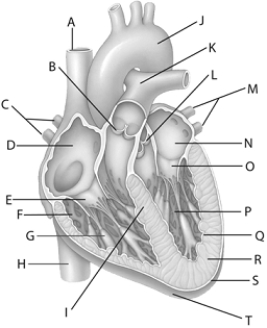 Use the figure above to answer the following questions.
-The anatomical structure identified with the letter "D" in the figure above is the
Use the figure above to answer the following questions.
-The anatomical structure identified with the letter "D" in the figure above is the (Multiple Choice)
4.8/5  (79)
(79)  Use the figure above to answer the following questions.
-About how many liters of blood does an average human have?
Use the figure above to answer the following questions.
-About how many liters of blood does an average human have? (Multiple Choice)
4.7/5 (70)
(70) Classification.Respond to the following statements in reference to the four structures of the heart listed below.
a.right atrium
b.left atrium
c.left ventricle
d.right ventricle
-Deoxygenated blood exits the heart from this structure.
(Essay)
4.8/5 (64)
(64) MATCHING
Classification.Respond to the following statements in reference to the five components of mammalian blood listed below.
a.red blood cells
b.basophils
c.platelets
d.albumin
-This blood component helps to maintain the proper osmotic concentration of the blood.
(Essay)
5.0/5 (88)
(88) Classification.Respond to the following statements in reference to the four structures of the heart listed below.
a.right atrium
b.left atrium
c.left ventricle
d.right ventricle
-The __________ circuit carries blood from the heart to body tissues, and then returns it to the heart.
(Essay)
5.0/5 (83)
(83) Chart the path of blood through the heart, including the valves passed.
(Essay)
4.9/5 (72)
(72) MATCHING
Classification.Respond to the following statements in reference to the five components of mammalian blood listed below.
a.red blood cells
b.basophils
c.platelets
d.albumin
-This blood component plays a central role in clotting blood following a wound.
(Essay)
4.9/5 (90)
(90) Use the figure above to answer the following questions.
-Most of the oxygen in the blood is transported by
Use the figure above to answer the following questions.
-Most of the oxygen in the blood is transported by (Multiple Choice)
4.9/5 (81)
(81) MATCHING
Classification.Respond to the following statements in reference to the five components of mammalian blood listed below.
a.red blood cells
b.basophils
c.platelets
d.albumin
-Oxygen is transported throughout the body by this blood component.
(Essay)
4.9/5 (97)
(97) An individual has an issue with their red blood cells.Are they most likely to have an issue with their immunity, oxygen transport, or hemostasis?
(Essay)
4.9/5 (67)
(67) Use the figure above to answer the following questions.
-Which cell does NOT belong with the others?
Use the figure above to answer the following questions.
-Which cell does NOT belong with the others? (Multiple Choice)
4.7/5 (74)
(74) The SA node, also known as the __________, spontaneously generates the action potentials that set the pace for cardiac contractions.
(Essay)
4.7/5 (78)
(78) 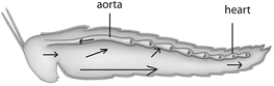 -The animal in the above diagram has a ____ circulatory system.
 (Multiple Choice)
4.8/5 (71)
(71) The __________ gland produces hormones and is the site where __________ (a kind of white blood cell) mature.
(Essay)
4.8/5 (66)
(66) MATCHING
Classification.Respond to the following statements in reference to the five components of mammalian blood listed below.
a.red blood cells
b.basophils
c.platelets
d.albumin
-This blood component contains hemoglobin.
(Essay)
4.9/5 (79)
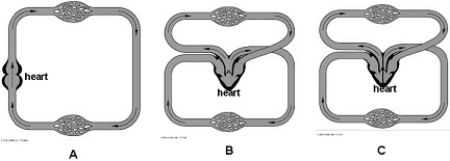
(79) Use the figure above to answer the following questions.
-A fish circulatory system is indicated by
Use the figure above to answer the following questions.
-A fish circulatory system is indicated by (Multiple Choice)
5.0/5 (94)
(94) 
Filters
- Essay(0)
- Multiple Choice(0)
- Short Answer(0)
- True False(0)
- Matching(0)