



 Chat with AI
Exam 42: Animal Development

Exam 1: Invitation to Biology80 Questions
Exam 2: Lifes Chemical Basis53 Questions
Exam 3: Molecules of Life62 Questions
Exam 4: Cell Structure and Function80 Questions
Exam 5: Ground Rules of Metabolism58 Questions
Exam 6: Where It Startsphotosynthesis57 Questions
Exam 7: How Cells Release Chemical Energy60 Questions
Exam 8: Dna Structure and Function60 Questions
Exam 9: From Dna to Protein64 Questions
Exam 10: Gene Control64 Questions
Exam 11: How Cells Reproduce77 Questions
Exam 12: Meiosis and Sexual Reproduction58 Questions
Exam 13: Observing Patterns in Inherited Traits97 Questions
Exam 14: Chromosomes and Human Inheritance74 Questions
Exam 15: Studying and Manipulating Genomes57 Questions
Exam 16: Evidence of Evolution53 Questions
Exam 17: Processes of Evolution72 Questions
Exam 18: Organizing Information About Species46 Questions
Exam 19: Lifes Origin and Early Evolution60 Questions
Exam 20: Viruses and Prokaryotes56 Questions
Exam 21: Protiststhe Simplest Eukaryotes61 Questions
Exam 22: The Land Plants66 Questions
Exam 23: Fungi52 Questions
Exam 24: Animal Evolutionthe Invertebrates74 Questions
Exam 25: Animal Evolutionthe Chordates71 Questions
Exam 26: Animal Evolutionhuman Evolution51 Questions
Exam 27: Plant Tissues79 Questions
Exam 28: Plant Nutrition and Transport68 Questions
Exam 29: Life Cycles of Flowering Plants88 Questions
Exam 30: Communication Strategies in Plants72 Questions
Exam 31: Animal Tissues and Organ Systems77 Questions
Exam 32: Neural Control96 Questions
Exam 33: Sensory Perception71 Questions
Exam 34: Endocrine Control91 Questions
Exam 35: Structural Support and Movement72 Questions
Exam 36: Circulation58 Questions
Exam 37: Immunity73 Questions
Exam 38: Respiration78 Questions
Exam 39: Digestion and Nutrition98 Questions
Exam 40: Maintaining the Internal Environment73 Questions
Exam 41: Animal Reproductive Systems105 Questions
Exam 42: Animal Development69 Questions
Exam 43: Animal Behavior74 Questions
Exam 44: Population Ecology59 Questions
Exam 45: Community Ecology71 Questions
Exam 46: Ecosystems63 Questions
Exam 47: The Biosphere72 Questions
Exam 48: Human Impacts on the Biosphere62 Questions
Select questions type


Classification.Respond to the following statements with reference to the five terms listed below.
a.zygote
b.blastula
c.cleavage
d.gastrula
e.somites
-This is a longitudinal series of paired segments.
(Essay)
4.9/5  (71)
(71) Which of the following does NOT occur in the first trimester during human development?
(Multiple Choice)
4.8/5 (82)
(82) 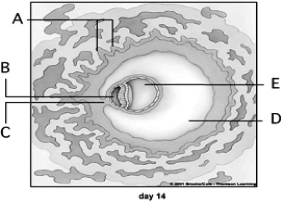 Use the figure above showing developmental day 14 to answer the following questions.
-The cavity of the sac that will directly enclose the embryo is indicated by
Use the figure above showing developmental day 14 to answer the following questions.
-The cavity of the sac that will directly enclose the embryo is indicated by (Multiple Choice)
4.7/5 (82)
(82) Classification.Respond to the following statements with reference to the five terms listed below.
a.zygote
b.blastula
c.cleavage
d.gastrula
e.somites
-This is the division of the zygote.
(Essay)
4.9/5 (83)
(83) Which of the following gives rise to the embryo during human development?
(Multiple Choice)
5.0/5 (81)
(81) What would happen if human chorionic gonadotropin levels did not rise adequately during pregnancy?
(Essay)
4.9/5 (79)
(79) Which of the following is the final stage of the prenatal period?
(Multiple Choice)
4.9/5 (97)
(97) The female hormones that participate in milk production for and delivery to the newborn are
(Multiple Choice)
5.0/5 (79)
(79) The explanation for the differences between a human liver cell and a cell from the skin is the
(Multiple Choice)
4.7/5 (89)
(89) Is a mutation more likely to be lethal if it impacts early or late stages in development?
(Essay)
4.9/5 (71)
(71) The hormone ____ is involved in a positive feedback cycle that results in strong uterine contractions during labor.
(Multiple Choice)
4.8/5 (104)
(104) MATCHING
Matching.Choose the one best answer for each numbered item.
a.visible marker of the site where an amphibian's body axis will be established and where gastrulation will begin
b.the formation of two or three embryonic tissue layers
c.the fusion of male and female nuclei
d.the entire body divides transversely; each half grows and regenerates the missing part
e.selective gene expression results in different cell types
f.subdividing of the zygote by mitosis; no growth occurs
g.region of zygote that has less yolk and is pigmented
h.an embryonic stage of development that has three primary tissue layers before organogenesis begins
i.the formation of organs
j.
one body part develops in response to signals from an adjacent part
k.the growth, shaping, and spatial coordination of tissues and organs so that a predefined pattern of the whole organism results
l.
occurs in the formation of the human hand
-controlled cell death
(Essay)
5.0/5 (83)
(83) Classification.Respond to the following statements with reference to the five terms below.
a.somites
b.blastomeres
c.ectoderm
d.mesoderm
e.endoderm
-These reorganize themselves into the gastrula.
(Essay)
4.8/5 (83)
(83) MATCHING
Matching.Choose the one best answer for each numbered item.
a.visible marker of the site where an amphibian's body axis will be established and where gastrulation will begin
b.the formation of two or three embryonic tissue layers
c.the fusion of male and female nuclei
d.the entire body divides transversely; each half grows and regenerates the missing part
e.selective gene expression results in different cell types
f.subdividing of the zygote by mitosis; no growth occurs
g.region of zygote that has less yolk and is pigmented
h.an embryonic stage of development that has three primary tissue layers before organogenesis begins
i.the formation of organs
j.
one body part develops in response to signals from an adjacent part
k.the growth, shaping, and spatial coordination of tissues and organs so that a predefined pattern of the whole organism results
l.
occurs in the formation of the human hand
-gray crescent
(Essay)
4.8/5 (93)
(93) MATCHING
Matching.Choose the one best answer for each numbered item.
a.visible marker of the site where an amphibian's body axis will be established and where gastrulation will begin
b.the formation of two or three embryonic tissue layers
c.the fusion of male and female nuclei
d.the entire body divides transversely; each half grows and regenerates the missing part
e.selective gene expression results in different cell types
f.subdividing of the zygote by mitosis; no growth occurs
g.region of zygote that has less yolk and is pigmented
h.an embryonic stage of development that has three primary tissue layers before organogenesis begins
i.the formation of organs
j.
one body part develops in response to signals from an adjacent part
k.the growth, shaping, and spatial coordination of tissues and organs so that a predefined pattern of the whole organism results
l.
occurs in the formation of the human hand
-gastrula
(Essay)
4.8/5 (65)
(65) Classification.Respond to the following statements with reference to the five terms below.
a.somites
b.blastomeres
c.ectoderm
d.mesoderm
e.endoderm
-These are the source of most bones and the skeletal muscle of the head and trunk.
(Essay)
4.8/5 (81)
(81) The change in the developmental fates of different cell lineages in response to signals from adjacent tissues is
(Multiple Choice)
4.9/5 (86)
(86) Nutrients and antibodies move across the placenta from mother to embryo or fetus, as do __________, which can cause birth defects.
(Essay)
4.8/5 (89)
(89) 
Filters
- Essay(0)
- Multiple Choice(0)
- Short Answer(0)
- True False(0)
- Matching(0)