



 Chat with AI
Exam 44: Population Ecology

Exam 1: Invitation to Biology80 Questions
Exam 2: Lifes Chemical Basis53 Questions
Exam 3: Molecules of Life62 Questions
Exam 4: Cell Structure and Function80 Questions
Exam 5: Ground Rules of Metabolism58 Questions
Exam 6: Where It Startsphotosynthesis57 Questions
Exam 7: How Cells Release Chemical Energy60 Questions
Exam 8: Dna Structure and Function60 Questions
Exam 9: From Dna to Protein64 Questions
Exam 10: Gene Control64 Questions
Exam 11: How Cells Reproduce77 Questions
Exam 12: Meiosis and Sexual Reproduction58 Questions
Exam 13: Observing Patterns in Inherited Traits97 Questions
Exam 14: Chromosomes and Human Inheritance74 Questions
Exam 15: Studying and Manipulating Genomes57 Questions
Exam 16: Evidence of Evolution53 Questions
Exam 17: Processes of Evolution72 Questions
Exam 18: Organizing Information About Species46 Questions
Exam 19: Lifes Origin and Early Evolution60 Questions
Exam 20: Viruses and Prokaryotes56 Questions
Exam 21: Protiststhe Simplest Eukaryotes61 Questions
Exam 22: The Land Plants66 Questions
Exam 23: Fungi52 Questions
Exam 24: Animal Evolutionthe Invertebrates74 Questions
Exam 25: Animal Evolutionthe Chordates71 Questions
Exam 26: Animal Evolutionhuman Evolution51 Questions
Exam 27: Plant Tissues79 Questions
Exam 28: Plant Nutrition and Transport68 Questions
Exam 29: Life Cycles of Flowering Plants88 Questions
Exam 30: Communication Strategies in Plants72 Questions
Exam 31: Animal Tissues and Organ Systems77 Questions
Exam 32: Neural Control96 Questions
Exam 33: Sensory Perception71 Questions
Exam 34: Endocrine Control91 Questions
Exam 35: Structural Support and Movement72 Questions
Exam 36: Circulation58 Questions
Exam 37: Immunity73 Questions
Exam 38: Respiration78 Questions
Exam 39: Digestion and Nutrition98 Questions
Exam 40: Maintaining the Internal Environment73 Questions
Exam 41: Animal Reproductive Systems105 Questions
Exam 42: Animal Development69 Questions
Exam 43: Animal Behavior74 Questions
Exam 44: Population Ecology59 Questions
Exam 45: Community Ecology71 Questions
Exam 46: Ecosystems63 Questions
Exam 47: The Biosphere72 Questions
Exam 48: Human Impacts on the Biosphere62 Questions
Select questions type


The Reznick and Endler guppy study showed that killifish and pike-cichlids raised in natural conditions will
(Multiple Choice)
4.9/5  (79)
(79) Demographics include __________ and __________ structure, such as the size of the __________ base.
(Essay)
4.9/5 (84)
(84) Density-independent factors that limit population growth include
(Multiple Choice)
4.9/5 (77)
(77) Organisms that demonstrate type I survivorship are characterized by
(Multiple Choice)
4.7/5 (79)
(79) __________ can be used to estimate the population density for mobile animals.
(Essay)
4.9/5 (89)
(89) Which of the following is not a problem caused by Canada geese?
(Multiple Choice)
4.9/5 (80)
(80) Classification.Respond to the following statements with reference to the five terms listed below, which are used by ecologists.
a.carrying capacity
b.net reproduction per individual per unit time
c.age structure
d.survivorship
e.growth rate
-The maximum number of individuals that a given habitat can support is this.
(Essay)
4.7/5 (82)
(82) 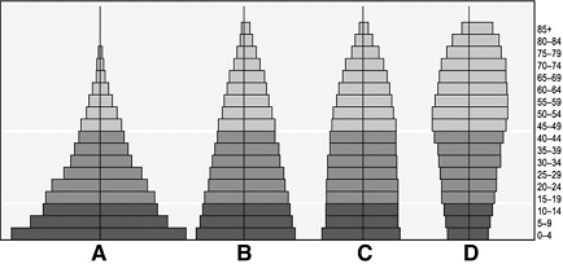 The following questions refer to the age structure diagrams above.
-The age structure diagram for countries with a 2.1 total fertility rate is indicated by
The following questions refer to the age structure diagrams above.
-The age structure diagram for countries with a 2.1 total fertility rate is indicated by (Multiple Choice)
4.8/5 (78)
(78) MATCHING
Matching.Choose the most appropriate response for each.
a.describes a population that is experiencing unrestrained growth
b.the birth rate minus the death rate plus any inward migration and minus any outward migration
c.the distribution of individuals at each age level in a population
d.for example, the amount of glucose in a culture flask containing bacteria
-J-shaped curve
(Essay)
5.0/5 (85)
(85) Random dispersion of individuals in a population occurs when habitat conditions are ____, resource availability is ____, and individuals or pairs of individuals ____ one another.
(Multiple Choice)
4.8/5 (73)
(73) A population's __________ is the average number of children born to women during their reproductive years.
(Essay)
4.9/5 (81)
(81) A population of deer is sampled.25 deer are caught and tagged.Two months later, the researchers return and find that 4 of the 16 deer they observe have tags.This would suggest a total population size of what number? Explain your answer.
(Essay)
4.8/5 (82)
(82) With __________ growth, a small population starts growing slowly, then grows rapidly, and then levels off once __________ is reached.
(Essay)
4.8/5 (82)
(82) The maximum possible rate of increase is a species' __________ potential.
(Essay)
4.8/5 (70)
(70) 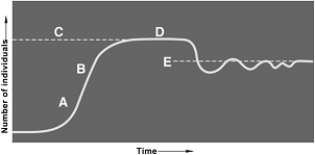 The following questions refer to the figure above illustrating logistic growth.
-The population is in exponential growth at
The following questions refer to the figure above illustrating logistic growth.
-The population is in exponential growth at (Multiple Choice)
4.8/5 (92)
(92) When the birth rate plus immigration equals the death rate plus emigration the result is
(Multiple Choice)
4.7/5 (74)
(74) Individuals in the population grouped according to levels of maturity define the population's
(Multiple Choice)
4.9/5 (75)
(75) The work of Reznick and Endler with guppies shows all of the following EXCEPT that
(Multiple Choice)
4.9/5 (83)
(83) 
Filters
- Essay(0)
- Multiple Choice(0)
- Short Answer(0)
- True False(0)
- Matching(0)