



 Chat with AI
Exam 7: How Cells Release Chemical Energy

Exam 1: Invitation to Biology80 Questions
Exam 2: Lifes Chemical Basis53 Questions
Exam 3: Molecules of Life62 Questions
Exam 4: Cell Structure and Function80 Questions
Exam 5: Ground Rules of Metabolism58 Questions
Exam 6: Where It Startsphotosynthesis57 Questions
Exam 7: How Cells Release Chemical Energy60 Questions
Exam 8: Dna Structure and Function60 Questions
Exam 9: From Dna to Protein64 Questions
Exam 10: Gene Control64 Questions
Exam 11: How Cells Reproduce77 Questions
Exam 12: Meiosis and Sexual Reproduction58 Questions
Exam 13: Observing Patterns in Inherited Traits97 Questions
Exam 14: Chromosomes and Human Inheritance74 Questions
Exam 15: Studying and Manipulating Genomes57 Questions
Exam 16: Evidence of Evolution53 Questions
Exam 17: Processes of Evolution72 Questions
Exam 18: Organizing Information About Species46 Questions
Exam 19: Lifes Origin and Early Evolution60 Questions
Exam 20: Viruses and Prokaryotes56 Questions
Exam 21: Protiststhe Simplest Eukaryotes61 Questions
Exam 22: The Land Plants66 Questions
Exam 23: Fungi52 Questions
Exam 24: Animal Evolutionthe Invertebrates74 Questions
Exam 25: Animal Evolutionthe Chordates71 Questions
Exam 26: Animal Evolutionhuman Evolution51 Questions
Exam 27: Plant Tissues79 Questions
Exam 28: Plant Nutrition and Transport68 Questions
Exam 29: Life Cycles of Flowering Plants88 Questions
Exam 30: Communication Strategies in Plants72 Questions
Exam 31: Animal Tissues and Organ Systems77 Questions
Exam 32: Neural Control96 Questions
Exam 33: Sensory Perception71 Questions
Exam 34: Endocrine Control91 Questions
Exam 35: Structural Support and Movement72 Questions
Exam 36: Circulation58 Questions
Exam 37: Immunity73 Questions
Exam 38: Respiration78 Questions
Exam 39: Digestion and Nutrition98 Questions
Exam 40: Maintaining the Internal Environment73 Questions
Exam 41: Animal Reproductive Systems105 Questions
Exam 42: Animal Development69 Questions
Exam 43: Animal Behavior74 Questions
Exam 44: Population Ecology59 Questions
Exam 45: Community Ecology71 Questions
Exam 46: Ecosystems63 Questions
Exam 47: The Biosphere72 Questions
Exam 48: Human Impacts on the Biosphere62 Questions
Select questions type


Intermediates in the breakdown of ____ can be diverted into glycolysis and the Krebs cycle.
(Multiple Choice)
4.8/5  (88)
(88) Which of the following molecules does NOT have a total of three carbon atoms?
(Multiple Choice)
4.7/5 (78)
(78) Classification.Use the five compounds listed below for the following questions.
a.ethanol
b.pyruvate
c.lactate
d.citrate
e.acetaldehyde
-This compound is an intermediate product of alcoholic fermentation but not lactate fermentation.
(Essay)
4.9/5 (81)
(81) The correct operational sequence of the three processes listed below is I.
Glycolysis
II)
Electron transport chain
III)
Krebs cycle
(Multiple Choice)
4.8/5 (88)
(88) During the third stage of aerobic respiration, electrons and hydrogen ions released by the reactions of the first two stages are picked up by
(Multiple Choice)
4.8/5 (87)
(87) Classification.Use the five compounds listed below for the following questions.
a.ethanol
b.pyruvate
c.lactate
d.citrate
e.acetaldehyde
-This compound is produced by fast-twitch muscle fibers.
(Essay)
4.8/5 (68)
(68) Classification.Use the five compounds listed below for the following questions.
a.ethanol
b.pyruvate
c.lactate
d.citrate
e.acetaldehyde
-This compound is utilized in alcoholic fermentation and lactate fermentation.
(Essay)
4.8/5 (86)
(86) Classification.Use the five processes listed below for the following questions.
a.glycolysis
b.aerobic respiration
c.anaerobic electron transfer
d.alcoholic fermentation
e.lactate fermentation
-This process precedes the Krebs cycle.
(Essay)
4.8/5 (86)
(86) In the breakdown of glucose, a phosphorylated six-carbon compound is split into two three-carbon compounds, which are named
(Multiple Choice)
4.9/5 (76)
(76) How many ATP are spent before a glucose molecule can be broken down to release energy?
(Multiple Choice)
4.9/5 (97)
(97) What molecule is the entry point to aerobic respiration for carbohydrates, proteins and fats?
(Essay)
4.8/5 (78)
(78) MATCHING
Matching.Select the one most appropriate choice for each.
a.produces NADH and CO2; pyruvate oxidized
b.produces ATP, NADH, and CO2
c.splits glucose into two pyruvate molecules
d.regenerates NAD+ as pyruvate is converted to ethanol or lactate
e.uses a membrane-bound system that sets up production of ATP
-the Krebs cycle
(Essay)
4.9/5 (77)
(77) 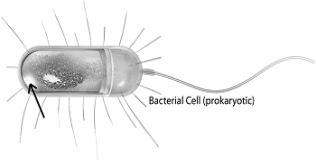 -Which of the following is indicated by the arrow as the location of glycolysis?
 (Multiple Choice)
4.9/5 (72)
(72) Which of the following yields carbon dioxide during the breakdown of glucose in aerobic respiration?
(Multiple Choice)
4.9/5 (72)
(72) Classification.Use the five processes listed below for the following questions.
a.glycolysis
b.aerobic respiration
c.anaerobic electron transfer
d.alcoholic fermentation
e.lactate fermentation
-In this one-step process, the final product is lactate.
(Essay)
4.7/5 (69)
(69) How many ATP molecules (total) are produced per molecule of glucose degraded during glycolysis?
(Multiple Choice)
4.8/5 (92)
(92) 
Filters
- Essay(0)
- Multiple Choice(0)
- Short Answer(0)
- True False(0)
- Matching(0)