



 Chat with AI
Exam 4: The Origin of Modern Astronomy

Exam 1: Here and Now53 Questions
Exam 2: A Users Guide to the Sky80 Questions
Exam 3: Cycles of the Sun and Moon116 Questions
Exam 4: The Origin of Modern Astronomy109 Questions
Exam 5: Light and Telescopes114 Questions
Exam 6: Atoms and Spectra82 Questions
Exam 7: The Sun101 Questions
Exam 8: The Family of Stars133 Questions
Exam 9: The Formation and Structure of Stars91 Questions
Exam 10: The Deaths of Stars115 Questions
Exam 11: Neutron Stars and Black Holes70 Questions
Exam 12: The Milky Way Galaxy79 Questions
Exam 13: Galaxies: Normal and Active143 Questions
Exam 14: Modern Cosmology73 Questions
Exam 15: The Origin of the Solar System77 Questions
Exam 16: Earth and Moon: Bases for Comparative Planetology74 Questions
Exam 17: Mercury, Venus and Mars80 Questions
Exam 18: The Outer Solar System103 Questions
Exam 19: Meteorites, Asteroids, and Comets67 Questions
Exam 20: Astrobiology: Life on Other Worlds54 Questions
Select questions type


Which of the following objects cannot transit (i.e., pass in front of) the sun as seen from Jupiter?
(Multiple Choice)
4.9/5  (88)
(88) Saturn is on average 10 AU from the sun. What is the approximate orbital period of Saturn?
(Multiple Choice)
4.8/5 (70)
(70) Describe the Ptolemaic model of the universe. Draw a diagram of the model showing the major components of the model for Earth, the moon, the sun, and the five planets visible to the Greeks.
(Essay)
4.9/5 (102)
(102) Using the figures in this chapter, copy the diagrams of Ptolemy and Copernicus side by side, and with arrows and words below the diagrams, describe the differences between them.
(Not Answered)
This question doesn't have any answer yet
Explain how gravity is used to explain the presence of the tides we experience on Earth.
(Not Answered)
This question doesn't have any answer yet
The Copernican model of the solar system has the planets orbit the sun along elliptical paths.
(True/False)
4.9/5 (82)
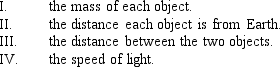
(82) 
The geometry of an ellipse is described by two numbers: the ____ which is half the longest diameter of the ellipse and the ____ which tells us the shape of the ellipse.
(Multiple Choice)
4.9/5 (88)
(88) According to Kepler's third law, a planet's orbital period ____________________ is equal to its average distance from the sun ____________________.
(Short Answer)
5.0/5 (89)
(89) The vernal equinox is the point on the sky where the sun crosses the ____________ going north and east.
(Multiple Choice)
4.9/5 (67)
(67) ____ orbit is one in which an object orbiting Earth has an orbital period equal to the rotation period of Earth.
(Multiple Choice)
4.9/5 (81)
(81) Which of the following planets can be seen as a crescent phase from Earth?
(Multiple Choice)
4.8/5 (76)
(76) Retrograde motion (east to west among the stars) is observed
(Multiple Choice)
4.8/5 (76)
(76) Describe the differences between the Ptolemaic, Tychonian, and Copernican models of the universe.
(Not Answered)
This question doesn't have any answer yet
The Copernican system was no more accurate than the Ptolemaic system in predicting the positions of the planets because ___________just as in the Ptolemaic system.
(Multiple Choice)
4.9/5 (89)
(89) A(n) ____ is well supported (observationally and/or experimentally) system of rules and principles that can be applied to a wide variety of circumstances.
(Multiple Choice)
4.8/5 (72)
(72) A comet in a highly elliptical orbit is found to have a semimajor axis equal to one astronomical unit (AU). According to Kepler's 3rd law, what would be the sidereal period of this comet?
(Multiple Choice)
4.9/5 (76)
(76) 
Filters
- Essay(0)
- Multiple Choice(0)
- Short Answer(0)
- True False(0)
- Matching(0)