



 Chat with AI
Exam 5: Light and Telescopes

Exam 1: Here and Now53 Questions
Exam 2: A Users Guide to the Sky80 Questions
Exam 3: Cycles of the Sun and Moon116 Questions
Exam 4: The Origin of Modern Astronomy109 Questions
Exam 5: Light and Telescopes114 Questions
Exam 6: Atoms and Spectra82 Questions
Exam 7: The Sun101 Questions
Exam 8: The Family of Stars133 Questions
Exam 9: The Formation and Structure of Stars91 Questions
Exam 10: The Deaths of Stars115 Questions
Exam 11: Neutron Stars and Black Holes70 Questions
Exam 12: The Milky Way Galaxy79 Questions
Exam 13: Galaxies: Normal and Active143 Questions
Exam 14: Modern Cosmology73 Questions
Exam 15: The Origin of the Solar System77 Questions
Exam 16: Earth and Moon: Bases for Comparative Planetology74 Questions
Exam 17: Mercury, Venus and Mars80 Questions
Exam 18: The Outer Solar System103 Questions
Exam 19: Meteorites, Asteroids, and Comets67 Questions
Exam 20: Astrobiology: Life on Other Worlds54 Questions
Select questions type


The process of combining signals from separate telescopes to improve resolution is called ____________________.
(Short Answer)
4.9/5  (74)
(74) An ordinary glass lens forms an image by ____________ of light.
(Multiple Choice)
4.8/5 (79)
(79) Why are nearly all recently built astronomical telescopes reflectors instead of refractors?
(Not Answered)
This question doesn't have any answer yet
The optical shape of segmented mirrors is controlled by computer-driven thrusters under the mirrors in what is called
(Multiple Choice)
5.0/5 (84)
(84) What are some new techniques and technologies that enable construction of optical telescopes with very large mirrors?
(Not Answered)
This question doesn't have any answer yet
The diagram below illustrates the layout and light path of a reflecting telescope of the ____________________ design. 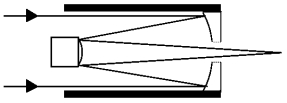
(Short Answer)
4.9/5 (88)
(88) 
What statement below best describes the refraction of light?
(Multiple Choice)
4.7/5 (96)
(96) How does the nature of radio waves allow a radio telescope to use a wire mesh surface? Would you expect millimeter wavelength telescopes to need smoother surfaces than typical radio dishes? Why or why not?
(Essay)
5.0/5 (72)
(72) The main reason for positioning many radio telescopes across a large area and combining the signals is
(Multiple Choice)
4.8/5 (85)
(85) Explain why the majority of large modern telescopes are not refractors.
(Not Answered)
This question doesn't have any answer yet

Filters
- Essay(0)
- Multiple Choice(0)
- Short Answer(0)
- True False(0)
- Matching(0)