



 Chat with AI
Exam 5: Light and Telescopes

Exam 1: Here and Now53 Questions
Exam 2: A Users Guide to the Sky80 Questions
Exam 3: Cycles of the Sun and Moon116 Questions
Exam 4: The Origin of Modern Astronomy109 Questions
Exam 5: Light and Telescopes114 Questions
Exam 6: Atoms and Spectra82 Questions
Exam 7: The Sun101 Questions
Exam 8: The Family of Stars133 Questions
Exam 9: The Formation and Structure of Stars91 Questions
Exam 10: The Deaths of Stars115 Questions
Exam 11: Neutron Stars and Black Holes70 Questions
Exam 12: The Milky Way Galaxy79 Questions
Exam 13: Galaxies: Normal and Active143 Questions
Exam 14: Modern Cosmology73 Questions
Exam 15: The Origin of the Solar System77 Questions
Exam 16: Earth and Moon: Bases for Comparative Planetology74 Questions
Exam 17: Mercury, Venus and Mars80 Questions
Exam 18: The Outer Solar System103 Questions
Exam 19: Meteorites, Asteroids, and Comets67 Questions
Exam 20: Astrobiology: Life on Other Worlds54 Questions
Select questions type


A(n) ____________________ is used to measure the brightness and color of stars.
(Short Answer)
4.8/5  (81)
(81) If the magnification of a telescope can be changed simply by exchanging eyepieces, why can't you just magnify objects to very large sizes by choosing an appropriate eyepiece?
(Short Answer)
4.9/5 (79)
(79) Reflecting telescopes are no longer popular with astronomers because they are expensive and suffer from chromatic aberration.
(True/False)
4.9/5 (74)
(74) Observations of radio waves from astronomical objects suffer from poorer resolution than visible observations with the same size dish (or mirror) because
(Multiple Choice)
4.9/5 (85)
(85) A telescope that suffers from chromatic aberration and has a low light-gathering power is most likely
(Multiple Choice)
4.9/5 (73)
(73) Telescopes observing in the far ultraviolet can work from high-flying aircraft.
(True/False)
4.8/5 (87)
(87) What is the frequency of the shortest wavelength light that can be detected by the average human eye?
(Multiple Choice)
4.8/5 (82)
(82) Which of the following types of electromagnetic radiation has the highest frequency?
(Multiple Choice)
4.9/5 (69)
(69) The figure below shows a single lens with two rays of white light incident on it from the left. Sketch the paths of the blue, yellow, and red components of each of these rays to the point where the light from the upper and lower rays would meet. 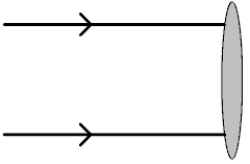
(Short Answer)
4.7/5 (89)
(89) X-rays easily penetrate Earth's atmosphere and reach the ground from space.
(True/False)
4.9/5 (84)
(84) A telescope that suffers from chromatic aberration and has a low light-gathering power is most likely
(Multiple Choice)
4.9/5 (79)
(79) What is the wavelength of the shortest wavelength light visible to the human eye?
(Multiple Choice)
4.8/5 (94)
(94) A wave on a lake is found to have a wavelength of 2 m and a frequency of 0.3 Hz. What is the speed of this wave?
(Short Answer)
4.8/5 (97)
(97) The main reason for building large optical telescopes on Earth's surface is
(Multiple Choice)
4.8/5 (83)
(83) Which of the following telescopes must be used above Earth's atmosphere?
(Multiple Choice)
4.8/5 (84)
(84) The objective of most radio telescopes is similar to the objective of a reflecting optical telescope in that
(Multiple Choice)
4.8/5 (84)
(84) What is the ratio of the light-gathering power of a 5-m telescope to that of a 0.5-m telescope?
(Multiple Choice)
4.9/5 (75)
(75) A new generation of ground-based telescopes is currently being built that overcomes the limitations of the older large telescopes. Some of these new telescopes
(Multiple Choice)
4.9/5 (82)
(82) 
Filters
- Essay(0)
- Multiple Choice(0)
- Short Answer(0)
- True False(0)
- Matching(0)