



 Chat with AI
Exam 10: The Deaths of Stars

Exam 1: Here and Now53 Questions
Exam 2: A Users Guide to the Sky80 Questions
Exam 3: Cycles of the Sun and Moon116 Questions
Exam 4: The Origin of Modern Astronomy109 Questions
Exam 5: Light and Telescopes114 Questions
Exam 6: Atoms and Spectra82 Questions
Exam 7: The Sun101 Questions
Exam 8: The Family of Stars133 Questions
Exam 9: The Formation and Structure of Stars91 Questions
Exam 10: The Deaths of Stars115 Questions
Exam 11: Neutron Stars and Black Holes70 Questions
Exam 12: The Milky Way Galaxy79 Questions
Exam 13: Galaxies: Normal and Active143 Questions
Exam 14: Modern Cosmology73 Questions
Exam 15: The Origin of the Solar System77 Questions
Exam 16: Earth and Moon: Bases for Comparative Planetology74 Questions
Exam 17: Mercury, Venus and Mars80 Questions
Exam 18: The Outer Solar System103 Questions
Exam 19: Meteorites, Asteroids, and Comets67 Questions
Exam 20: Astrobiology: Life on Other Worlds54 Questions
Select questions type


In the diagram below, which point indicates the location on the H-R diagram of a one-solar-mass star when it undergoes helium flash? 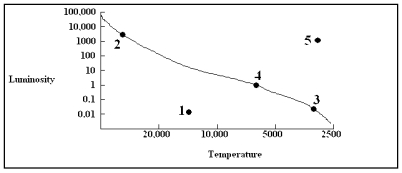
(Multiple Choice)
4.8/5  (71)
(71) A(n) ____ is a collection of 100 to 1000 stars in a region about 25 pc in diameter. The stars in the collection are typically quite young.
(Multiple Choice)
4.7/5 (73)
(73) Stars that have ejected a planetary nebula eventually become
(Multiple Choice)
4.9/5 (75)
(75) About how long will a 0.5-  star spend on the main sequence?
 (Multiple Choice)
4.9/5 (75)
(75) A(n) ____________________ supernova is caused by the collapse of a massive star that has lost its outer envelope of hydrogen.
(Short Answer)
4.7/5 (76)
(76) Stars less massive than 0.4 solar mass never become giant stars.
(True/False)
4.9/5 (87)
(87) A gas in which the pressure no longer depends on the temperature of the gas is said to be ____________________.
(Short Answer)
4.9/5 (91)
(91) What properties of degenerate matter are important to the structure of stars? Why?
(Not Answered)
This question doesn't have any answer yet
In A.D. 1054, Chinese astronomers observed the appearance of a new star, whose location is now occupied by
(Multiple Choice)
5.0/5 (87)
(87) Type II supernovae are believed to occur when the cores of massive stars collapse.
(True/False)
4.7/5 (85)
(85) 
Filters
- Essay(0)
- Multiple Choice(0)
- Short Answer(0)
- True False(0)
- Matching(0)