



 Chat with AI
Exam 10: The Deaths of Stars

Exam 1: Here and Now53 Questions
Exam 2: A Users Guide to the Sky80 Questions
Exam 3: Cycles of the Sun and Moon116 Questions
Exam 4: The Origin of Modern Astronomy109 Questions
Exam 5: Light and Telescopes114 Questions
Exam 6: Atoms and Spectra82 Questions
Exam 7: The Sun101 Questions
Exam 8: The Family of Stars133 Questions
Exam 9: The Formation and Structure of Stars91 Questions
Exam 10: The Deaths of Stars115 Questions
Exam 11: Neutron Stars and Black Holes70 Questions
Exam 12: The Milky Way Galaxy79 Questions
Exam 13: Galaxies: Normal and Active143 Questions
Exam 14: Modern Cosmology73 Questions
Exam 15: The Origin of the Solar System77 Questions
Exam 16: Earth and Moon: Bases for Comparative Planetology74 Questions
Exam 17: Mercury, Venus and Mars80 Questions
Exam 18: The Outer Solar System103 Questions
Exam 19: Meteorites, Asteroids, and Comets67 Questions
Exam 20: Astrobiology: Life on Other Worlds54 Questions
Select questions type


As a main-sequence star exhausts hydrogen in its core, its surface becomes___ and its energy output per second (luminosity) becomes ____
(Multiple Choice)
4.9/5  (78)
(78) Because more massive stars have more gravitational energy, they can fuse heavier nuclear fuels.
(True/False)
5.0/5 (86)
(86) The theory that the collapse of a massive star's iron core produces neutrinos was supported by
(Multiple Choice)
4.9/5 (93)
(93) The average size of a white dwarf is about the same size as the Earth.
(True/False)
4.9/5 (92)
(92) A main-sequence star of 8.5 solar masses can become a white dwarf by
(Multiple Choice)
4.9/5 (78)
(78) Explain how we can find the age of a star cluster.
(Not Answered)
This question doesn't have any answer yet
Helium fusion does not begin until the star has entered the giant region of the H-R diagram.
(True/False)
4.8/5 (68)
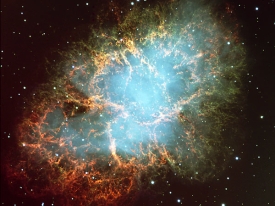
(68) 
Giant and supergiant stars are rare because that stage of stellar evolution is short.
(True/False)
4.7/5 (62)
(62) Why can't a massive star generate energy through iron fusion?
(Not Answered)
This question doesn't have any answer yet
Even the youngest star clusters have no stars still contracting toward the main sequence.
(True/False)
4.9/5 (74)
(74) After what evolutionary stage does a star become a white dwarf?
(Multiple Choice)
4.8/5 (76)
(76) 
Filters
- Essay(0)
- Multiple Choice(0)
- Short Answer(0)
- True False(0)
- Matching(0)