



 Chat with AI
Exam 14: Modern Cosmology

Exam 1: Here and Now53 Questions
Exam 2: A Users Guide to the Sky80 Questions
Exam 3: Cycles of the Sun and Moon116 Questions
Exam 4: The Origin of Modern Astronomy109 Questions
Exam 5: Light and Telescopes114 Questions
Exam 6: Atoms and Spectra82 Questions
Exam 7: The Sun101 Questions
Exam 8: The Family of Stars133 Questions
Exam 9: The Formation and Structure of Stars91 Questions
Exam 10: The Deaths of Stars115 Questions
Exam 11: Neutron Stars and Black Holes70 Questions
Exam 12: The Milky Way Galaxy79 Questions
Exam 13: Galaxies: Normal and Active143 Questions
Exam 14: Modern Cosmology73 Questions
Exam 15: The Origin of the Solar System77 Questions
Exam 16: Earth and Moon: Bases for Comparative Planetology74 Questions
Exam 17: Mercury, Venus and Mars80 Questions
Exam 18: The Outer Solar System103 Questions
Exam 19: Meteorites, Asteroids, and Comets67 Questions
Exam 20: Astrobiology: Life on Other Worlds54 Questions
Select questions type


How can the big bang still be visible? In what form has it been detected?
(Short Answer)
4.8/5  (78)
(78) If galaxy A is four times more distant than galaxy B, then according to the Hubble law, galaxy A will recede ____ than galaxy B.
(Multiple Choice)
4.8/5 (93)
(93) How could the measurement of the Hubble constant at great distances tell us whether the universe is open or closed?
(Short Answer)
4.8/5 (67)
(67) Why would a value of 500 km/s/Mpc for the Hubble constant contradict theories of stellar evolution?
(Not Answered)
This question doesn't have any answer yet
The age of the universe can be estimated or constrained from
(Multiple Choice)
4.9/5 (66)
(66) The deuterium and lithium-7 in distant quasars and in the interstellar medium suggests that the universe is open.
(True/False)
4.9/5 (75)
(75) How old is the universe since the Big Bang? Pick the best answer according to radioactive dating in the solar system, light travel times to most distant galaxies, time reversal of the Big Bang, and observations of the 3-K radiation.
(Multiple Choice)
4.8/5 (82)
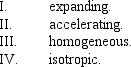
(82) 
The cosmic background radiation comes from a time after the origin of the universe
(Multiple Choice)
4.7/5 (84)
(84) What do the size and distribution of small scale temperature variations suggest about the geometry of the universe?
(Short Answer)
4.9/5 (75)
(75) 
Filters
- Essay(0)
- Multiple Choice(0)
- Short Answer(0)
- True False(0)
- Matching(0)