



 Chat with AI
Exam 15: The Origin of the Solar System

Exam 1: Here and Now53 Questions
Exam 2: A Users Guide to the Sky80 Questions
Exam 3: Cycles of the Sun and Moon116 Questions
Exam 4: The Origin of Modern Astronomy109 Questions
Exam 5: Light and Telescopes114 Questions
Exam 6: Atoms and Spectra82 Questions
Exam 7: The Sun101 Questions
Exam 8: The Family of Stars133 Questions
Exam 9: The Formation and Structure of Stars91 Questions
Exam 10: The Deaths of Stars115 Questions
Exam 11: Neutron Stars and Black Holes70 Questions
Exam 12: The Milky Way Galaxy79 Questions
Exam 13: Galaxies: Normal and Active143 Questions
Exam 14: Modern Cosmology73 Questions
Exam 15: The Origin of the Solar System77 Questions
Exam 16: Earth and Moon: Bases for Comparative Planetology74 Questions
Exam 17: Mercury, Venus and Mars80 Questions
Exam 18: The Outer Solar System103 Questions
Exam 19: Meteorites, Asteroids, and Comets67 Questions
Exam 20: Astrobiology: Life on Other Worlds54 Questions
Select questions type


Outgassing refers to the formation of an atmosphere by the attraction of gases from the surrounding nebula.
(True/False)
4.9/5  (94)
(94) The first solid grains of ______ formed in hot regions near the sun. Much farther from the sun the first grains (or rather flakes) of ________also formed by a similar process as the close-in grains, the process of _______.
(Multiple Choice)
4.8/5 (77)
(77) How does the solar nebula theory account for the presence of comets?
(Not Answered)
This question doesn't have any answer yet
The most important effect in clearing the solar nebula of gas and dust was
(Multiple Choice)
4.7/5 (69)
(69) How is radioactive dating used to determine the age of an object?
(Multiple Choice)
4.9/5 (63)
(63) A future news release might report that a new planet has been found around a star very similar to our sun. This newly discovered planet is claimed to have a mass 40 times that of Earth and is located nearly 25 AU from the star it orbits. Which of the following would be a reasonable prediction about this planet? 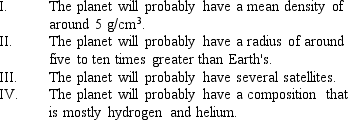
(Multiple Choice)
4.8/5 (86)
(86) After the first solid grains formed in our solar system, these particles could then grow by the process of ____, the collision and sticking of one particle with another to continue the formation of planetesimals. Each of these has many atoms or molecules.
(Multiple Choice)
4.9/5 (71)
(71) The ____________________ planets have larger radii than the ____________________ planets.
(Short Answer)
4.7/5 (73)
(73) On a photograph of the moon, the moon measures 30 cm in diameter and a small crater measures 0.2 cm. The moon's physical diameter is 1738 km. What is the physical diameter of the small crater?
(Multiple Choice)
4.9/5 (85)
(85) The original cloud from which the sun and planets formed had a composition rich in hydrogen and helium.
(True/False)
4.8/5 (86)
(86) Condensation in the solar nebula probably led to the formation of
(Multiple Choice)
4.8/5 (80)
(80) Once a terrestrial planet had formed from a large number of planetesimals, heat could have melted it and allowed it to differentiate into a metallic core of ____density and a rocky mantle or crust of ______ density.
(Multiple Choice)
4.8/5 (76)
(76) Describe some characteristics that all the planets seem to share and use the solar nebula theory to explain them.
(Not Answered)
This question doesn't have any answer yet
The condensation sequence suggests that ____ should condense as solids closest to the sun.
(Multiple Choice)
4.9/5 (70)
(70) ____ is the separation of material in a newly formed planet or asteroid according to density. This happens when the object becomes molten.
(Multiple Choice)
4.9/5 (82)
(82) The oldest objects found so far in our solar system are Earth rocks that are 1 billion years old.
(True/False)
4.7/5 (72)
(72) 
Filters
- Essay(0)
- Multiple Choice(0)
- Short Answer(0)
- True False(0)
- Matching(0)