



 Chat with AI
Exam 15: The Origin of the Solar System

Exam 1: Here and Now53 Questions
Exam 2: A Users Guide to the Sky80 Questions
Exam 3: Cycles of the Sun and Moon116 Questions
Exam 4: The Origin of Modern Astronomy109 Questions
Exam 5: Light and Telescopes114 Questions
Exam 6: Atoms and Spectra82 Questions
Exam 7: The Sun101 Questions
Exam 8: The Family of Stars133 Questions
Exam 9: The Formation and Structure of Stars91 Questions
Exam 10: The Deaths of Stars115 Questions
Exam 11: Neutron Stars and Black Holes70 Questions
Exam 12: The Milky Way Galaxy79 Questions
Exam 13: Galaxies: Normal and Active143 Questions
Exam 14: Modern Cosmology73 Questions
Exam 15: The Origin of the Solar System77 Questions
Exam 16: Earth and Moon: Bases for Comparative Planetology74 Questions
Exam 17: Mercury, Venus and Mars80 Questions
Exam 18: The Outer Solar System103 Questions
Exam 19: Meteorites, Asteroids, and Comets67 Questions
Exam 20: Astrobiology: Life on Other Worlds54 Questions
Select questions type


Describe some characteristics that the Jovian planets have in common. Use the solar nebula theory to explain the commonality.
(Not Answered)
This question doesn't have any answer yet
Protoplanets of the Jovian planets could have grown very hot from
(Multiple Choice)
4.8/5  (88)
(88) The large planetesimals would have grown faster than the smaller planetesimals because
(Multiple Choice)
5.0/5 (86)
(86) Which one of the following objects is most like the planetesimals that formed in the solar nebula?
(Multiple Choice)
4.7/5 (63)
(63) Describe four effects that helped to clear the solar nebula.
(Not Answered)
This question doesn't have any answer yet
The first small solid grains or flakes formed in our solar system by the process of ____, the addition of material to an object an atom or molecule at a time.
(Multiple Choice)
4.8/5 (65)
(65) The speed of the solar wind is approximately 400 km/s and the distance from the sun to Saturn is 9.5 AU (1 AU = 1.5*108 km). How long does it take a particle in the solar wind to reach Saturn?
(Multiple Choice)
4.9/5 (98)
(98) What observational evidence do we have that nebulae from which planets could form surround other stars?
(Short Answer)
4.7/5 (77)
(77) When particles in the solar nebula grew large enough, they stopped growing by accretion and began growing by condensation.
(True/False)
4.8/5 (80)
(80) A(n) ____________________ hypothesis of the formation of the solar system uses sudden events that drastically alter the form of the early solar system.
(Short Answer)
4.8/5 (91)
(91) Which are the oldest solar system objects that have been dated radioactively? What are their ages?
(Not Answered)
This question doesn't have any answer yet
The diagram below illustrates the radioactive decay of Potassium (40K), which has a half-life of 1.3 billion years. If a lunar rock is found that currently contains 5 grams of 40K, and it is determined that the sample contained 20 grams when it was formed, how old is the lunar rock? 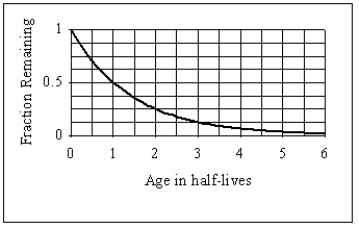
(Multiple Choice)
4.8/5 (79)
(79) A solar system with a planet's orbit edge-on to Earth may show ____________________ of the light of the star at certain points in the planet's orbit.
(Short Answer)
4.8/5 (74)
(74) ____ are located beyond the asteroid belt (3 AU) from the sun, have extremely large masses and very low densities.
(Multiple Choice)
4.9/5 (75)
(75) 
Filters
- Essay(0)
- Multiple Choice(0)
- Short Answer(0)
- True False(0)
- Matching(0)