



 Chat with AI
Exam 18: The Outer Solar System

Exam 1: Here and Now53 Questions
Exam 2: A Users Guide to the Sky80 Questions
Exam 3: Cycles of the Sun and Moon116 Questions
Exam 4: The Origin of Modern Astronomy109 Questions
Exam 5: Light and Telescopes114 Questions
Exam 6: Atoms and Spectra82 Questions
Exam 7: The Sun101 Questions
Exam 8: The Family of Stars133 Questions
Exam 9: The Formation and Structure of Stars91 Questions
Exam 10: The Deaths of Stars115 Questions
Exam 11: Neutron Stars and Black Holes70 Questions
Exam 12: The Milky Way Galaxy79 Questions
Exam 13: Galaxies: Normal and Active143 Questions
Exam 14: Modern Cosmology73 Questions
Exam 15: The Origin of the Solar System77 Questions
Exam 16: Earth and Moon: Bases for Comparative Planetology74 Questions
Exam 17: Mercury, Venus and Mars80 Questions
Exam 18: The Outer Solar System103 Questions
Exam 19: Meteorites, Asteroids, and Comets67 Questions
Exam 20: Astrobiology: Life on Other Worlds54 Questions
Select questions type


The graph below indicates the temperature of Saturn's atmosphere as a function of distance from the upper cloud layer. Water will condense to form droplets at a temperature of approximately 270 K in the atmosphere of Saturn. At what distance from the upper cloud layer will clouds of water vapor form? 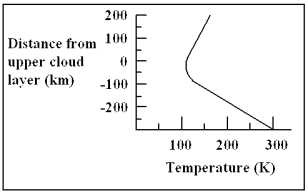
(Multiple Choice)
4.9/5  (75)
(75) How does the Charon-Pluto system resemble the Earth-Moon system (in contrast to Mars and its moons or even Jupiter and its moons)?
(Short Answer)
4.8/5 (93)
(93) Uranus and Neptune do not contain liquid metallic hydrogen because they
(Multiple Choice)
5.0/5 (95)
(95) Pluto's density is 1.8 g/cm3. Iron is about 5 g/cm3. Rock is about is 3 g/cm3. Ice or water is 1.0 g/cm3. This implies that
(Multiple Choice)
4.9/5 (61)
(61) How do we know that the interior of Jupiter is a liquid metallic material?
(Short Answer)
4.8/5 (91)
(91) We can be sure the particles in the rings of Neptune are very small because
(Multiple Choice)
5.0/5 (87)
(87) Contrast the lightness/darkness of the ring particles orbiting Jupiter, Saturn, Uranus, and Neptune.
(Essay)
4.8/5 (81)
(81) Although Uranus and Neptune have no liquid metallic hydrogen in their interiors, they do have magnetic fields.
(True/False)
4.7/5 (79)
(79) Describe the possible history of a typical Plutino as astronomers now believe it occured.
(Essay)
4.8/5 (90)
(90) The fresh, newly created surfaces of icy satellites of Jovian planets
(Multiple Choice)
4.9/5 (67)
(67) The ____________________ was a large cyclonic storm in the atmosphere of Neptune observed by Voyager 2.
(Short Answer)
4.7/5 (87)
(87) Which of these are nearly 90 degrees to the orbit plane of Uranus?
(Multiple Choice)
4.9/5 (67)
(67) The atmosphere of ____ contains mostly nitrogen with some methane.
(Multiple Choice)
4.8/5 (84)
(84) Satellites that lack craters are generally old, inactive bodies.
(True/False)
4.8/5 (71)
(71) What is the significance of the colors of Uranus and Neptune?
(Not Answered)
This question doesn't have any answer yet

Filters
- Essay(0)
- Multiple Choice(0)
- Short Answer(0)
- True False(0)
- Matching(0)