



 Chat with AI
Exam 18: The Outer Solar System

Exam 1: Here and Now53 Questions
Exam 2: A Users Guide to the Sky80 Questions
Exam 3: Cycles of the Sun and Moon116 Questions
Exam 4: The Origin of Modern Astronomy109 Questions
Exam 5: Light and Telescopes114 Questions
Exam 6: Atoms and Spectra82 Questions
Exam 7: The Sun101 Questions
Exam 8: The Family of Stars133 Questions
Exam 9: The Formation and Structure of Stars91 Questions
Exam 10: The Deaths of Stars115 Questions
Exam 11: Neutron Stars and Black Holes70 Questions
Exam 12: The Milky Way Galaxy79 Questions
Exam 13: Galaxies: Normal and Active143 Questions
Exam 14: Modern Cosmology73 Questions
Exam 15: The Origin of the Solar System77 Questions
Exam 16: Earth and Moon: Bases for Comparative Planetology74 Questions
Exam 17: Mercury, Venus and Mars80 Questions
Exam 18: The Outer Solar System103 Questions
Exam 19: Meteorites, Asteroids, and Comets67 Questions
Exam 20: Astrobiology: Life on Other Worlds54 Questions
Select questions type


The narrowness of the rings of Uranus and Neptune is believed to be caused by
(Multiple Choice)
4.7/5  (71)
(71) For an observer on Uranus, the ecliptic passes only a few degrees from the celestial poles.
(True/False)
4.8/5 (89)
(89) ____ are Kuiper belt objects that are in a 3:2 resonance orbit with the orbit of Neptune.
(Multiple Choice)
4.8/5 (88)
(88) The diagram below shows a cross section of the interior of Uranus. Which of the regions do current computer models suggest is composed primarily of partly solid water? The lowest pressure regions will be gaseous. 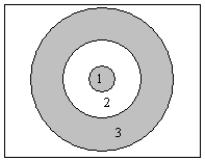
(Multiple Choice)
4.9/5 (88)
(88) The rings around Uranus and Neptune are confined by shepherd satellites.
(True/False)
4.8/5 (74)
(74) The ____ of a planet is the region around the planet where the magnetic field is able to deflect the solar wind and other charged particles.
(Multiple Choice)
4.8/5 (70)
(70) The existence of Uranus was predicted by the application of Newton's laws of motion and gravity.
(True/False)
4.9/5 (77)
(77) Although Neptune has no liquid metallic hydrogen in its interior, it does have a magnetic field.
(True/False)
4.9/5 (77)
(77) The graph below plots the escape velocity of several solar system objects along the vertical axis and the surface temperature along the horizontal axis. The lines plotted in the figure are the speeds of the fastest gas particles as a function of temperature for various gases. Which of the objects in this diagram has the greatest surface temperature? 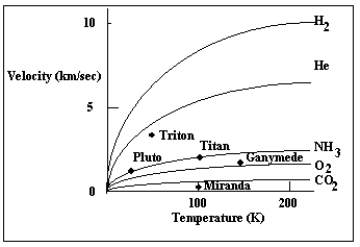
(Multiple Choice)
4.8/5 (74)
(74) What do the densities of the moons of Jupiter tell us about their origin?
(Not Answered)
This question doesn't have any answer yet
Why is it believed that the rings of Saturn could not have formed just as the planet itself formed?
(Multiple Choice)
4.9/5 (73)
(73) ____________________ is the smallest of the large moons of Uranus and its surface has features called ovoids. These ovoids may have been formed by the upheaval of material by convection in the interior.
(Short Answer)
4.8/5 (70)
(70) Why are the belts and zones on Saturn less distinct than those on Jupiter?
(Not Answered)
This question doesn't have any answer yet

Filters
- Essay(0)
- Multiple Choice(0)
- Short Answer(0)
- True False(0)
- Matching(0)