



 Chat with AI
Exam 17: Project Management

Exam 1: Introduction to Operations Management78 Questions
Exam 2: Competitiveness, Strategy, and Productivity75 Questions
Exam 3: Forecasting144 Questions
Exam 4: Product and Service Design100 Questions
Exam 5: Strategic Capacity Planning for Products and Services210 Questions
Exam 6: Process Selection and Facility Layout137 Questions
Exam 7: Work Design and Measurement200 Questions
Exam 8: Location Planning and Analysis65 Questions
Exam 9: Management of Quality101 Questions
Exam 10: Quality Control117 Questions
Exam 11: Aggregate Planning and Master Scheduling80 Questions
Exam 12: Inventory Management134 Questions
Exam 13: MRP and ERP85 Questions
Exam 14: Jit and Lean Operations126 Questions
Exam 15: Supply Chain Management91 Questions
Exam 16: Scheduling102 Questions
Exam 17: Project Management118 Questions
Exam 18: Management of Waiting Lines68 Questions
Exam 19: Linear Programming98 Questions
Select questions type


The standard deviation of the critical path is equal to the sum of the standard deviations of all of the activities on the critical path.
(True/False)
4.7/5  (72)
(72) A hierarchical listing of what must be done in a project is called a
(Multiple Choice)
4.9/5 (82)
(82) Many activities have slack time; if we add these slack times together, this represents the potential improvement in early completion for the project.
(True/False)
4.9/5 (70)
(70) Consider the following work breakdown structure:
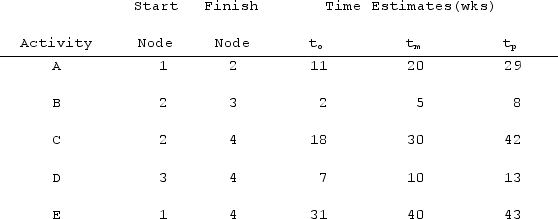 What is the estimated slack time for activity E?
 (Multiple Choice)
4.9/5 (80)
(80) Activity 4-5 in a network diagram has an optimistic time estimate of five days, a most likely time estimate of seven days, and a pessimistic time estimate of 10 days. Its expected time (in days)is approximately
(Multiple Choice)
4.8/5 (85)
(85) Consider the following work breakdown structure:
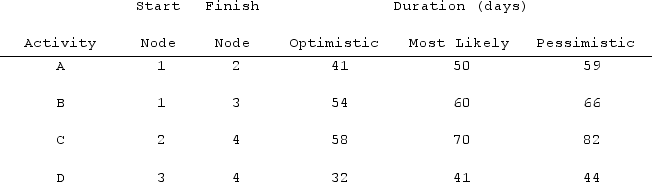 What is the estimated standard deviation in the time for activity D?
 (Multiple Choice)
4.8/5 (79)
(79) Consider the following work breakdown structure:
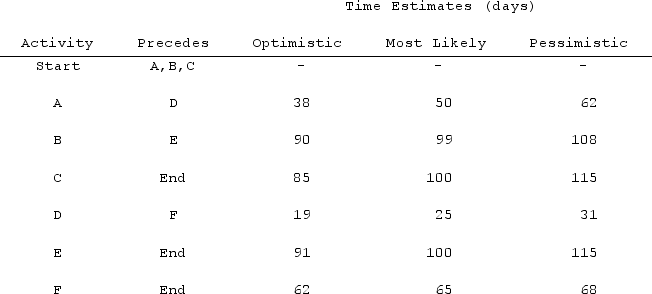 What is the estimated expected (mean)time for activity E?
 (Multiple Choice)
4.8/5 (77)
(77) Consider the following work breakdown structure:
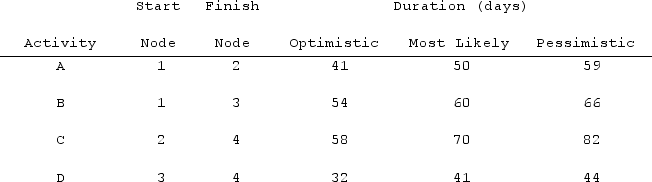 What is the estimated slack time for activity D?
 (Multiple Choice)
4.8/5 (87)
(87) Once a project is approved and underway, project managers are only responsible for effectively managing time and costs which, if done well, will assure project completion on time and on budget.
(True/False)
4.9/5 (81)
(81) Consider the following work breakdown structure:
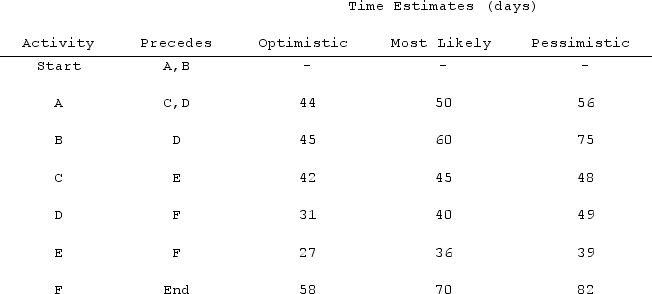 What is the estimated standard deviation in the time for activity E?
 (Multiple Choice)
4.8/5 (85)
(85) Consider the following work breakdown structure:
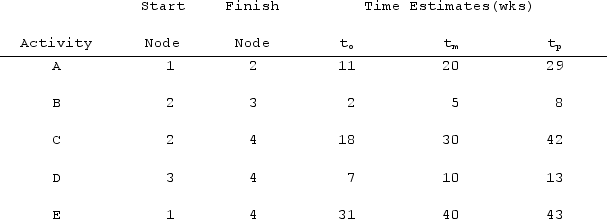 What is the estimated standard deviation in the time for activity E?
 (Multiple Choice)
5.0/5 (92)
(92) A sequence of activities that leads from the starting node to the finishing node is called a
(Multiple Choice)
4.9/5 (89)
(89) In project network analysis, "slack" refers to the difference between
(Multiple Choice)
4.7/5 (72)
(72) Matrix organizations transfer control of workers to project managers for the duration of the project.
(True/False)
5.0/5 (69)
(69) One upside to terminating a project that is not going as well as planned is that
(Multiple Choice)
4.7/5 (93)
(93) Once a project is underway, the project manager usually is not responsible for effectively managing
(Multiple Choice)
4.7/5 (93)
(93) Path probabilities are calculated by dividing path mean by path standard deviations.
(True/False)
4.7/5 (74)
(74) Consider the following work breakdown structure:
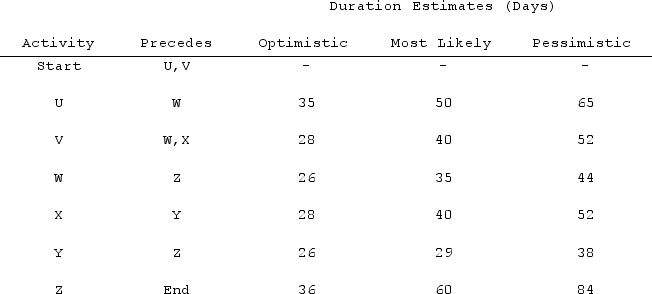 What is the probability that the critical path for this project will be completed within 200 days?
 (Multiple Choice)
4.9/5 (92)
(92) 
Filters
- Essay(0)
- Multiple Choice(0)
- Short Answer(0)
- True False(0)
- Matching(0)