



 Chat with AI
Exam 17: Project Management

Exam 1: Introduction to Operations Management78 Questions
Exam 2: Competitiveness, Strategy, and Productivity75 Questions
Exam 3: Forecasting144 Questions
Exam 4: Product and Service Design100 Questions
Exam 5: Strategic Capacity Planning for Products and Services210 Questions
Exam 6: Process Selection and Facility Layout137 Questions
Exam 7: Work Design and Measurement200 Questions
Exam 8: Location Planning and Analysis65 Questions
Exam 9: Management of Quality101 Questions
Exam 10: Quality Control117 Questions
Exam 11: Aggregate Planning and Master Scheduling80 Questions
Exam 12: Inventory Management134 Questions
Exam 13: MRP and ERP85 Questions
Exam 14: Jit and Lean Operations126 Questions
Exam 15: Supply Chain Management91 Questions
Exam 16: Scheduling102 Questions
Exam 17: Project Management118 Questions
Exam 18: Management of Waiting Lines68 Questions
Exam 19: Linear Programming98 Questions
Select questions type


Although PERT and CPM were originally developed independently, they are now nearly identical in terms of analysis and procedures.
(True/False)
5.0/5  (88)
(88) A project is represented by the following diagram:  The critical path for the network shown is:
 (Multiple Choice)
4.9/5 (79)
(79) Which of the following is not a limitation of PERT and similar project-scheduling techniques?
(Multiple Choice)
4.7/5 (76)
(76) A popular visual tool for planning and scheduling simple projects, and for monitoring progress, is the
(Multiple Choice)
4.8/5 (88)
(88) A PERT/CPM activity has an optimistic time estimate of three days, a most likely time estimate of eight days, and a pessimistic time estimate of 10 days. The expected time (in days)of this activity is
(Multiple Choice)
4.9/5 (70)
(70) Activities not on the critical path have a slack time equal to zero.
(True/False)
4.9/5 (91)
(91) Activity J has a duration of 7 and an earliest finish time of 21. If J's latest start time is 16, this must mean that J's slack is
(Multiple Choice)
4.9/5 (73)
(73) The probability of occurrence of risk events is lower near the beginning of a project and higher near the end of the project since very few activities remain.
(True/False)
4.8/5 (87)
(87) Consider the following work breakdown structure:
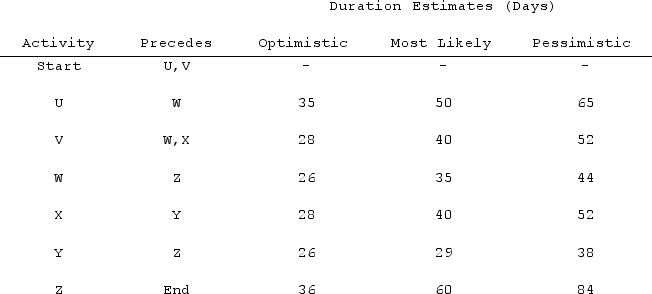 What is the estimated expected (mean)time for project completion?
 (Multiple Choice)
5.0/5 (82)
(82) One way that project management differs from management of more traditional activities is because of the limited time framework of projects.
(True/False)
4.7/5 (82)
(82) Consider the following work breakdown structure:
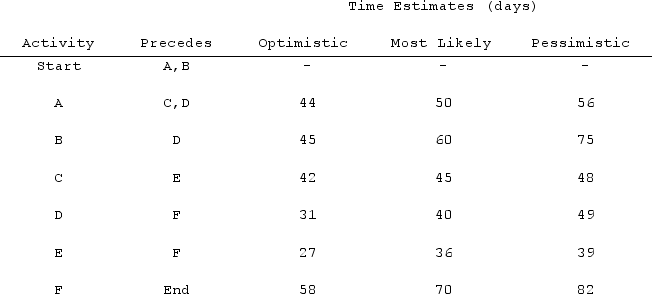 What is the estimated expected (mean)time for activity E?
 (Multiple Choice)
4.9/5 (87)
(87) Consider the following work breakdown structure:
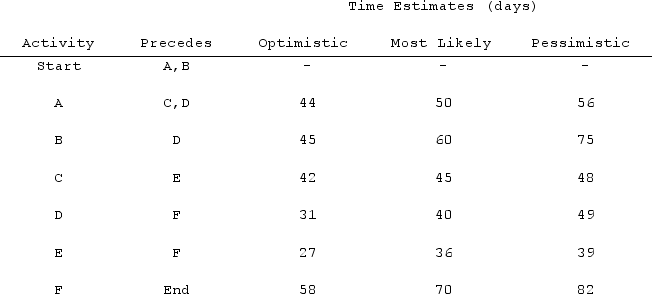 What is the estimated slack time for activity D?
 (Multiple Choice)
4.8/5 (81)
(81) In the probabilistic approach to project network analysis, the time estimate annotated tm for any activity is the
(Multiple Choice)
4.9/5 (67)
(67) Which of the following is determined as a direct result of computing the earliest starting and finishing times for the activities of a project network?
(Multiple Choice)
4.7/5 (90)
(90) Consider the following work breakdown structure:
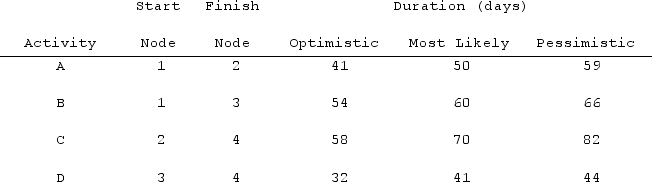 What is the estimated expected (mean)time for project completion?
 (Multiple Choice)
4.9/5 (72)
(72) Most likely time generally is at least as long as optimistic time.
(True/False)
5.0/5 (77)
(77) In a project network, the critical path is the sequence of activities which has the
(Multiple Choice)
4.7/5 (74)
(74) A method used for establishing a logical framework for identifying the required activities for the project is called
(Multiple Choice)
4.7/5 (85)
(85) Project management software eliminates constraint violations when there are shared resources.
(True/False)
4.7/5 (90)
(90) 
Filters
- Essay(0)
- Multiple Choice(0)
- Short Answer(0)
- True False(0)
- Matching(0)