



 Chat with AI
Exam 17: Project Management

Exam 1: Introduction to Operations Management78 Questions
Exam 2: Competitiveness, Strategy, and Productivity75 Questions
Exam 3: Forecasting144 Questions
Exam 4: Product and Service Design100 Questions
Exam 5: Strategic Capacity Planning for Products and Services210 Questions
Exam 6: Process Selection and Facility Layout137 Questions
Exam 7: Work Design and Measurement200 Questions
Exam 8: Location Planning and Analysis65 Questions
Exam 9: Management of Quality101 Questions
Exam 10: Quality Control117 Questions
Exam 11: Aggregate Planning and Master Scheduling80 Questions
Exam 12: Inventory Management134 Questions
Exam 13: MRP and ERP85 Questions
Exam 14: Jit and Lean Operations126 Questions
Exam 15: Supply Chain Management91 Questions
Exam 16: Scheduling102 Questions
Exam 17: Project Management118 Questions
Exam 18: Management of Waiting Lines68 Questions
Exam 19: Linear Programming98 Questions
Select questions type


Consider the following work breakdown structure:
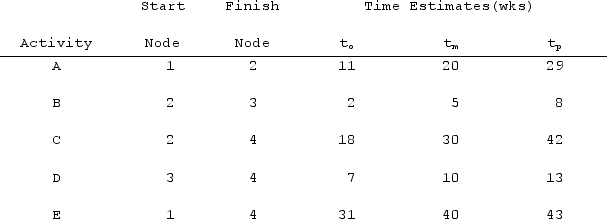 What is the probability that the critical path for this project will be completed within 52 weeks?
 (Multiple Choice)
4.8/5  (92)
(92) Consider the following work breakdown structure:
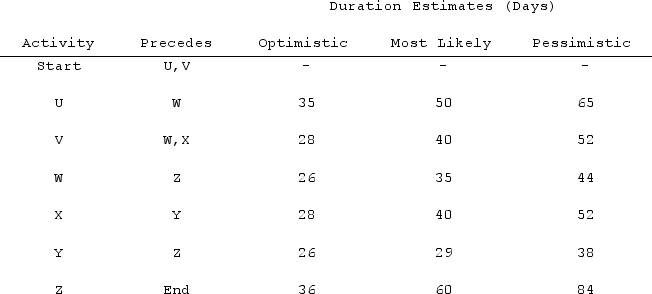 What is the estimated slack time for activity W?
 (Multiple Choice)
4.9/5 (99)
(99) Which decision in project management has typical factors that include establishing appropriate metrics for evaluating the project and managing equipment?
(Multiple Choice)
4.7/5 (90)
(90) There are four activities on the critical path, and they have standard deviations of 1, 2, 4, and 2 days. The standard deviation of the critical path is
(Multiple Choice)
4.8/5 (67)
(67) Which phase of the project life cycle happens in conjunction with project execution?
(Multiple Choice)
4.8/5 (88)
(88) A disadvantage of activity-on-node diagrams is the occasional need for dummy activities.
(True/False)
4.9/5 (84)
(84) Which of the following is not a form of risk reduction in project management?
(Multiple Choice)
5.0/5 (90)
(90) The project computing algorithm requires both a forward and a backward pass.
(True/False)
4.9/5 (70)
(70) Consider the portion of a project depicted by this graph:  What is the latest start time of activity 6-7 if the latest finish of activity 7-8 is 26, and the latest finish of activity 7-9 is 23?
 (Multiple Choice)
4.9/5 (85)
(85) The earliest finish time for an activity is equal to the latest finish time minus the activity slack.
(True/False)
4.7/5 (81)
(81) Which of the following is not typically treated as part of a project life cycle?
(Multiple Choice)
4.9/5 (77)
(77) To _____ an activity means to shorten the time it will take.
(Multiple Choice)
4.8/5 (78)
(78) The project management strategy of injecting additional resources in order to reduce the length of the project is called
(Multiple Choice)
4.9/5 (65)
(65) The sum of times of the longest path in a network indicates expected project duration, and the activities represent the critical activities.
(True/False)
4.8/5 (82)
(82) Project management differs from management of more traditional activities mainly because of:
(I)its limited time frame.(II)its unique, defined set of activities.(III)the requirement for use of the appropriate resources.(IV)the need for planning and execution.
(Multiple Choice)
4.9/5 (66)
(66) An advantage of Gantt charts in project management is that they identify which activities can be delayed without delaying the overall project.
(True/False)
4.7/5 (79)
(79) The advantage a precedence diagram has over a Gantt chart is
(Multiple Choice)
4.9/5 (68)
(68) The costs associated with risk events tend to be lower near the beginning of a project and higher near the end of the project.
(True/False)
4.9/5 (86)
(86) Consider the following work breakdown structure:
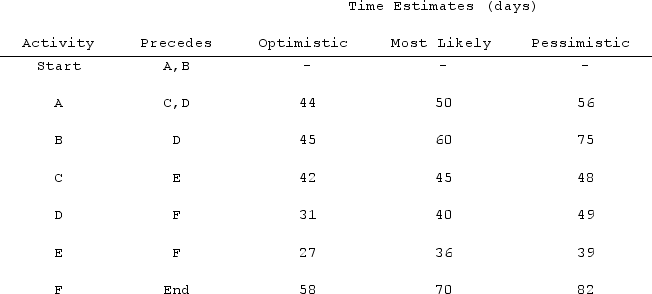 What is the estimated expected (mean)time for project completion?
 (Multiple Choice)
4.8/5 (84)
(84) 
Filters
- Essay(0)
- Multiple Choice(0)
- Short Answer(0)
- True False(0)
- Matching(0)