



 Chat with AI
Exam 9: The Muscular System: Skeletal Muscle Tissue and Muscle Organization

Exam 1: Foundations: An Introduction to Anatomy124 Questions
Exam 2: Foundations: The Cell117 Questions
Exam 3: Foundations: Tissues and Early Embryology127 Questions
Exam 4: The Integumentary System127 Questions
Exam 5: The Skeletal System: Osseous Tissue and Skeletal Structure142 Questions
Exam 6: The Skeletal System: Axial Division150 Questions
Exam 7: The Skeletal System: Appendicular Division131 Questions
Exam 8: The Skeletal System: Articulations131 Questions
Exam 9: The Muscular System: Skeletal Muscle Tissue and Muscle Organization145 Questions
Exam 10: The Muscular System: Axial Musculature142 Questions
Exam 11: The Muscular System: Appendicular Musculature135 Questions
Exam 12: Surface Anatomy and Cross-Sectional Anatomy129 Questions
Exam 13: The Nervous System: Neural Tissue127 Questions
Exam 14: The Nervous System: The Spinal Cord and Spinal Nerves131 Questions
Exam 15: The Nervous System: Sensory and Motor Tracts of the Spinal Cord81 Questions
Exam 16: The Nervous System: The Brain and Cranial Nerves132 Questions
Exam 17: The Nervous System: Autonomic Nervous System115 Questions
Exam 18: The Nervous System: General and Special Senses127 Questions
Exam 19: The Endocrine System102 Questions
Exam 20: The Cardiovascular System: Blood71 Questions
Exam 21: The Cardiovascular System: The Heart150 Questions
Exam 22: The Cardiovascular System: Vessels and Circulation129 Questions
Exam 23: The Lymphatic System105 Questions
Exam 24: The Respiratory System128 Questions
Exam 25: The Digestive System132 Questions
Exam 26: The Urinary System135 Questions
Exam 27: The Reproductive System134 Questions
Exam 28: Embryology and Human Development140 Questions
Select questions type


Why does a sarcomere itself appear to be banded, and what constituents comprise these bands?
(Essay)
4.8/5  (70)
(70) What type of muscular activity is present in a muscle at rest?
(Multiple Choice)
4.9/5 (85)
(85) When all of the motor units of a muscle contract at the maximal rate of stimulation, it leads to the production of ________.
(Multiple Choice)
4.9/5 (70)
(70) The neurotransmitter involved in the process of contraction in skeletal muscles is ________.
(Multiple Choice)
4.9/5 (74)
(74) The sarcoplasmic reticulum conducts action potentials that spread across the sarcolemma into the cell.
(True/False)
4.8/5 (93)
(93) In muscles that have been repeatedly stimulated to produce near-maximal tension, the net effect is ________.
(Multiple Choice)
4.8/5 (79)
(79) Regarding the effect of sarcomere length on tension production, a very highly stretched muscle (increased sarcomere length above normal 3.1 µm)will produce a contraction (% maximum tension)that is ________.
(Multiple Choice)
4.8/5 (91)
(91) Slow muscle fibers contain large amounts of the oxygen-binding protein ________.
(Multiple Choice)
4.8/5 (79)
(79) Figure 9.1
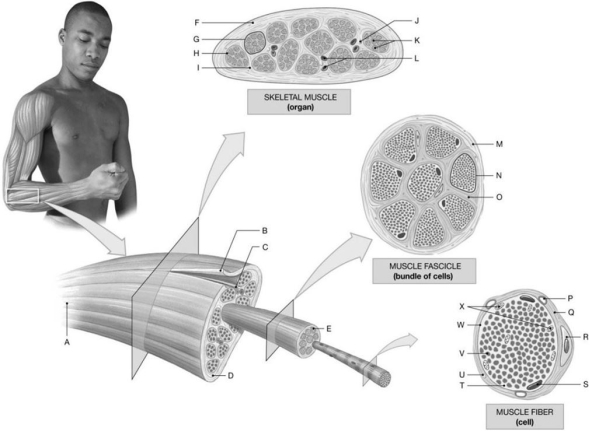 Using the diagrams of the structural organization of skeletal muscle, identify the specified labeled part in each of the following questions.
-Identify the specific structure indicated by Label B.
Using the diagrams of the structural organization of skeletal muscle, identify the specified labeled part in each of the following questions.
-Identify the specific structure indicated by Label B. (Multiple Choice)
4.8/5 (87)
(87) What does the term longissimus in a muscle name primarily indicate about that muscle?
(Multiple Choice)
4.7/5 (76)
(76) What characteristic of muscle tissue allows it to respond to stimulation by the nervous system?
(Multiple Choice)
4.9/5 (77)
(77) What does the name flexor carpi radialis most likely mean?
(Multiple Choice)
4.7/5 (77)
(77) Tropomyosin and troponin are which of the following types of molecules?
(Multiple Choice)
4.9/5 (73)
(73) Each skeletal muscle fiber is controlled by a single ________.
(Multiple Choice)
4.8/5 (89)
(89) The structures within the muscle fiber that shorten to cause skeletal muscle fiber contraction are (the)________.
(Multiple Choice)
4.9/5 (90)
(90) A muscle that opposes the action of a prime mover is a synergist.
(True/False)
4.8/5 (78)
(78) 
Filters
- Essay(0)
- Multiple Choice(0)
- Short Answer(0)
- True False(0)
- Matching(0)